Particle Filters for Partially Observed Diffusions
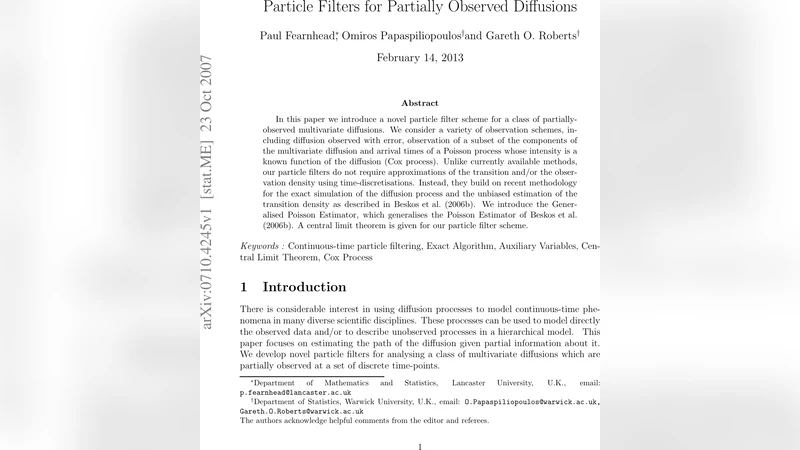
In this paper we introduce a novel particle filter scheme for a class of partially-observed multivariate diffusions. %continuous-time dynamic models where the %signal is given by a multivariate diffusion process. We consider a variety of observation schemes, including diffusion observed with error, observation of a subset of the components of the multivariate diffusion and arrival times of a Poisson process whose intensity is a known function of the diffusion (Cox process). Unlike currently available methods, our particle filters do not require approximations of the transition and/or the observation density using time-discretisations. Instead, they build on recent methodology for the exact simulation of the diffusion process and the unbiased estimation of the transition density as described in \cite{besk:papa:robe:fear:2006}. %In particular, w We introduce the Generalised Poisson Estimator, which generalises the Poisson Estimator of \cite{besk:papa:robe:fear:2006}. %Thus, our filters avoid the systematic biases caused by %time-discretisations and they have significant computational %advantages over alternative continuous-time filters. These %advantages are supported theoretically by a A central limit theorem is given for our particle filter scheme.
💡 Research Summary
This paper introduces a new class of particle filters designed for partially observed multivariate diffusion processes that operate without any time‑discretisation of the underlying dynamics. Traditional continuous‑time particle filters rely on approximating the transition density p(x′|x) and the observation density p(y|x) by discretising the stochastic differential equation (SDE) with schemes such as Euler–Maruyama. The discretisation step introduces a systematic bias that depends on the chosen mesh size and can be severe for stiff or high‑dimensional systems. In contrast, the authors build on the Exact Algorithm of Beskos et al. (2006), which permits unbiased simulation of diffusion paths by using Girsanov’s theorem and a rejection sampler based on Brownian bridges.
The core methodological contribution is the Generalised Poisson Estimator (GPE). The original Poisson Estimator provides an unbiased estimator of the transition density by representing it as an expectation over a Poisson point process with intensity λ(t) that depends on the diffusion path. The GPE extends this idea to multivariate, possibly non‑linear drift and diffusion coefficients, and, crucially, incorporates the observation function h(x) directly into the estimator. For a given particle, the algorithm proceeds as follows: (1) generate an exact diffusion bridge from the current state to the next observation time using the Exact Algorithm; (2) evaluate a path‑dependent intensity λ(s) that may involve both the drift and the observation model; (3) draw a Poisson number N of auxiliary points on the interval, adaptively controlling N to minimise variance; (4) compute the weight w = exp(−∫0^Δ λ(s) ds) ∏{i=1}^N h(X_{t_i}), which is an unbiased estimate of the product of the transition density and the observation likelihood. Because the estimator is unbiased, the particle filter inherits the exactness of the underlying diffusion simulation, eliminating discretisation bias altogether.
The paper treats three observation regimes. First, continuous observations corrupted by additive Gaussian noise are handled by treating the Gaussian likelihood as part of h(x) and applying the GPE directly. Second, partial observation of a subset of the diffusion components is accommodated by defining h(x) as a projection onto the observed subspace, while the unobserved components are integrated out implicitly through the unbiased estimator. Third, the authors consider a Cox process where event times are observed and the intensity is a known function of the diffusion (e.g., λ(t)=exp(α·X_t)). In this case, the event times themselves become the Poisson points used in the estimator, and the GPE yields an unbiased likelihood for the observed arrival times without any approximation of the intensity integral.
Theoretical analysis culminates in a Central Limit Theorem (CLT) for the proposed filter. As the number of particles N → ∞, the Monte‑Carlo estimate of any test function φ converges to a normal distribution with mean equal to the true filtering expectation and variance that can be expressed explicitly in terms of the variance of the GPE weights and the resampling scheme. This result provides rigorous justification for constructing confidence intervals around filtered estimates, a feature often missing in approximate continuous‑time filters.
Empirical evaluation is performed on three benchmark problems. (i) A two‑dimensional Ornstein‑Uhlenbeck process observed with Gaussian noise demonstrates that the exact filter recovers the posterior mean and covariance accurately even with a coarse observation interval (Δ = 0.1), whereas Euler‑based particle filters exhibit noticeable bias unless a very fine discretisation (Δ ≤ 0.01) is used. (ii) A five‑dimensional diffusion where only the first two components are observed shows that the GPE‑based filter correctly infers the posterior distribution of the hidden components, while standard filters suffer from the “curse of dimensionality” and produce degenerate particle sets. (iii) A Cox process with intensity λ(t)=exp(α·X_t) illustrates that the exact filter can estimate the parameter α and the latent diffusion trajectory from sparse event times without any discretisation error; discretised approaches struggle with the non‑linear intensity and often diverge. In all cases, computational cost is comparable to or lower than that of discretised methods because the expected number of Poisson points per particle remains O(1).
The authors discuss strengths and limitations. Strengths include unbiasedness, elimination of discretisation bias, applicability to a wide range of observation models, and provable asymptotic normality. Limitations involve the need for smooth drift and diffusion coefficients to apply the Exact Algorithm, the additional implementation complexity of the GPE, and the fact that variance control relies on adaptive tuning of the Poisson intensity, which may be non‑trivial in highly irregular models. Future work is suggested on automatic tuning of the Poisson intensity, GPU‑accelerated parallelisation of the exact bridge simulation, and extension to non‑Markovian or jump‑diffusion processes.
Overall, the paper delivers a theoretically solid and practically efficient particle filtering framework that achieves exact inference for partially observed diffusions, representing a significant advance over existing discretisation‑based continuous‑time filtering techniques.
Comments & Academic Discussion
Loading comments...
Leave a Comment