Wireless Network Information Flow
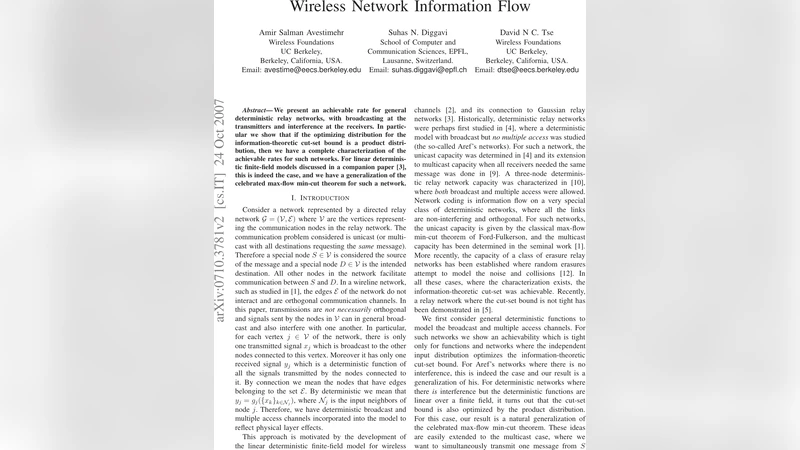
We present an achievable rate for general deterministic relay networks, with broadcasting at the transmitters and interference at the receivers. In particular we show that if the optimizing distribution for the information-theoretic cut-set bound is a product distribution, then we have a complete characterization of the achievable rates for such networks. For linear deterministic finite-field models discussed in a companion paper [3], this is indeed the case, and we have a generalization of the celebrated max-flow min-cut theorem for such a network.
💡 Research Summary
The paper tackles the fundamental problem of characterizing the achievable information rates in general deterministic relay networks where each transmitter can broadcast to multiple receivers and each receiver experiences interference from several transmitters. By abstracting the wireless medium into a deterministic model—where the effect of a channel is represented by a fixed, noise‑free mapping (often linear over a finite field)—the authors are able to apply information‑theoretic tools without the complications introduced by stochastic noise.
The central result is a tight achievability theorem that matches the classic cut‑set bound under a specific condition: the distribution that maximizes the cut‑set expression must be a product distribution, i.e., the inputs of all nodes are statistically independent. When this product‑distribution optimality holds, the upper bound given by the cut‑set theorem is not merely a bound but the exact capacity of the network. The proof constructs a coding scheme based on linear network coding: each relay forms linear combinations of its incoming symbols (over a finite field) and forwards the resulting symbols. Because the deterministic model guarantees that these linear combinations are received without distortion, the scheme can be analyzed using flow arguments.
To demonstrate that the product‑distribution condition is satisfied in an important class of networks, the authors focus on the linear deterministic finite‑field model introduced in a companion paper. In this model each link is a shift‑and‑mask operation that mimics the high‑SNR behavior of a Gaussian channel. The authors show that, for any such network, the cut‑set bound is maximized by independent, uniformly distributed inputs. Consequently, the capacity of the linear deterministic network is exactly the minimum cut value, which is precisely the statement of the max‑flow min‑cut theorem extended to wireless settings.
The paper also discusses the implications for practical wireless system design. The product‑distribution optimality implies that each node can operate independently, dramatically reducing the complexity of joint code design. Moreover, the linear deterministic abstraction captures the essence of interference alignment and signal space partitioning in high‑SNR regimes, suggesting that the insights gained here can guide the development of coding and scheduling strategies for real Gaussian networks, especially in multi‑hop, cooperative, and massive‑MIMO scenarios.
In summary, the authors provide a rigorous bridge between classical network flow theory and modern wireless communication: they prove that, for deterministic relay networks with broadcast and interference, the cut‑set bound is achievable whenever independent inputs are optimal, and they verify that this condition holds for the widely studied linear deterministic finite‑field model. This result generalizes the celebrated max‑flow min‑cut theorem to a broad class of wireless networks and offers a powerful analytical framework for future research on capacity‑optimal coding schemes in multi‑hop wireless systems.
Comments & Academic Discussion
Loading comments...
Leave a Comment