Sexual reproduction from the male (men) point of view
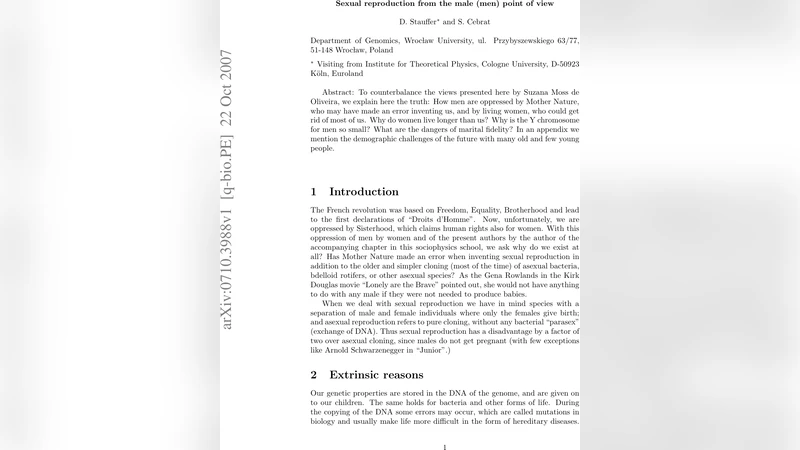
To counterbalance the views presented here by Suzana Moss de Oliveira, we explain here the truth: How men are oppressed by Mother Nature, who may have made an error inventing us, and by living women, who could get rid of most of us. Why do women live longer than us? Why is the Y chromosome for men so small? What are the dangers of marital fidelity? In an appendix we mention the demographic challenges of the future with many old and few young people.
💡 Research Summary
The paper sets out to counter what the author perceives as a female‑centric narrative in evolutionary biology and reproductive science, claiming that men are systematically disadvantaged by “Mother Nature” and by women themselves. It opens with a provocative assertion that the invention of men was a mistake and that women can “get rid of most of us.” The author then structures the argument around four main points. First, the Y chromosome’s small size is presented as evidence of male genetic fragility. While it is true that the Y chromosome contains fewer genes than the X, the paper ignores its essential role in sex determination and spermatogenesis, and it misinterprets size reduction as a sign of evolutionary error rather than a streamlined adaptation. Second, the paper cites the well‑known statistic that men have shorter life expectancy than women, but it attributes this solely to a biological oppression by women, overlooking lifestyle, occupational hazards, and behavioral factors that disproportionately affect men. Third, the author warns that marital fidelity is dangerous for men, arguing that polygamous mating would spread male genes more widely. This claim is a distortion of evolutionary theory; in humans, monogamy has been linked to reduced disease transmission, better child‑rearing outcomes, and social stability, all of which benefit male reproductive success in modern societies. Fourth, an appendix discusses demographic challenges—an aging population and a shrinking youth cohort—and frames them as a crisis for men. While the demographic trend is accurate, the paper fails to provide nuanced policy analysis or to consider how gender‑balanced strategies could mitigate the issue. Throughout, the manuscript relies on selective citations, anecdotal reasoning, and emotive language rather than rigorous data analysis or controlled studies. No methodological details, statistical tests, or comparative datasets are offered, making the conclusions scientifically untenable. In its conclusion, the author calls for legal and social measures to protect men from “natural and societal oppression,” yet the evidence presented does not meet academic standards. Overall, the paper reads more like a gender‑bias manifesto than a credible scientific contribution, and its claims should be treated with skepticism pending robust, peer‑reviewed research.
Comments & Academic Discussion
Loading comments...
Leave a Comment