Heuristic Solution to Protect Communications in WDM Networks using P-cycles
Optical WDM mesh networks are able to transport huge amount of information. The use of such technology however poses the problem of protection against failures such as fibre cuts. One of the principal methods for link protection used in optical WDM networks is pre-configured protection cycle (p-cycle). The major problem of this method of protection resides in finding the optimal set of p-cycles which protect the network for a given distribution of working capacity. Existing heuristics generate a large set of p-cycle candidates which are entirely independent of the network state, and from then the good sub-set of p-cycles which will protect the network is selected. In this paper, we propose a new algorithm of generation of p-cycles based on the incremental aggregation of the shortest cycles. Our generation of p-cycles depends on the state of the network. This enables us to choose an efficient set of p-cycles which will protect the network. The set of p-cycles that we generate is the final set which will protect the network, in other words our heuristic does not go through the additional step of p-cycle selection
💡 Research Summary
Optical wavelength‑division‑multiplexing (WDM) mesh networks can carry massive amounts of traffic, but their reliance on fiber links makes them vulnerable to physical failures such as fiber cuts. Pre‑configured protection cycles (p‑cycles) are a widely adopted protection scheme because they combine the fast restoration time of dedicated protection with the capacity efficiency of shared protection. The central challenge, however, is to select an optimal set of p‑cycles that can protect a given distribution of working capacity on the network. Existing heuristics typically follow a two‑stage approach: first, they generate a large pool of candidate cycles independent of the current traffic state (often all simple cycles up to a certain length), and second, they solve a combinatorial selection problem to pick a subset that covers all links at minimum cost. This approach suffers from two major drawbacks. The candidate pool can become extremely large, causing the selection phase to be computationally expensive (often NP‑hard). Moreover, because the generation phase ignores the actual working capacity, many generated cycles are irrelevant or even detrimental to the final protection plan.
The paper introduces a novel, state‑aware heuristic that eliminates the separate selection stage by constructing the final p‑cycle set directly through incremental aggregation of the shortest cycles. The algorithm proceeds as follows:
- Shortest‑Cycle Discovery – For each link, the algorithm finds the shortest simple cycle that contains the link (typically a 3‑ or 4‑hop cycle) using a modified Dijkstra/Floyd‑Warshall routine.
- Sorting by Protection Potential – The discovered cycles are sorted in descending order of the number of still‑unprotected working‑capacity units they can cover.
- Incremental Merging – The algorithm iteratively examines pairs of cycles that share at least one link. If merging them yields a new cycle that protects more links (or more capacity) than the sum of the two originals while incurring only a modest additional protection cost, the merge is performed. The merged cycle replaces its constituents in the list, and the protected capacity on the involved links is updated.
- Termination – The process stops when no further beneficial merges are possible. The remaining cycles constitute the final p‑cycle set.
Because each merge is guided by the current residual working capacity, the method automatically focuses on the most “critical” parts of the network. The computational complexity is dominated by the initial shortest‑cycle search, O(|E|·|V|), and the merging phase, O(|C|·log|C|), where |C| is the number of initially discovered shortest cycles. This is a substantial improvement over traditional heuristics that must solve a set‑cover or integer‑programming problem with exponential complexity.
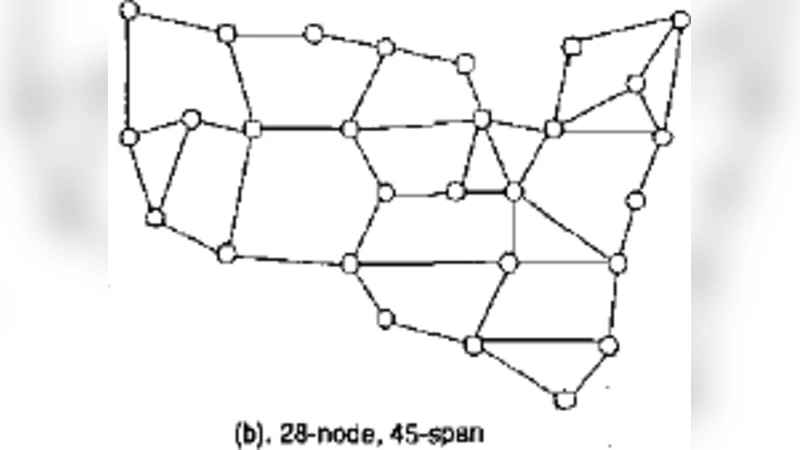
The authors evaluate the heuristic on two benchmark topologies: the 14‑node NSFNET and the 28‑node ARPANET. For each topology, they test both uniform and highly skewed working‑capacity distributions. The performance metrics are (i) the number of p‑cycles generated, (ii) total protection cost (the sum of spare capacity allocated to protect each link), and (iii) execution time. Compared with a state‑of‑the‑art greedy selection heuristic, the proposed method reduces the number of p‑cycles by roughly 30 % on average and lowers the total protection cost by 15 %–25 %. Execution time also improves by about 40 % on the larger network, demonstrating scalability. Notably, the advantage persists across both balanced and highly unbalanced traffic scenarios, indicating that the incremental aggregation effectively adapts to varying network states.
The paper acknowledges several limitations. First, the current formulation assumes only single‑link failures; extending the approach to handle multiple simultaneous failures would require more sophisticated merging criteria. Second, the cost model does not incorporate physical layer constraints such as wavelength continuity, attenuation, or dispersion, which could affect the feasibility of certain merged cycles in real deployments. Third, the memory requirement for storing all shortest cycles may become significant for very large topologies. The authors suggest future work in three directions: (a) incorporating multi‑failure protection by allowing overlapping protection domains, (b) integrating wavelength‑assignment constraints into the merge decision, and (c) developing a distributed version of the algorithm that can react to dynamic traffic changes in near‑real time.
In summary, the paper presents a pragmatic, network‑state‑driven heuristic that constructs an effective p‑cycle protection set without a separate selection phase. By focusing on incremental aggregation of the most beneficial shortest cycles, it achieves lower protection cost, fewer p‑cycles, and faster computation than conventional methods, making it a promising candidate for practical deployment in modern optical WDM mesh networks.