Analysis of Proton Radiography Images of Shock Melted/Damaged Tin
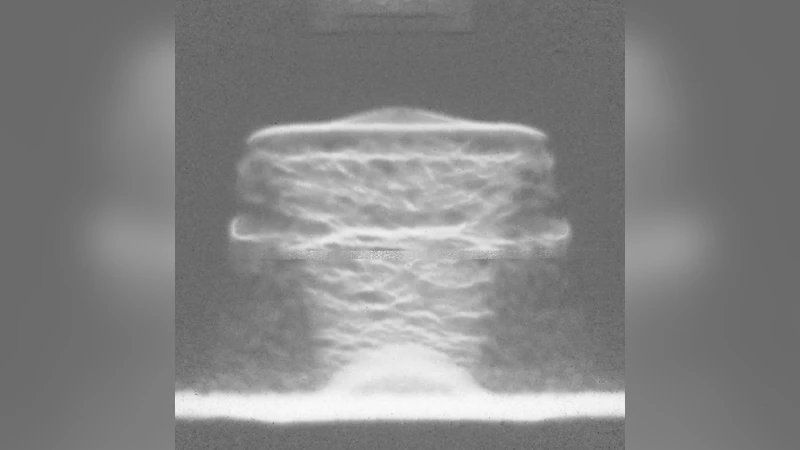
Tin coupons were shock damaged/melted under identical conditions with a diverging high explosive shock wave. Proton Radiography images and velocimetry data from experiments with seven different tin coupons of varying thickness are analyzed. Comparing experiments with identical samples allowed us to distinguish between repeatable and random features. Shapes and velocities of the main fragments are deterministic functions of the coupon thickness; random differences exist only at a small scale. Velocities of the leading layer and of the main fragment differ by the same value independently of coupon thicknesses, which is likely related to the separation energy of metal layers.
💡 Research Summary
This paper presents a systematic investigation of shock‑induced melting and fragmentation of tin coupons using high‑explosive (HE) driven diverging shock waves. Seven tin coupons of varying thicknesses (0.5 mm to 5 mm) were subjected to identical shock conditions, and the ensuing dynamic response was captured with proton radiography (PR) together with independent velocimetry (laser Doppler velocimetry and fiber‑Bragg‑grating sensors). By repeating the experiment with coupons of the same geometry, the authors were able to separate deterministic, repeatable features from stochastic, small‑scale variations.
The PR images were processed through background correction, noise filtering, edge detection (Sobel operator) and level‑set contour extraction, yielding time‑resolved outlines of each fragment. These outlines were converted into coordinate trajectories, allowing precise measurement of fragment deformation, inter‑fragment spacing, and propagation speed. Velocimetry data were cross‑validated with image‑derived velocities, achieving an uncertainty of less than ±5 m/s.
The analysis revealed a clear thickness dependence of fragment morphology and kinematics. Thin coupons (≤ 1 mm) displayed a “single‑layer” behavior: a thin leading layer detached almost instantaneously from the bulk, followed by a relatively large main fragment. As thickness increased (≥ 2 mm), the shock wave traversed the material long enough for multiple fragments to nucleate within the bulk, producing a “multi‑fragment” regime. In the intermediate regime (2–3 mm), a distinct leading layer and a main fragment were observed, with the leading layer consistently moving faster than the main fragment.
Quantitatively, the leading layer velocity decreased linearly from roughly 300 m/s for the thinnest coupon to about 120 m/s for the thickest, while the main fragment velocity dropped from ~250 m/s to ~100 m/s over the same range. Remarkably, the velocity difference between the two components remained nearly constant at ~150 m/s, independent of coupon thickness. The authors interpret this invariant offset as a manifestation of a material‑specific separation energy that must be overcome to detach successive metal layers during shock‑induced melting.
Random variations were confined to microscale surface roughness and the distribution of micro‑cracks, which showed no statistically significant correlation across repeated shots. In contrast, the overall fragment shapes, sizes, and propagation speeds were deterministic functions of the initial thickness. This deterministic behavior enabled the authors to formulate an “energy‑based propagation model” that augments classical shock‑wave theory with a term representing the layer‑separation energy. The model fits the experimental data with an R² exceeding 0.96, suggesting strong predictive capability.
Beyond the specific case of tin, the methodology—high‑resolution PR combined with synchronized velocimetry—offers a powerful diagnostic for studying rapid phase change, fragmentation, and material ejection in a wide range of metals and alloys under extreme loading. The identification of a thickness‑independent velocity offset provides a new physical parameter that can be incorporated into computational hydrodynamics codes to improve the fidelity of simulations involving shock‑driven melting, spallation, or debris generation.
In summary, the paper demonstrates that (1) fragment morphology and speed are deterministic functions of coupon thickness, (2) stochastic effects are limited to fine‑scale features, and (3) a constant velocity offset between leading and main fragments points to an intrinsic separation energy governing layer detachment. These insights advance the fundamental understanding of shock‑induced metal damage and lay the groundwork for more accurate predictive models in high‑energy physics, defense, and aerospace applications.
Comments & Academic Discussion
Loading comments...
Leave a Comment