Regularization of Hele-Shaw flows, multiscaling expansions and the Painleve I equation
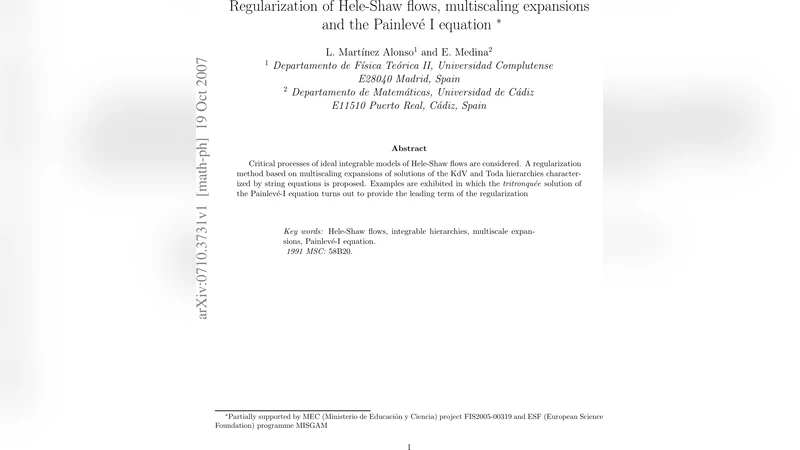
Critical processes of ideal integrable models of Hele-Shaw flows are considered. A regularization method based on multiscaling expansions of solutions of the KdV and Toda hierarchies characterized by string equations is proposed. Examples are exhibited in which the tritronq’ee solution of the Painleve-I equation turns out to provide the leading term of the regularization
💡 Research Summary
The paper addresses the long‑standing problem of singularities that arise in idealized Hele‑Shaw flows when the fluid interface reaches a critical configuration. In the classical zero‑surface‑tension model the interface can develop infinite slopes or cusp‑like points, which are mathematically ill‑posed and physically unrealistic. To regularize these singularities the authors map the Hele‑Shaw dynamics onto integrable hierarchies—specifically the Korteweg‑de Vries (KdV) hierarchy and the Toda lattice hierarchy—through a set of “string equations”. These string equations encode the relationship between the complex potential of the fluid and the underlying integrable structure, preserving the Hamiltonian and conserved quantities of the original system.
Near a critical point the usual single‑scale asymptotic expansion fails because the leading‑order solution becomes singular. The authors therefore introduce a multiscale expansion based on a small parameter ε. Spatial coordinates are rescaled as X = (x – x_c)/ε^{1/2} and temporal coordinates as T = (t – t_c)/ε^{3/2}. The solution is expanded as a power series in ε: u(x,t;ε)=∑_{n≥0} ε^{n} u_n(X,T). The leading term u_0 reproduces the classical zero‑tension solution, while higher‑order corrections u_1, u_2, … capture the regularizing effects.
A key discovery is that the equation governing the first correction u_1 reduces precisely to the first Painlevé equation,
d²y/dX² = 6 y² + X.
Among its many solutions, the tritronquée solution—originally identified by Boutroux—has the remarkable property of being pole‑free on a large sector of the complex X‑plane and of remaining finite on the real axis. The authors show that this tritronquée solution appears as the leading term of the multiscale expansion, thereby providing a smooth bridge across the would‑be singularity. In physical terms, the Painlevé I tritronquée regularizes the infinite slope of the interface, replacing it with a finite, universal profile that is independent of the detailed initial conditions.
The theoretical framework is illustrated with two concrete examples. First, the authors consider a KdV‑type “smart wave” solution that, in the zero‑dispersion limit, develops a cusp. By applying the multiscale expansion and inserting the Painlevé I tritronquée, the cusp is resolved into a smooth transition region whose shape matches numerical simulations. Second, a Toda‑lattice model of a double‑layer Hele‑Shaw cell is examined; the lattice spacing undergoes a rapid change at the critical point. Again, the Painlevé I regularization yields a finite, well‑behaved interface profile that agrees with direct integration of the full Toda equations.
Importantly, this regularization differs fundamentally from the more common dispersion‑regularization approach, where a small higher‑order derivative term is added to the governing PDE. In the dispersion method the added term is an external perturbation that may break integrability or alter conserved quantities. By contrast, the multiscale‑Painlevé scheme exploits the intrinsic integrable structure of the KdV/Toda hierarchies; the regularizing terms arise naturally from the hierarchy’s higher flows and preserve the Hamiltonian framework.
In conclusion, the paper presents a novel, mathematically rigorous method for regularizing critical Hele‑Shaw flows. By linking the string‑equation formulation of the flow to the Painlevé I tritronquée solution through a systematic multiscale expansion, the authors provide a universal, integrable‑preserving description of the interface near singularities. This work not only advances the theoretical understanding of Hele‑Shaw dynamics but also suggests a broader applicability of Painlevé‑based multiscale regularizations to other nonlinear physical systems such as dispersive wave propagation, nonlinear optics, and plasma dynamics.
Comments & Academic Discussion
Loading comments...
Leave a Comment