Some remarks on groupoids and small categories
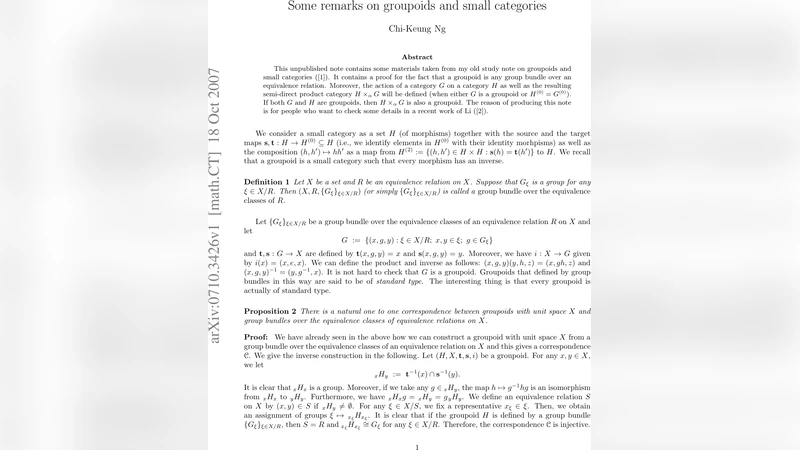
This unpublished note contains some materials taken from my old study note on groupoids and small categories. It contains a proof for the fact that any groupoid is a group bundle over an equivalence relation. Moreover, the action of a category $G$ on a category $H$ as well as the resulting semi-direct product category $H\times_\alpha G$ will be defined (when either $G$ is a groupoid or $H^{(0)} = G^{(0)}$). If both $G$ and $H$ are groupoids, then $H\times_\alpha G$ is also a groupoid. The reason of producing this note is for people who want to check some details in a recent work of Li.
💡 Research Summary
This unpublished note revisits the relationship between groupoids and small categories, offering a concise yet thorough treatment of several foundational constructions that have recently appeared in the literature, notably in a paper by Li. The author begins by recalling the definition of a groupoid as a category in which every morphism is invertible, and then shows that any groupoid can be canonically decomposed into a “group bundle over an equivalence relation.” The equivalence relation is the natural one on the object set: two objects are equivalent precisely when there exists at least one morphism between them. For each equivalence class the isotropy groups (the automorphism groups of the objects) are all isomorphic, and the collection of these groups, indexed by the classes, forms a bundle. The proof proceeds by selecting, for any pair of equivalent objects, a morphism that transports the isotropy group of one object to the other, verifying that this transport respects group multiplication and that the resulting family of groups assembles into a bundle whose total space recovers the original groupoid.
Having established this structural picture, the note turns to the notion of an action of one category (G) on another category (H). Because a general category does not have inverses, the definition is restricted to two situations: either (G) is itself a groupoid (so that each morphism is invertible), or the object sets of (G) and (H) coincide. An action (\alpha) assigns to each morphism (g\in G) a functorial endomorphism of (H), denoted (\alpha_g), satisfying three axioms: identity preservation (\alpha_{1_x}= \mathrm{id}H), compatibility with composition (\alpha{g_1g_2}=\alpha_{g_1}\circ\alpha_{g_2}), and preservation of the internal composition of (H) (\alpha_g(h_1h_2)=\alpha_g(h_1)\alpha_g(h_2)). This definition generalises the familiar group action on a set or on a group to the categorical setting, and when (G) is a groupoid the action restricts on each equivalence class to an ordinary group action on the corresponding isotropy group of (H).
Using an action, the author constructs the semi‑direct product category (H\times_{\alpha} G). Objects are the common objects of (H) and (G); a morphism is a pair ((h,g)) with (h\in H) and (g\in G) such that the source and target match appropriately. Composition is defined by ((h_1,g_1)\circ (h_2,g_2) = (h_1,\alpha_{g_1}(h_2),, g_1g_2)). The axioms of the action guarantee associativity and the existence of identity morphisms. Moreover, when both (G) and (H) are groupoids, each pair ((h,g)) possesses an inverse ((\alpha_{g^{-1}}(h^{-1}),, g^{-1})), making the semi‑direct product itself a groupoid. This result shows that the class of groupoids is closed under the semi‑direct product construction, mirroring the well‑known closure of groups under semi‑direct products.
The final part of the note explains why these constructions matter for Li’s recent work. Li’s paper assumes the existence of a groupoid equipped with a bundle of groups and an action that intertwines the two structures. The present note supplies the missing verifications: the equivalence‑relation bundle description, the precise definition of the action, and the proof that the resulting semi‑direct product is again a groupoid. By filling in these details, the author provides a solid foundation for Li’s arguments and offers a reference for readers who wish to check the technical steps.
In summary, the note delivers three main contributions: (1) a clear proof that any groupoid is a group bundle over its natural equivalence relation, (2) a categorical generalisation of group actions, and (3) the construction and groupoid‑preserving property of the semi‑direct product (H\times_{\alpha}G). These results not only clarify existing literature but also furnish useful tools for future investigations involving groupoids, bundles, and categorical actions.
Comments & Academic Discussion
Loading comments...
Leave a Comment