Phenomenological and ontological models in natural science
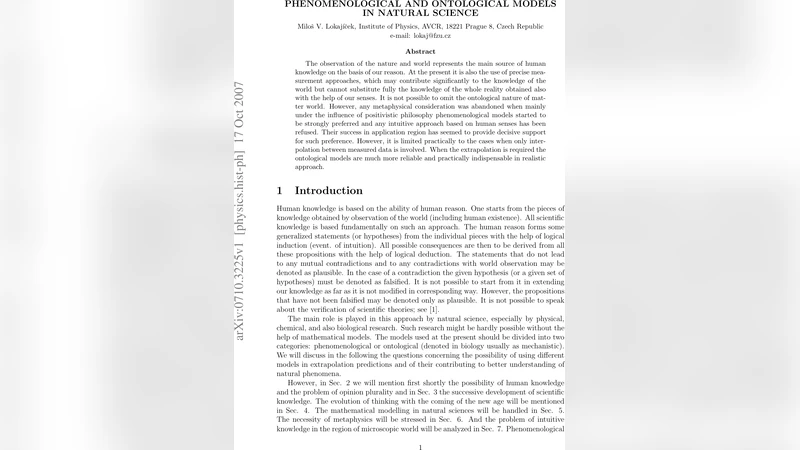
The observation of the nature and world represents the main source of human knowledge on the basis of our reason. At the present it is also the use of precise measurement approaches, which may contribute significantly to the knowledge of the world but cannot substitute fully the knowledge of the whole reality obtained also with the help of our senses. It is not possible to omit the ontological nature of matter world. However, any metaphysical consideration was abandoned when mainly under the influence of positivistic philosophy phenomenological models started to be strongly preferred and any intuitive approach based on human senses has been refused. Their success in application region has seemed to provide decisive support for such preference. However, it is limited practically to the cases when only interpolation between measured data is involved. When the extrapolation is required the ontological models are much more reliable and practically indispensable in realistic approach.
💡 Research Summary
The paper sets out to compare two dominant paradigms in the methodology of natural‑science research: phenomenological models, which are rooted in positivist and empiricist traditions, and ontological (or realist) models, which aim to capture the underlying structure of the material world. Phenomenological models translate observed data and precise measurements into mathematical relationships or statistical estimators. Their strength lies in reproducibility, ease of calibration, and immediate applicability to engineering, chemistry, medicine, and other fields where interpolation between known data points is required. The author points out, however, that this data‑driven approach is fundamentally limited when extrapolation beyond the measured domain is needed. Because phenomenological models do not embed physical constraints or causal mechanisms, they can produce unreliable predictions in regimes where no prior data exist.
Ontological models, by contrast, start from assumed fundamental entities—mass, charge, fields, wavefunctions, spacetime geometry—and derive equations that describe how these entities interact. Classical mechanics, electromagnetism, quantum mechanics, and general relativity are classic examples. While such models must still be tested against experiment, their basic premises are intended to reflect the real structure of nature. Consequently, they provide a conceptual scaffold that enables scientists to venture into uncharted territories, such as extreme temperatures, pressures, or scales, and to design experiments with a clear expectation of underlying behavior. The paper argues that for any scientific endeavor requiring extrapolation—climate forecasting, drug discovery, space mission planning—ontological reasoning is indispensable.
A further theme is the role of human senses and intuition. The author notes that the early modern rejection of “subjective” perception in favor of pure measurement created a false dichotomy: that only objective data matter. In practice, scientists constantly rely on sensory experience, pattern recognition, and intuitive judgment to formulate hypotheses, spot anomalies, and decide which models to trust. The resurgence of data‑intensive methods (big data, machine learning) does not eliminate the need for ontological insight; rather, it heightens the risk of over‑fitting phenomenological patterns without understanding their causal basis.
Through a series of case studies—climate models, pharmaceutical design, and astrophysical simulations—the paper demonstrates that phenomenological models excel at short‑term, data‑rich predictions, while ontological models are essential for long‑term, data‑sparse, or fundamentally novel problems. The author concludes that the two approaches should not be seen as mutually exclusive but as complementary tools. Effective scientific progress requires a balanced integration: use phenomenological models for rapid, accurate interpolation where data are abundant, and employ ontological models to guide extrapolation, generate new hypotheses, and maintain a coherent picture of reality. Maintaining this synergy, together with the human capacity for intuition, is presented as the optimal path forward for natural‑science research.
Comments & Academic Discussion
Loading comments...
Leave a Comment