Products in Hopf-Cyclic Cohomology
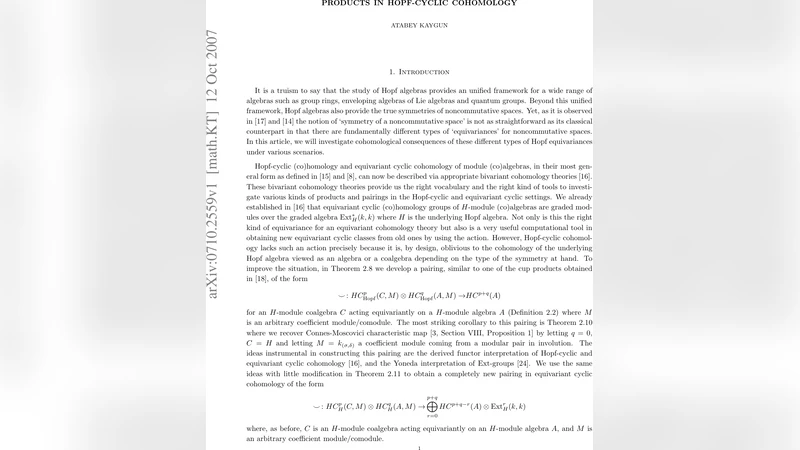
We construct several pairings in Hopf-cyclic cohomology of (co)module (co)algebras with arbitrary coefficients. The key ideas instrumental in constructing these pairings are the derived functor interpretation of Hopf-cyclic and equivariant cyclic (co)homology, and the Yoneda interpretation of Ext-groups. As a special case of one of these pairings, we recover the Connes-Moscovici characteristic map in Hopf-cyclic cohomology. We also prove that this particular pairing, along with few others, would stay the same if we replace the derived category of (co)cyclic modules with the homotopy category of (special) towers of $X$-complexes, or the derived category of mixed complexes.
💡 Research Summary
The paper develops a systematic framework for constructing several pairings in Hopf‑cyclic cohomology when the underlying objects are (co)module (co)algebras equipped with arbitrary coefficients. The authors begin by re‑interpreting both Hopf‑cyclic cohomology and equivariant cyclic (co)homology as derived functors. In this setting, the cohomology groups appear as Ext‑groups in the category of cyclic or equivariant cyclic modules over a Hopf algebra H. By invoking the Yoneda description of Ext, each Ext‑class is realized as a concrete extension chain of cyclic modules, which makes it possible to define explicit composition operations at the level of morphisms.
Three main pairings are introduced. The first is an “internal” pairing
\
Comments & Academic Discussion
Loading comments...
Leave a Comment