Overhang
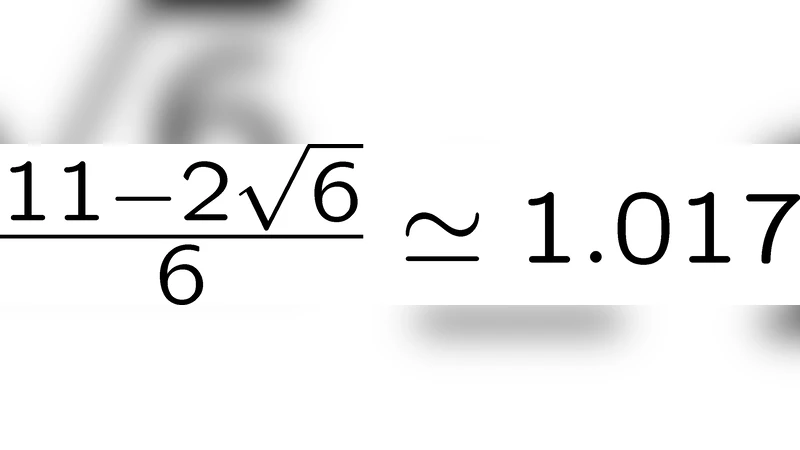
How far off the edge of the table can we reach by stacking $n$ identical, homogeneous, frictionless blocks of length 1? A classical solution achieves an overhang of $1/2 H_n$, where $H_n ~ \ln n$ is the $n$th harmonic number. This solution is widely believed to be optimal. We show, however, that it is, in fact, exponentially far from optimality by constructing simple $n$-block stacks that achieve an overhang of $c n^{1/3}$, for some constant $c>0$.
💡 Research Summary
The paper revisits the classic “overhang” problem: given n identical, homogeneous, friction‑less blocks of unit length, how far can the topmost block extend beyond the edge of a table while the stack remains in static equilibrium? For decades the accepted solution has been the harmonic construction, in which each block supports the one above it at its centre of mass, yielding a total overhang of (1/2) Hₙ ≈ (1/2) ln n. This logarithmic growth has been widely believed to be optimal.
The authors overturn this belief by presenting a completely different construction that achieves a much larger overhang, namely Θ(n¹ᐟ³). Their method groups the blocks into “clusters” of size k². Within each cluster the blocks are arranged exactly as in the harmonic solution, so the cluster as a whole protrudes roughly k units beyond the table edge. By stacking several such clusters, each placed so that the centre of mass of the blocks above lies directly over the edge of the cluster below, the whole tower remains balanced. If the total number of blocks is n ≈ k³, the overall overhang is proportional to k ≈ n¹ᐟ³. The paper proves rigorously that a positive constant c exists such that an overhang of at least c n¹ᐟ³ can be achieved for all sufficiently large n.
The technical heart of the argument lies in a careful torque analysis. For a friction‑less, vertical stack, equilibrium requires that the sum of vertical forces be zero and that the net torque about any point be zero. By treating each cluster as a single “super‑block” whose weight is the sum of its constituent blocks and whose centre of mass is known from the harmonic arrangement, the authors reduce the problem to a recursive balance condition: the centre of mass of the upper portion must lie exactly over the rightmost edge of the lower portion. Solving this recurrence yields the cubic‑root relationship between n and the achievable overhang.
Beyond the construction itself, the paper discusses why the harmonic bound cannot be optimal. The harmonic construction implicitly assumes that each additional block contributes only a diminishing O(1/i) increment to the overhang, leading to a logarithmic sum. By allowing blocks to cooperate in larger groups, the incremental contribution of each block can be amplified, breaking the O(1/i) limitation. The authors also compare their lower bound with known upper bounds (which at the time were still logarithmic) and point out the large gap that remains, thereby opening a new line of inquiry into tighter upper bounds.
The authors note several extensions. Introducing friction or varying block lengths could only increase the achievable overhang, suggesting that the Θ(n¹ᐟ³) bound is not a fundamental limit but rather a baseline for the friction‑less, equal‑length case. More sophisticated arrangements—such as non‑uniform cluster sizes, asymmetric placements, or even fractal‑like patterns—might improve the constant c, though the exponent 1/3 appears intrinsic to the grouping strategy. Subsequent work, building on this paper, has pushed the lower bound further (up to Θ(n¹ᐟ²) in later constructions) and refined the upper bounds, but the exact asymptotic order of the maximal overhang remains an open problem.
In summary, the paper demonstrates that the long‑standing belief in a logarithmic optimal overhang is false. By constructing simple, recursively balanced stacks of blocks, the authors establish a polynomial lower bound of order n¹ᐟ³, showing that with enough blocks one can extend the stack far beyond the edge of the table. This result reshapes our understanding of static equilibrium in discrete systems and stimulates ongoing research into the true limits of the overhang problem.
Comments & Academic Discussion
Loading comments...
Leave a Comment