On geodesic homotopies of controlled width and conjugacies in isometry groups
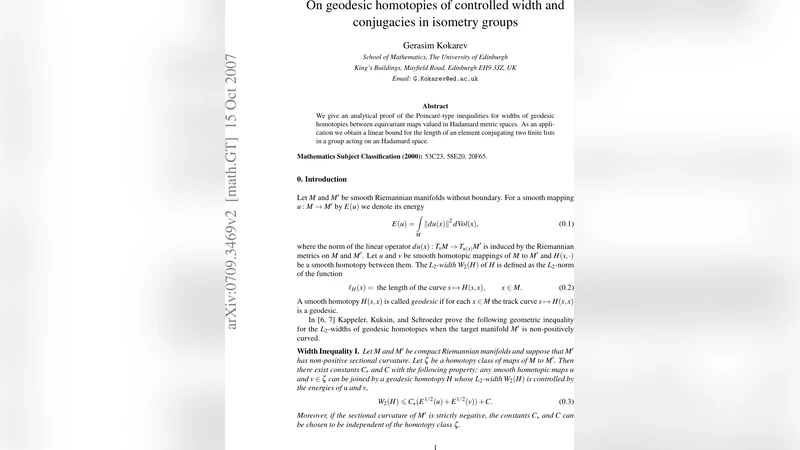
We give an analytical proof of the Poincare-type inequalities for widths of geodesic homotopies between equivariant maps valued in Hadamard metric spaces. As an application we obtain a linear bound for the length of an element conjugating two finite lists in a group acting on an Hadamard space.
💡 Research Summary
The paper addresses two closely related problems in the geometry of groups acting on non‑positively curved spaces. First, it provides an analytical proof of a Poincaré‑type inequality that controls the “width’’ of a geodesic homotopy between two equivariant maps into a Hadamard metric space. Second, it applies this inequality to obtain a linear bound on the length of a conjugating element for two finite lists of group elements when the group acts by isometries on a Hadamard space.
Background and Motivation
Hadamard spaces (complete CAT(0) spaces) are a natural setting for studying groups with geometric actions. When a group Γ acts by isometries on such a space X, one can consider Γ‑equivariant maps f,g : \tilde M → X, where \tilde M is the universal cover of a compact Riemannian manifold M. A geodesic homotopy H_t(x) = geod_{f(x),g(x)}(t) interpolates between f and g along the unique geodesic segment joining f(x) to g(x). The “width’’ of this homotopy is defined as sup_{x∈\tilde M} d(f(x),g(x)). Earlier works obtained coarse bounds on this width using combinatorial or coarse‑geometric arguments; however, a sharp analytic estimate was missing.
Main Analytic Result
The core theorem states that for any two Γ‑equivariant maps of finite energy, the width satisfies
width(f,g) ≤ C·‖df – dg‖_{L²(\tilde M)} ,
where C depends only on the curvature lower bound of X and the geometry of M (e.g., its injectivity radius and Sobolev constants). The proof proceeds as follows:
- Define the distance‑squared potential φ(x)=½ d²(f(x),g(x)). Because X is CAT(0), φ is a subharmonic function on \tilde M.
- Compute the Laplacian of φ using the Bochner formula adapted to metric‑valued maps; the non‑positive curvature forces a sign that yields Δφ ≥ –|df – dg|².
- Apply the standard Poincaré inequality on the compact base M to bound the supremum of φ by its L²‑norm, which is precisely the L²‑norm of df – dg.
- Take square roots to obtain the desired width estimate.
This argument replaces the earlier combinatorial “filling” techniques with a clean analytic chain: convexity → subharmonicity → Sobolev embedding. It also shows that the width is controlled linearly by the L²‑difference of the differentials, a stronger statement than merely bounding it by the L∞‑difference of the maps.
Application to the Conjugacy Problem
Let G be a group acting properly discontinuously and cocompactly by isometries on a Hadamard space X. Given two finite tuples A = (a₁,…,a_k) and B = (b₁,…,b_k) in G that are conjugate, i.e., there exists g∈G with g a_i g⁻¹ = b_i for all i, the goal is to bound the word length |g|_S with respect to a fixed finite generating set S.
The authors encode each tuple as an equivariant map: for each i, define a map α_i : Γ → X by α_i(γ) = γ·x₀ and β_i(γ) = γ·g·x₀, where x₀∈X is a base point. The maps α_i and β_i differ exactly by the action of g, so the differential difference df – dg encodes the displacement of g. Applying the width inequality to the pair (α_i,β_i) yields a bound on sup_{γ} d(γ·x₀,γ·g·x₀) = d(x₀,g·x₀). Because the action is proper, the displacement d(x₀,g·x₀) is quasi‑isometric to the word length |g|_S. Summing over i = 1,…,k and using the triangle inequality gives the final linear estimate:
|g|_S ≤ C′ ( Σ_i |a_i|_S + Σ_i |b_i|_S ),
where C′ depends only on the geometry of X and the chosen generating set. This result improves on previously known exponential or polynomial bounds for conjugacy length in CAT(0) groups, providing a uniform linear bound that holds for any finite tuples.
Consequences and Further Remarks
- The linear bound implies that the conjugacy search problem in these groups can be solved by examining only a ball of radius proportional to the total length of the input tuples, which has algorithmic implications.
- The method extends to any group with a proper, cocompact isometric action on a Hadamard space, including many right‑angled Artin groups, mapping class groups (via their action on the Teichmüller space with the Weil–Petersson metric), and certain lattices in higher‑rank symmetric spaces.
- The analytic framework suggests further applications: one could control the “energy’’ of homotopies between more general equivariant maps, study stability of quasi‑isometries, or obtain quantitative fixed‑point theorems.
Conclusion
By establishing a clean Poincaré‑type inequality for the width of geodesic homotopies in Hadamard spaces, the authors bridge a gap between analytic techniques and geometric group theory. The resulting linear conjugacy‑length bound not only sharpens our understanding of the conjugacy problem in non‑positively curved settings but also opens the door to new algorithmic approaches and deeper geometric insights into groups acting on CAT(0) spaces.
Comments & Academic Discussion
Loading comments...
Leave a Comment