Pricing, Competition, and Routing for Selfish and Strategic Nodes in Multi-hop Relay Networks
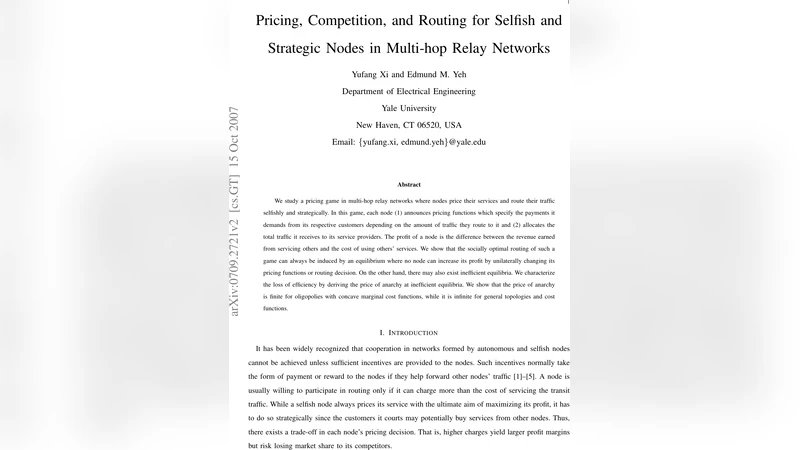
We study a pricing game in multi-hop relay networks where nodes price their services and route their traffic selfishly and strategically. In this game, each node (1) announces pricing functions which specify the payments it demands from its respective customers depending on the amount of traffic they route to it and (2) allocates the total traffic it receives to its service providers. The profit of a node is the difference between the revenue earned from servicing others and the cost of using others’ services. We show that the socially optimal routing of such a game can always be induced by an equilibrium where no node can increase its profit by unilaterally changing its pricing functions or routing decision. On the other hand, there may also exist inefficient equilibria. We characterize the loss of efficiency by deriving the price of anarchy at inefficient equilibria. We show that the price of anarchy is finite for oligopolies with concave marginal cost functions, while it is infinite for general topologies and cost functions.
💡 Research Summary
The paper investigates a novel game‑theoretic model of multi‑hop relay networks in which every node acts as an autonomous economic agent. Each node i announces a pricing function p_i(·) that specifies the payment demanded from any downstream customer as a function of the amount of traffic x_i that the customer routes to i. Simultaneously, i decides how to split the total traffic it receives among its upstream service providers S_i by choosing a routing vector r_i = (r_{ij}){j∈S_i} with ∑{j∈S_i} r_{ij}=x_i. The cost of providing service to a given amount of traffic is described by a cost function c_j(·) for each provider j. Node i’s profit is therefore
π_i = p_i(x_i) – ∑{j∈S_i} c_j(r{ij}).
The authors first prove the existence of at least one Nash equilibrium (NE) for this pricing game under mild regularity conditions (continuous, non‑decreasing pricing functions and convex cost functions). In equilibrium each node’s routing choice coincides with a minimum‑cost path given the prevailing prices, while the pricing functions are best responses to the routing decisions of downstream nodes.
A central contribution is the demonstration that a socially optimal routing—i.e., the flow that minimizes the total network cost Σ_j c_j(total traffic through j)—can be induced as a Nash equilibrium. This is achieved by designing each node’s price function to be the marginal cost of service plus a uniform markup λ·x, where λ is the Lagrange multiplier associated with the global cost minimization problem. Under such “marginal‑cost pricing with a constant markup,” individual profit maximization aligns with the global objective, guaranteeing that the equilibrium flow coincides with the optimal flow.
The paper also shows that not all equilibria are efficient. When nodes are free to choose arbitrary pricing functions, they may set prices that are significantly above marginal cost, causing traffic to be routed through sub‑optimal paths. To quantify this inefficiency the authors introduce the Price of Anarchy (PoA), defined as the ratio between the worst‑case total cost at any Nash equilibrium and the optimal total cost.
Two analytical regimes are examined. In oligopolistic settings where the marginal cost functions are concave (i.e., c_i’’(x) ≤ 0) and the number of competing providers is small, the authors prove that the PoA is bounded by a finite constant (e.g., PoA ≤ 2). The concavity limits the incentive for any single node to inflate its price excessively because the cost savings from traffic diversion are limited. Conversely, for general network topologies and arbitrary cost functions, the PoA can become unbounded. The authors construct explicit examples (e.g., a star topology with a zero‑cost central node and peripheral nodes that can charge arbitrarily high prices) where a Nash equilibrium leads to arbitrarily large total cost, implying an infinite PoA.
The discussion concludes with practical implications. Regulators or network operators can mitigate inefficiency by imposing price caps, enforcing marginal‑cost pricing, or providing a central coordinator that adjusts λ to keep the markup modest. In networks where cost functions are naturally concave and the market structure resembles an oligopoly, the autonomous pricing game is likely to remain efficient; otherwise, unchecked strategic pricing can severely degrade overall performance.
Overall, the paper makes four key contributions: (1) formulation of a joint pricing‑and‑routing game for multi‑hop relay networks, (2) proof that socially optimal routing can be sustained as a Nash equilibrium via appropriate price design, (3) identification and quantification of inefficient equilibria through the PoA metric, and (4) rigorous analysis showing that the PoA is finite for concave marginal costs but can be infinite in general. These results bridge network flow theory and economic mechanism design, offering valuable guidance for the design of pricing policies in decentralized communication infrastructures.