Twisted equivariant K-theory for proper actions of discrete groups
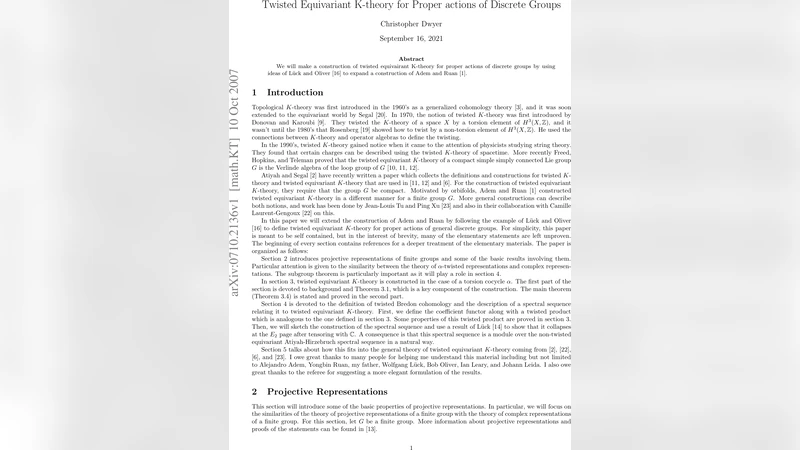
We give a construction for twisted equivariant K-theory in the case of a proper action of a discrete group using twisted bundles. Our construction uses results of Lueck and Oliver to extend a construction of Adem and Ruan. We also show the existence of a Chern character to twisted Bredon cohomology. This gives a partial answer to the question of when you can construct twisted equivariant K-theory out of finite rank twisted bundles.
💡 Research Summary
The paper develops a rigorous construction of twisted equivariant K‑theory for spaces equipped with a proper action of a discrete group G, using finite‑dimensional twisted vector bundles. The authors begin by recalling that ordinary equivariant K‑theory classifies G‑equivariant complex vector bundles over a G‑space X, while a “twist” is encoded by a class α∈H²(G,U(1)) (or, equivalently, a central U(1)‑extension of G). In the twisted setting the G‑action on a bundle is only projective: for g₁,g₂∈G one has ρ(g₁)ρ(g₂)=α(g₁,g₂)ρ(g₁g₂).
Adem and Ruan previously defined such a theory for finite groups, but their construction relied on the existence of enough finite‑rank twisted bundles only when G is finite or the action is free. To overcome this limitation, the authors invoke the work of Lück and Oliver on equivariant dimension theory for proper actions. Lück–Oliver proved that for a proper G‑CW complex X, every equivariant K‑theory class can be represented by a difference of finite‑dimensional G‑bundles. By adapting their arguments to the projective setting, the paper shows that the same holds for α‑twisted bundles whenever α has finite order.
The main definition is:
K⁎_G^α(X) = Grothendieck group of isomorphism classes of finite‑dimensional α‑projective G‑vector bundles over X.
The authors construct an α‑twisted equivariant K‑theory spectrum K_G^α and verify that its π₀ coincides with the above Grothendieck group, establishing equivalence with the more abstract homotopy‑theoretic definition. They also prove the usual functorial properties (restriction, induction, Mayer‑Vietoris, Bott periodicity) in the twisted context.
A substantial part of the work is devoted to a Chern character. The authors define an α‑twisted Bredon cohomology H⁎_G(X;ℚ^α), which is the Bredon cohomology of the orbit category with coefficients twisted by α. They then construct a natural transformation
ch^α : K⁎_G^α(X)⊗ℚ → H⁎_G(X;ℚ^α)
by applying the classical Chern–Weil construction fibrewise and averaging over the G‑orbits, taking into account the projective factor α. This map respects grading, is compatible with the ring structures, and becomes an isomorphism after tensoring with ℚ when X is a finite proper G‑CW complex and α has finite order. Consequently, the rational twisted equivariant K‑theory can be computed entirely in terms of twisted Bredon cohomology.
Finally, the paper addresses the foundational question: “When can twisted equivariant K‑theory be built solely from finite‑rank twisted bundles?” The answer given is partial but significant: if G is a discrete group acting properly on X and the twist α is of finite order, then every class in K⁎_G^α(X) is represented by a finite‑dimensional α‑projective bundle. This eliminates the need for infinite‑dimensional Hilbert bundles in the definition and aligns the theory with concrete geometric objects.
The authors conclude by outlining future directions, including extensions to non‑proper actions, to Lie groups, and to higher twists (gerbes). The results provide a solid bridge between geometric bundle data and algebraic invariants, and they open the way for explicit calculations of twisted equivariant K‑theory in many contexts of interest to both topology and mathematical physics.