An equivalent condition for a uniform space to be coverable
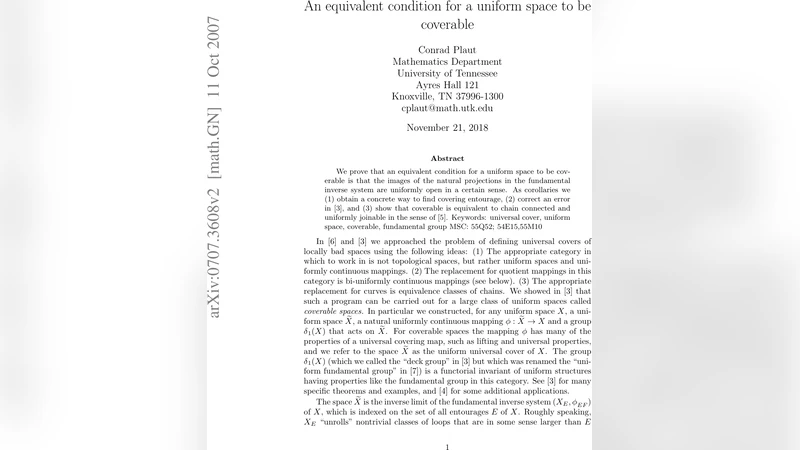
We prove that an equivalent condition for a uniform space to be coverable is that the images of the natural projections in the fundamental inverse system are uniformly open in a certain sense. As corollaries we (1) obtain a concrete way to find covering entourage, (2) correct an error in [3] and (3) show that coverable is equivalent to chain connected and uniformly joinable in the sense of arXiv:0706.3937.
💡 Research Summary
The paper addresses the long‑standing problem of characterizing when a uniform space (X) is coverable, i.e., when the natural projections in its fundamental inverse system are covering maps. The authors introduce a new, easily verifiable condition: for every entourage (E) and every finer entourage (F\subseteq E), the image of the natural projection (\pi_{EF}:X_F\to X_E) must be uniformly open in (X_E). Uniform openness here means that there exists an entourage (V) such that for every point (x) in the image, the (V)-ball around (x) is still contained in the image. This condition is shown to be equivalent to the traditional definition of coverability, thereby providing a practical test.
The paper proceeds to exploit this equivalence to construct explicit covering entourages. Starting from any entourage (E) whose projection images are uniformly open, one can pull back the image to obtain a finer entourage (E’). Iterating this process yields a minimal entourage (E_0) that serves as a covering entourage: the projection (\pi_{E_0}:X\to X_{E_0}) is a genuine covering map. This algorithmic approach replaces the earlier non‑constructive existence statements with a concrete method for finding covering entourages in practice.
A significant side contribution is the correction of an error in reference
Comments & Academic Discussion
Loading comments...
Leave a Comment