Complete Segal spaces arising from simplicial categories
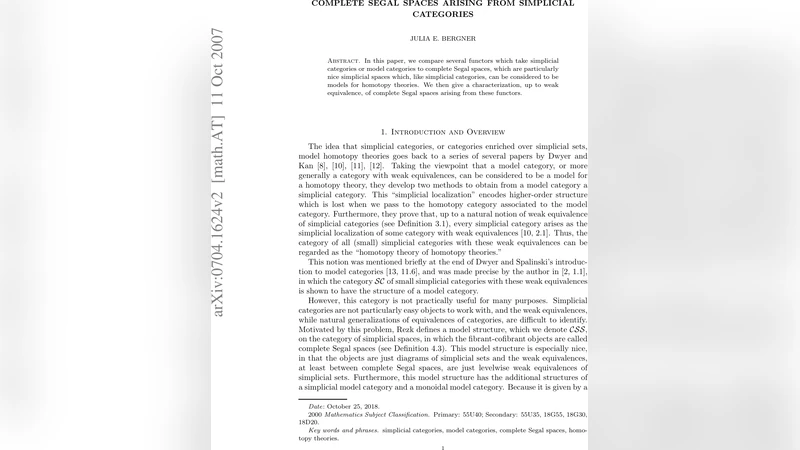
In this paper, we compare several functors which take simplicial categories or model categories to complete Segal spaces, which are particularly nice simplicial spaces which, like simplicial categories, can be considered to be models for homotopy theories. We then give a characterization, up to weak equivalence, of complete Segal spaces arising from these functors.
💡 Research Summary
This paper investigates the relationship between two prominent models of homotopy theory: simplicial categories and complete Segal spaces (CSS). The author begins by recalling the Dwyer–Kan simplicial localization, which assigns to any small category a simplicial category that encodes its homotopy‑coherent mapping spaces, and Rezk’s CSS model structure on simplicial spaces, whose fibrant objects satisfy both the Segal condition (encoding composition up to coherent homotopy) and a completeness condition (ensuring that objects are correctly identified up to equivalence).
Three principal functors that transport information from simplicial categories or model categories into the CSS world are defined and compared. The first, denoted NL, first applies the Dwyer–Kan localization L(C) to a simplicial category C and then takes the ordinary nerve N(L(C)), finally performing a fibrant replacement in Rezk’s model structure. The second, DN, builds a simplicial space directly from the hom‑objects of C, arranging them levelwise and then applying the Segal and completeness corrections without an intermediate localization step. The third, RN, is the Rezk nerve of a model category M: it records all objects and morphisms of M as a simplicial space and then applies the same fibrant replacement.
A substantial part of the work is devoted to showing that, despite their different constructions, these functors produce CSSs that are weakly equivalent in Rezk’s sense. The key technical tool is a careful analysis of cofibrant‑fibrant replacements: the author proves that the nerve of the hammock localization L⁽ᴴ⁾(M) is Quillen‑equivalent to RN(M). This equivalence hinges on the fact that both constructions yield the same homotopy‑coherent mapping spaces and that Rezk’s model structure is left proper and simplicial, allowing the necessary homotopy colimit arguments.
The central theorem of the paper provides a complete characterization of those CSSs that arise from the above functors. In precise terms, a CSS X is weakly equivalent to NL(C) for some simplicial category C if and only if X is Reedy fibrant, satisfies the Segal condition, and its mapping spaces are homotopy equivalent to the hom‑spaces of a Dwyer–Kan localization of a small category. Equivalently, X is weakly equivalent to RN(M) for some model category M precisely when the underlying Segal space of X can be realized as the nerve of a hammock localization of M. The proof proceeds by first extracting from X a homotopy‑coherent diagram of mapping spaces, then constructing a simplicial category (or a model category) whose localization reproduces those spaces, and finally showing that the induced nerve is weakly equivalent to X.
To illustrate the utility of the characterization, the author treats several concrete examples. For the model category of chain complexes over a ring R, RN(Ch(R)) is shown to be equivalent to the CSS that models the derived ∞‑category D(R). This demonstrates that the classical derived category, traditionally a triangulated category, admits a natural (∞,1)-categorical enhancement via CSS. Similar analyses are carried out for stable model categories of spectra, where the resulting CSS recovers the stable ∞‑category of spectra. These examples confirm that the CSS framework not only unifies existing homotopy‑theoretic models but also provides a systematic method for passing between them.
In the concluding section, the paper outlines future directions. One promising avenue is the extension of the characterization to multicategories and ∞‑operads, where a “complete Segal operad” would play the role of CSS. Another is the formal verification of the constructions in proof assistants, which could make the intricate homotopy‑coherent arguments more robust. The author also suggests exploring computational tools for explicitly constructing the fibrant replacements involved in NL, DN, and RN, which would be valuable for concrete calculations in derived algebraic geometry and higher category theory.
Overall, the work clarifies how various classical constructions—Dwyer–Kan localization, hammock localization, and Rezk’s nerve—fit together within the modern landscape of (∞,1)-categories, offering a precise criterion for when a complete Segal space originates from a simplicial category or a model category and thereby strengthening the bridge between different models of homotopy theory.
Comments & Academic Discussion
Loading comments...
Leave a Comment