Cross-Participants : fostering design-use mediation in an Open Source Software community
Motivation - This research aims at investigating emerging roles and forms of participation fostering design-use mediation during the Open Source Software design process Research approach - We compare online interactions for a successful “pushed-by-users” design process with unsuccessful previous proposals. The methodology developed, articulate structural analyses of the discussions (organization of discussions, participation) to actions to the code and documentation made by participants to the project. We focus on the useroriented and the developer-oriented mailing-lists of the Python project. Findings/Design - We find that key-participants, the cross-participants, foster the design process and act as boundary spanners between the users and the developers’ communities. Research limitations/Implications - These findings can be reinforced developing software to automate the structural analysis of discussions and actions to the code and documentation. Further analyses, supported by these tools, will be necessary to generalise our results. Originality/Value - The analysis of participation among the three interaction spaces of OSS design (discussion, documentation and implementation) is the main originality of this work compared to other OSS research that mainly analyse one or two spaces. Take away message - Beside the idealistic picture that users may intervene freely in the process, OSS design is boost and framed by some key-participants and specific rules and there can be barriers to users’ participation
💡 Research Summary
The paper investigates how design‑use mediation occurs in an open‑source software (OSS) community, focusing on the Python project’s mailing lists. The authors compare a successful “pushed‑by‑users” design episode with earlier, unsuccessful proposals. Their methodological framework integrates three interaction spaces that are typically studied in isolation: (1) discussion (mailing‑list threads), (2) documentation (wikis and specifications), and (3) implementation (code commits and documentation updates). By mapping the flow of ideas across these spaces, the study uncovers a distinct role – the “cross‑participant” – who actively participates in both the user‑oriented and developer‑oriented mailing lists.
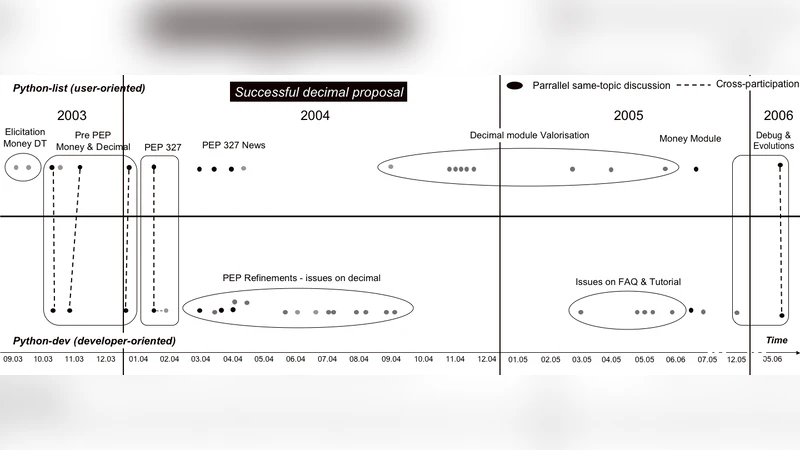
In the successful case, cross‑participants act as boundary spanners: they clarify user requirements in the user list, translate and summarize these requirements for the developer list, help shape the formal specification in the project wiki, and finally either commit the code themselves or shepherd the changes through review. Quantitative analysis of thread structures shows that cross‑participants have a higher reply density, occupy central positions in the communication network, and produce a disproportionate share of the linking posts that bridge the two lists. This bridging activity creates a coherent pipeline: user request → discussion → documented spec → code implementation.
Conversely, the failed proposals lack such mediation. User‑originated ideas remain confined to the user list, receive little attention from developers, and never become formalized in the wiki. Without a cross‑participant to translate and champion the ideas, the design process stalls, illustrating that OSS design is not an unrestricted “anyone can contribute” environment but one that depends on a few key actors and established norms.
The authors also discuss methodological limitations. Their structural analysis relies on manual coding of threads and linking actions to commits, which is labor‑intensive and not scalable. They propose developing automated tools that can extract and visualize the tri‑dimensional relationships among discussions, documentation, and code changes. Such tools would enable larger‑scale studies and help generalize the findings across other OSS projects.
Overall, the study contributes a novel perspective to OSS research by simultaneously examining three interaction spaces and highlighting the pivotal role of cross‑participants. It suggests that fostering or recognizing these boundary spanners could lower participation barriers for ordinary users, improve the efficiency of design‑use mediation, and ultimately lead to more user‑driven innovations in open‑source ecosystems.
Comments & Academic Discussion
Loading comments...
Leave a Comment