Electric Transport Properties of the p53 Gene and the Effects of Point Mutations
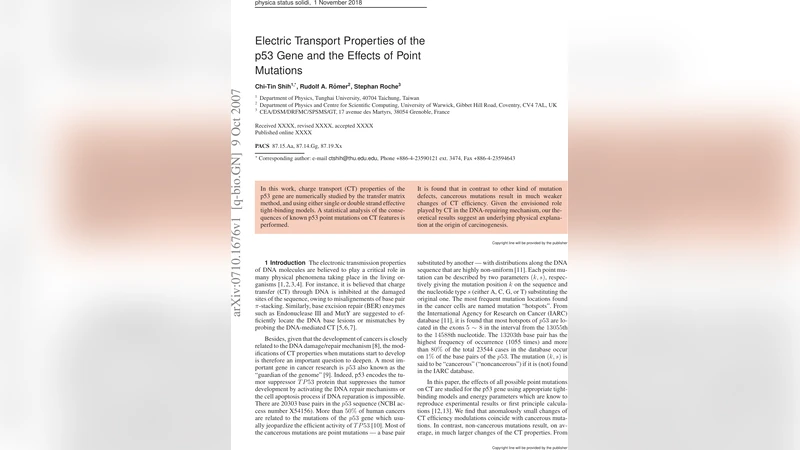
In this work, charge transport (CT) properties of the p53 gene are numerically studied by the transfer matrix method, and using either single or double strand effective tight-binding models. A statistical analysis of the consequences of known p53 point mutations on CT features is performed. It is found that in contrast to other kind of mutation defects, cancerous mutations result in much weaker changes of CT efficiency. Given the envisioned role played by CT in the DNA-repairing mechanism, our theoretical results suggest an underlying physical explanation at the origin of carcinogenesis.
💡 Research Summary
This paper investigates the charge‑transport (CT) properties of the human tumor‑suppressor gene p53 by means of numerical simulations based on the transfer‑matrix method (TMM) and two effective tight‑binding (TB) representations: a single‑strand (SS) model and a double‑strand (DS) model. The authors begin by motivating the study with the observation that more than 20 % of human cancers harbor point mutations in p53, yet most theoretical work has focused on the protein‑level consequences of these mutations. Recent hypotheses suggest that DNA itself may act as an electrical conduit, and that the efficiency of charge migration along the double helix could be a signal used by DNA‑repair enzymes to locate lesions. If mutations alter this electrical signal, the repair machinery might fail, providing a physical route to carcinogenesis.
In the methodological section, the p53 nucleotide sequence is mapped onto a TB Hamiltonian. For each base (or base‑pair) an on‑site energy εₙ is assigned according to its chemical identity, while nearest‑neighbour hopping integrals tₙₙ₊₁ encode the overlap of π‑orbitals and the influence of the surrounding solvent and counter‑ions. The SS model treats the DNA as a one‑dimensional chain, whereas the DS model adds inter‑strand coupling terms that mimic hydrogen‑bond mediated electronic communication between complementary bases. The TMM is then employed to compute the total transfer matrix M = Πₙ Mₙ, from which the transmission coefficient T(E) and, via the Landauer formula G = (2e²/h) T, the conductance are obtained over an energy window of –2 eV to +2 eV. The attenuation length λ, a measure of how far a charge can travel before its probability decays significantly, is extracted from the exponential decay of T with sequence length.
A comprehensive dataset of point mutations is drawn from the International Agency for Research on Cancer (IARC) TP53 database, comprising roughly 31 000 documented single‑base changes. These are classified into “cancerous” (≈5 000) mutations—those statistically associated with tumor formation—and “non‑cancerous” (the remainder) mutations. For each mutation the authors recompute the TB parameters, re‑run the TMM, and evaluate the relative change in transmission ΔT/T₀, where T₀ is the transmission of the wild‑type sequence at the same energy. Statistical analysis (means, standard deviations, t‑tests) reveals a striking dichotomy: cancerous mutations produce only modest reductions in transmission (average ΔT/T₀ ≈ –0.03 ± 0.02), whereas non‑cancerous mutations cause substantially larger drops (average ΔT/T₀ ≈ –0.12 ± 0.07). The DS model consistently yields higher sensitivity to mutations than the SS model, underscoring the importance of inter‑strand electronic coupling.
The authors interpret these findings in the context of DNA‑repair signaling. Many repair enzymes are thought to monitor the flow of electrons along the genome; a significant local decrease in conductance would flag a damaged site for enzymatic excision. Cancerous mutations, by leaving the CT pathway essentially intact, would evade this electronic surveillance, allowing the lesion to persist and eventually contribute to malignant transformation. Conversely, non‑cancerous mutations, which markedly disrupt charge flow, would be more readily recognized and corrected.
In the discussion, the paper emphasizes that the observed correlation between weak CT perturbation and oncogenic potential offers a plausible physical mechanism for the selective survival of certain mutations. It also suggests that the TB‑TMM framework could be extended to other tumor‑suppressor genes (e.g., BRCA1, PTEN) and to a broader class of DNA lesions (oxidative damage, cross‑links). The authors propose experimental validation through single‑molecule conductance measurements (break‑junction techniques, scanning tunnelling microscopy) and electrochemical assays that could directly probe the CT differences between wild‑type and mutant sequences.
The conclusion reiterates that charge transport is not merely a theoretical curiosity but may be integral to the genome’s self‑maintenance system. By demonstrating that cancer‑associated point mutations in p53 minimally disturb CT efficiency, the study provides a quantitative, physics‑based explanation for how certain genetic alterations escape repair and drive carcinogenesis. Future work aimed at integrating CT‑based diagnostics with nanotechnological sensors could open new avenues for early cancer detection and for the design of mutation‑specific therapeutic strategies.
Comments & Academic Discussion
Loading comments...
Leave a Comment