Comparaison entre calculs de vulnerabilite sismique et proprietes dynamiques mesurees
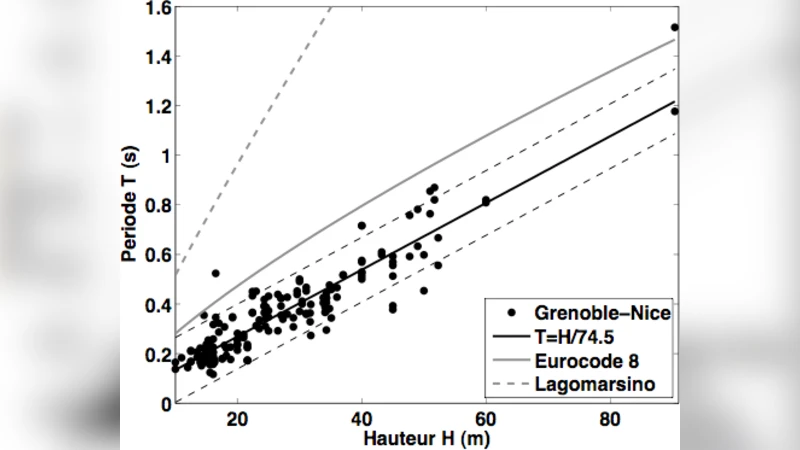
Large-scale seismic vulnerability assessment methods use simplified formulas and curves, often without providing uncertainties. They are seldom compared to experimental data. Therefore, we recorded ambient vibrations and estimated modal parameters (resonance frequencies, modal shapes and damping) of 60 buildings in Grenoble (France) of various types (masonry and reinforced concrete). The knowledge of resonance frequencies in the linear domain is essential in the seismic design. Hence, we compared resonance frequency formulas given in the design code with this experimental data. The variability is underestimated and only two parameters (type and height of the building) seem to be statistically significant. Moreover, we compared the linear part of capacity curves used in European Risk-UE method to the measured frequencies. The variability is still very large and these curve are often not relevant for the French buildings. As a result, ambient vibration recordings may become an interesting tool in order to calibrate the linear part of capacity curves.
💡 Research Summary
This paper presents a comprehensive field‑based validation of the simplified seismic vulnerability assessment tools that are widely used in Europe, focusing on the linear dynamic properties of buildings. Sixty structures of various typologies—masonry, reinforced‑concrete (RC) and mixed systems—located in Grenoble, France, were instrumented for ambient vibration recordings. Using Operational Modal Analysis (Stochastic Subspace Identification and Frequency Domain Decomposition), the authors extracted the first‑mode natural frequencies, modal shapes and damping ratios for each building.
The first part of the study compares these experimentally derived natural frequencies with the formulas prescribed in the current French design code (derived from Eurocode 8) and in other international standards. Those formulas are deliberately simple: they relate the fundamental frequency to the building height (H) and structural type through a power‑law relationship, ( f = a H^{-b} ). Statistical analysis shows that while the mean predicted frequencies are roughly in the same range as the measurements, the spread is dramatically underestimated. The standard deviation of the measured frequencies is two to three times larger than that implied by the code, and individual buildings of identical height and type can differ by up to 20‑30 % in frequency. The authors attribute this discrepancy to the omission of site‑specific factors (soil stiffness, foundation conditions), detailed structural details (wall thickness, column dimensions, material strength), and plan irregularities, all of which are known to affect stiffness but are not captured by the height‑type model.
The second part evaluates the linear portion of the capacity curves employed in the European Risk‑UE methodology. In Risk‑UE, the initial elastic stiffness K is derived from the natural frequency and the building mass ( ( K = (2\pi f)^2 M ) ), and the corresponding force‑displacement relationship is used as the “linear branch” of the capacity curve. By inserting the measured frequencies into this relationship, the authors reconstructed building‑specific linear capacity curves and compared them with the generic curves supplied by Risk‑UE for each height‑type class. The comparison reveals a systematic bias: French buildings, especially high‑rise RC towers, exhibit considerably lower elastic stiffness than the Risk‑UE reference. The average stiffness deficit ranges from 30 % to 45 % for the tallest structures. This finding suggests that the Risk‑UE reference curves, which are calibrated mainly on Central and Eastern European construction practices, are not directly transferable to the French context where material specifications, detailing rules, and construction traditions differ.
To assess the statistical relevance of the variables considered in the code and in Risk‑UE, the authors performed a multivariate ANOVA and stepwise regression including building type, height, construction year, retrofit status, and foundation type. Only building type and height emerged as statistically significant (p < 0.01); all other variables showed p‑values well above the conventional 0.05 threshold. Consequently, the current simplified models ignore a substantial portion of the variability that actually exists in the field.
A key contribution of the paper is the demonstration that ambient vibration testing is a low‑cost, non‑destructive, and scalable technique for acquiring reliable dynamic parameters of existing structures. The authors argue that such data can be used to calibrate both national design codes and pan‑European risk assessment tools, thereby reducing epistemic uncertainty in seismic vulnerability assessments. They propose a workflow in which ambient‑vibration‑derived frequencies are first used to adjust the elastic stiffness term of the capacity curve, after which more sophisticated non‑linear testing (e.g., forced vibration, shake‑table tests) or recorded earthquake responses can refine the post‑elastic branch.
In conclusion, the study provides strong empirical evidence that the widely adopted simplified formulas for natural frequencies and the generic linear capacity curves of Risk‑UE do not adequately capture the true variability of French buildings. By integrating ambient vibration measurements into the calibration process, engineers and risk analysts can achieve a more realistic representation of building behavior, leading to better-informed seismic design, retrofit prioritization, and loss estimation. Future work suggested by the authors includes extending the dataset to other European regions, incorporating site‑specific soil‑structure interaction models, and developing probabilistic frameworks that explicitly account for the observed dispersion in dynamic properties.
Comments & Academic Discussion
Loading comments...
Leave a Comment