Analyse de vulnerabilite sismique `a grande echelle par utilisation des proprietes dynamiques experimentales des b^atiments
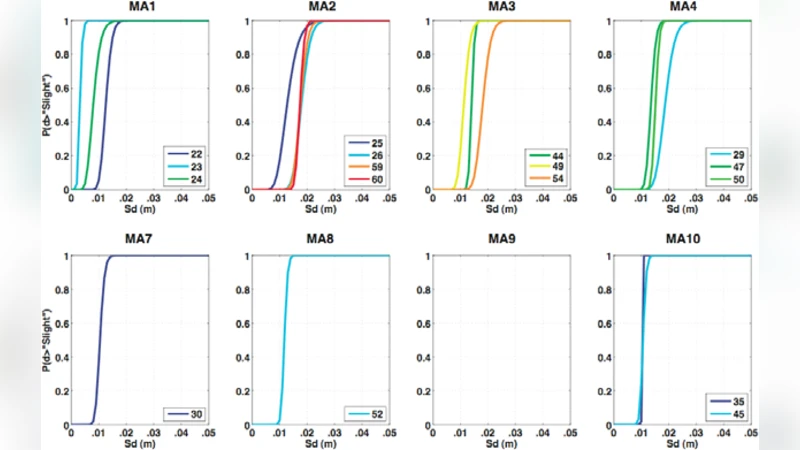
Two different way of assessing seismic vulnerability are available nowadays: observed or empirical and calculated vulnerability assessment methods. The first methods are based on observed damage after earthquakes correlated with the structural properties of buildings, whereas the second methods are based on numerical models more or less representing the buildings. In both cases, the trouble is the imperfect knowledge of existing buildings. We propose here a new method for estimating the vulnerability based on experimental modal parameters (resonance frequencies, modal shapes and damping ratio) estimated under ambient vibrations. They allow to build up a simplified numerical model of the elastic building behaviour. The motion produced by numerous earthquakes leads to determine its first damage level and therefore its vulnerability. An inter-story drift threshold based on HAZUS values defines the first damage level of the building. This method is applied to the Grenoble (France) city in which 60 buildings have been instrumented.
💡 Research Summary
The paper addresses a fundamental problem in seismic vulnerability assessment: the lack of reliable, detailed information on existing buildings. Traditional approaches fall into two categories. Empirical methods rely on observed damage after earthquakes and correlate it with building characteristics, but they are limited by the scarcity of post‑event data and by the difficulty of transferring observations across regions with different construction practices. Calculated methods use numerical models that attempt to represent the structural behavior of buildings, yet they require accurate input data (geometry, material properties, connections) that are often unavailable for the vast majority of structures in a city. Both approaches therefore suffer from significant uncertainties.
To overcome these limitations, the authors propose a novel methodology that bases vulnerability estimation on experimental modal parameters obtained from ambient vibration measurements. Ambient vibrations—generated by wind, traffic, and human activity—are recorded with a modest array of accelerometers or velocimeters installed in each building. Using modern operational modal analysis techniques such as Stochastic Subspace Identification (SSI) or Frequency Domain Decomposition (FDD), the authors extract three key parameters: natural frequencies, mode shapes, and damping ratios. These parameters encapsulate the global stiffness, mass distribution, and energy dissipation characteristics of the structure in a compact, non‑destructive way.
The extracted modal data are then used to construct a simplified linear elastic model of each building. In practice the authors adopt a one‑dimensional shear‑building representation, where each floor is modeled as a lumped mass connected by springs and dashpots that reflect the identified stiffness and damping. Because the model is linear, it can be solved efficiently for a large number of ground‑motion inputs.
The next step is to subject the model to a suite of recorded earthquake accelerograms. The authors compile a database of several hundred to a few thousand real ground motions, covering a range of magnitudes, distances, and site conditions. For each motion they compute the time history of inter‑story drift, which is the relative displacement between consecutive floors. The maximum drift in each story is recorded, and the building’s overall drift response is summarized by the largest value across all stories.
Damage is defined using the inter‑story drift thresholds prescribed in FEMA’s HAZUS methodology. HAZUS provides drift limits for the onset of “slight” damage for different building types (e.g., 0.5 %–1.0 % drift for typical reinforced‑concrete frames). If the simulated drift exceeds the appropriate HAZUS limit, the building is considered to have entered its first damage level for that ground motion. By repeating the analysis over the entire earthquake suite, the authors obtain a probability of first‑damage occurrence for each structure.
The methodology is applied to the city of Grenoble, France, where 60 buildings of varying age, height, and structural system (reinforced concrete, steel, timber) have been instrumented. Ambient vibration tests yielded natural frequencies ranging from 1.2 Hz for low‑rise timber frames to 5.8 Hz for high‑rise concrete cores, with damping ratios typically between 2 % and 5 %. The simplified shear models reproduced these frequencies within a few percent, confirming the adequacy of the linear representation for the low‑amplitude ambient excitation.
When subjected to the earthquake suite, the simulated drift responses revealed clear patterns. Older timber buildings exhibited the highest probabilities of exceeding HAZUS drift limits (often >30 % for the considered motions), whereas modern reinforced‑concrete frames showed much lower probabilities (<5 %). Mid‑rise steel structures fell in between, reflecting their intermediate stiffness and damping characteristics. The authors compare these results with those obtained from a conventional empirical vulnerability curve based on building typology and find that the modal‑based approach provides a more differentiated ranking, especially for buildings whose actual dynamic properties deviate from generic typological assumptions.
The discussion highlights several advantages of the proposed approach. First, ambient vibration testing is inexpensive, rapid, and non‑intrusive, making it feasible to survey large numbers of buildings in a short time. Second, the modal parameters directly capture the as‑built condition, including the effects of aging, retrofits, and irregularities that are difficult to infer from design documents alone. Third, the use of a large ensemble of real ground motions introduces a probabilistic dimension that partially compensates for the linear model’s inability to represent nonlinear damage mechanisms.
Nevertheless, the authors acknowledge important limitations. Ambient vibrations primarily excite the fundamental modes at low frequencies; higher modes and nonlinear behavior (e.g., yielding, cracking, foundation uplift) are not captured, potentially underestimating vulnerability for very stiff or heavily damaged structures. Damping estimation from ambient data can be noisy, and errors in damping directly affect drift predictions. Moreover, the HAZUS drift thresholds are derived from U.S. building stock and may not be fully appropriate for European construction practices without calibration.
In conclusion, the paper demonstrates that experimental modal analysis combined with large‑scale seismic simulation offers a viable, cost‑effective pathway to city‑wide seismic vulnerability mapping, especially in contexts where detailed building inventories are lacking. The authors suggest future work to integrate nonlinear modeling (e.g., pushover or fiber models) with the experimentally derived linear baseline, to develop region‑specific drift thresholds, and to explore real‑time monitoring frameworks that could update vulnerability assessments as buildings are retrofitted or as new ambient vibration data become available.