Traffic of molecular motors: from theory to experiments
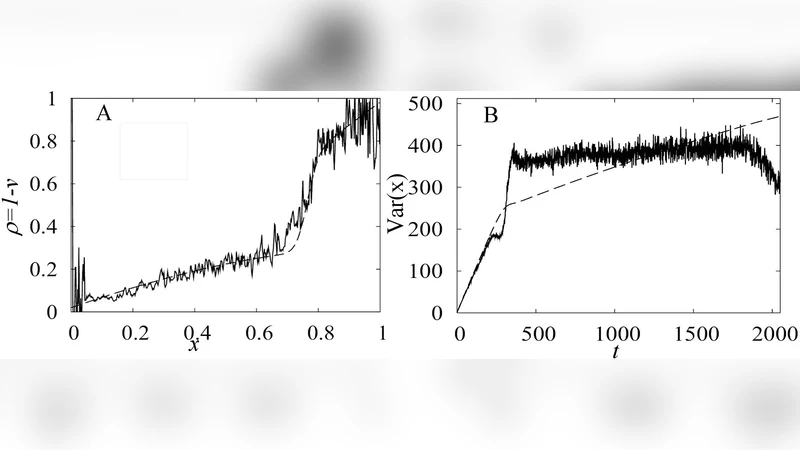
Intracellular transport along microtubules or actin filaments, powered by molecular motors such as kinesins, dyneins or myosins, has been recently modeled using one-dimensional driven lattice gases. We discuss some generalizations of these models, that include extended particles and defects. We investigate the feasibility of single molecule experiments aiming to measure the average motor density and to locate the position of traffic jams by mean of a tracer particle. Finally, we comment on preliminary single molecule experiments performed in living cells.
💡 Research Summary
The paper addresses the collective transport of molecular motors—kinesin, dynein, and myosin—along microtubules and actin filaments by employing one‑dimensional driven lattice‑gas models, specifically extensions of the asymmetric simple exclusion process (ASEP). Recognizing that real motors are not point particles and that cytoskeletal tracks contain localized irregularities, the authors introduce two major generalizations. First, they model motors as “extended particles” that occupy ℓ consecutive lattice sites, thereby strengthening exclusion effects and altering the fundamental current‑density relation to J(ρ)=p ρ (1‑ℓ ρ). This modification predicts a reduced maximal current and an expanded high‑density regime, reflecting the propensity for traffic jams when motor size is comparable to the lattice spacing. Second, they incorporate defects—sites or segments where the forward hopping rate is locally modified by a factor (1‑δ) or (1+δ). Analytical treatment shows that defects generate asymmetric density profiles: a high‑density “jam” builds up upstream of a slowing defect, while a low‑density region follows downstream. The strength and spatial extent of the defect control the jam length and the overall flux reduction.
To bridge theory and experiment, the authors propose a tracer‑particle methodology. By labeling a single motor with a fluorescent tag and tracking its trajectory with high‑speed microscopy, one can extract the local average velocity v(t) and mean‑square displacement ⟨Δx²(t)⟩. Using the theoretical relation v(x)=p
Comments & Academic Discussion
Loading comments...
Leave a Comment