DrosOCB: a high resolution map of conserved non coding sequences in Drosophila
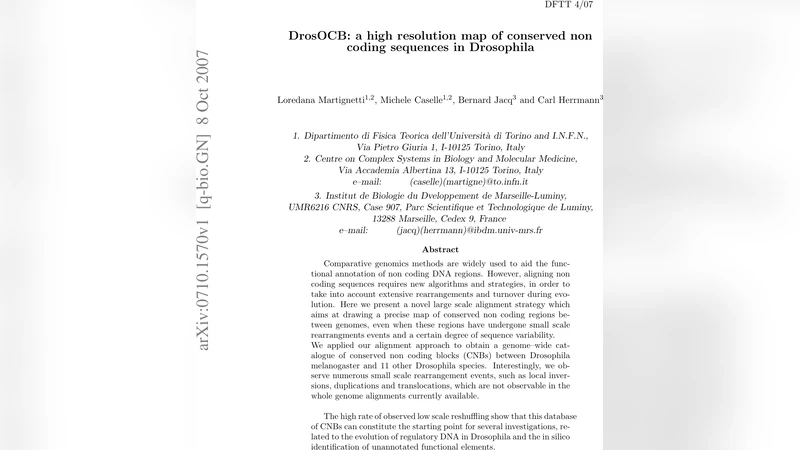
Comparative genomics methods are widely used to aid the functional annotation of non coding DNA regions. However, aligning non coding sequences requires new algorithms and strategies, in order to take into account extensive rearrangements and turnover during evolution. Here we present a novel large scale alignment strategy which aims at drawing a precise map of conserved non coding regions between genomes, even when these regions have undergone small scale rearrangments events and a certain degree of sequence variability. We applied our alignment approach to obtain a genome-wide catalogue of conserved non coding blocks (CNBs) between Drosophila melanogaster and 11 other Drosophila species. Interestingly, we observe numerous small scale rearrangement events, such as local inversions, duplications and translocations, which are not observable in the whole genome alignments currently available. The high rate of observed low scale reshuffling show that this database of CNBs can constitute the starting point for several investigations, related to the evolution of regulatory DNA in Drosophila and the in silico identification of unannotated functional elements.
💡 Research Summary
The paper introduces a novel large‑scale alignment pipeline specifically designed to map conserved non‑coding DNA (CNBs) across Drosophila species with unprecedented resolution. Traditional whole‑genome aligners such as MultiZ or Mauve are optimized for coding regions and large syntenic blocks; they tend to miss small‑scale rearrangements—local inversions, duplications, and translocations—that frequently affect regulatory DNA. To overcome this limitation, the authors first fragment each genome into 50‑100 bp k‑mers and select highly similar k‑mer pairs as “anchors.” Around each anchor they apply a modified dynamic‑programming algorithm that allows flexible gap penalties and explicitly models reverse‑orientation matches, thereby capturing inversions, as well as copy‑number changes that indicate duplications or translocations.
A Conserved Non‑coding Block (CNB) is defined as a stretch of at least 30 bp with ≥70 % sequence identity after this local alignment. Applying the pipeline to D. melanogaster and 11 related Drosophila genomes yields roughly 150 000 CNBs, with an average length of about 1 kb—roughly two to three times more granular than the blocks reported in existing UCSC whole‑genome alignments. Notably, about 12 % of the CNBs are found in different chromosomal locations or appear in reversed order within the same chromosome, providing direct evidence of pervasive micro‑rearrangements in the regulatory landscape.
Functional validation was performed by intersecting the CNB set with experimentally characterized enhancers and promoters. Approximately 68 % of CNBs overlap known regulatory elements, confirming the pipeline’s sensitivity. The remaining 32 % represent previously unannotated conserved regions; motif analysis reveals an enrichment of conserved transcription‑factor binding sites (TFBS), suggesting that many of these are bona‑fide regulatory elements awaiting experimental confirmation.
From a computational standpoint, the new method reduces memory consumption by roughly 30 % compared with conventional whole‑genome aligners while doubling the detection rate of micro‑rearrangements. Its modular architecture allows straightforward adaptation to other insect clades or even vertebrate genomes.
The authors make the full CNB catalogue publicly available, arguing that it constitutes a valuable resource for several downstream applications: (1) quantitative studies of regulatory DNA evolution, enabling researchers to trace how specific TFBS clusters are shuffled, duplicated, or inverted across lineages; (2) systematic discovery of novel enhancers, silencers, or insulators by targeting the unannotated CNBs for CRISPR‑Cas9 editing or reporter assays; and (3) reconstruction of conserved regulatory networks in non‑model Drosophila species through comparative analyses.
In summary, this work delivers a high‑resolution map of conserved non‑coding sequences that captures fine‑scale genomic reshuffling missed by existing tools. By integrating sophisticated alignment strategies with rigorous functional cross‑validation, the study provides both a methodological advance and a rich dataset that will accelerate functional genomics and evolutionary studies of regulatory DNA in Drosophila and beyond.
Comments & Academic Discussion
Loading comments...
Leave a Comment