The forgetful map in rational K-theory
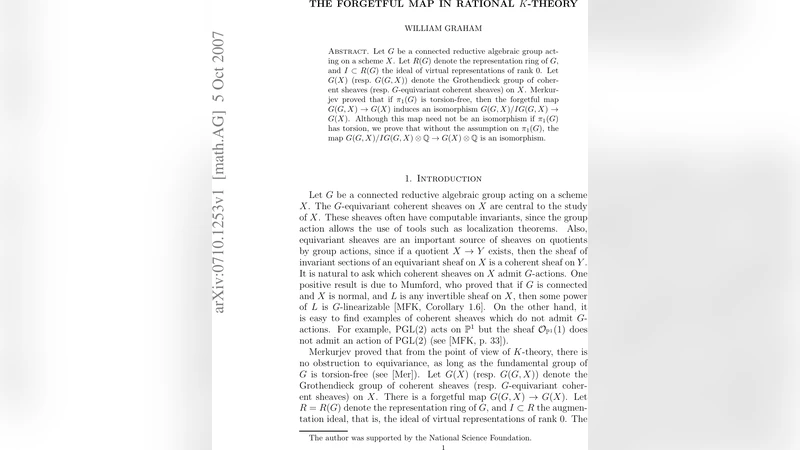
Let G be a connected reductive algebraic group acting on a scheme X. Let R(G) denote the representation ring of G, and let I be the ideal in R(G) of virtual representations of rank 0. Let G(X) (resp. G(G,X)) denote the Grothendieck group of coherent sheaves (resp. G-equivariant coherent sheaves) on X. Merkurjev proved that if the fundamental group of G is torsion-free, then the map of G(G,X)/IG(G,X) to G(X) is an isomorphism. Although this map need not be an isomorphism if the fundamental group of G has torsion, we prove that without the assumption on the fundamental group of G, this map is an isomorphism after tensoring with the rational numbers.
💡 Research Summary
The paper investigates the relationship between equivariant and ordinary Grothendieck groups of coherent sheaves when a connected reductive algebraic group (G) acts on a scheme (X). Let (G(G,X)) denote the equivariant Grothendieck group, (G(X)) the ordinary one, and let (R(G)) be the representation ring of (G). The ideal (I\subset R(G)) generated by virtual representations of rank 0 measures the “purely equivariant” part of (R(G)). The natural forgetful homomorphism
\
Comments & Academic Discussion
Loading comments...
Leave a Comment