Iterated distributive laws
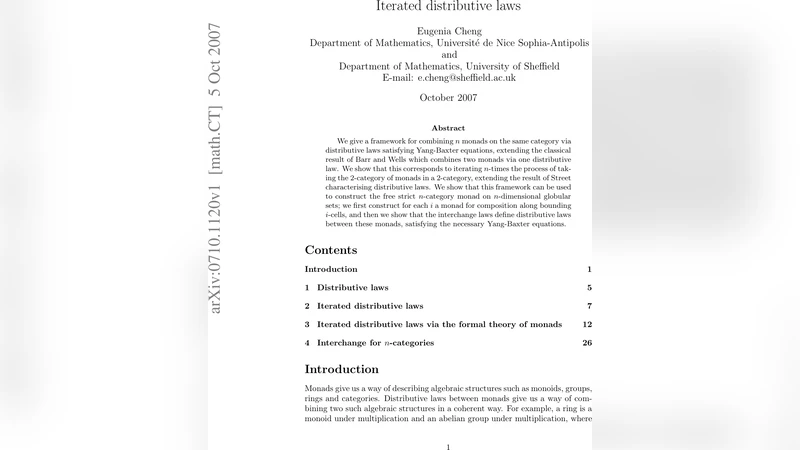
We give a framework for combining $n$ monads on the same category via distributive laws satisfying Yang-Baxter equations, extending the classical result of Barr and Wells which combines two monads via one distributive law. We show that this corresponds to iterating $n$-times the process of taking the 2-category of monads in a 2-category, extending the result of Street characterising distributive laws. We show that this framework can be used to construct the free strict $n$-category monad on $n$-dimensional globular sets; we first construct for each $i$ a monad for composition along bounding $i$-cells, and then we show that the interchange laws define distributive laws between these monads, satisfying the necessary Yang-Baxter equations.
💡 Research Summary
The paper develops a systematic framework for combining an arbitrary finite collection of monads on a single category, extending the classical result of Barr and Wells that deals with two monads linked by a single distributive law. The authors introduce, for each ordered pair (i, j) with i < j, a distributive law λᵢⱼ : Tᵢ ∘ Tⱼ ⇒ Tⱼ ∘ Tᵢ. However, unlike the two‑monad case, the collection {λᵢⱼ} must satisfy a family of coherence conditions known as Yang‑Baxter (or braid) equations. For any triple i < j < k the equation
λᵢⱼ · Tᵢλⱼₖ · λᵢₖTⱼ = Tⱼλᵢₖ · λᵢⱼTₖ · Tᵢλⱼₖ
must hold. These equations guarantee that any permutation of the monads yields the same composite monad, which the authors denote by T₁ ∘ … ∘ Tₙ. The first part of the paper proves that, under these conditions, the iterated composite indeed carries a monad structure whose unit and multiplication are obtained by repeatedly using the individual units, multiplications, and the λ’s.
The second major contribution is a 2‑categorical reinterpretation. In any 2‑category 𝒦, Street showed that the 2‑category Mnd(𝒦) of monads, monad morphisms, and monad transformations encodes distributive laws as 2‑cells. The authors iterate this construction: starting from 𝒦 they form Mnd(𝒦), then Mnd(Mnd(𝒦)), and so on, n times. At each level a new monad appears, together with a canonical distributive law to the monad constructed at the previous level. The iterated process reproduces exactly the data (λᵢⱼ) and the Yang‑Baxter equations, thereby giving a clean 2‑categorical explanation of why the coherence conditions are necessary and sufficient.
The abstract framework is then applied to a concrete and highly non‑trivial example: the free strict n‑category monad on the category of n‑dimensional globular sets (GSetₙ). For each dimension i (0 ≤ i < n) the authors define a monad Cᵢ that freely adds composition along bounding i‑cells. These monads capture horizontal, vertical, and higher‑dimensional compositions separately. The classical interchange laws between different dimensions (e.g., the “square” law that says composing first horizontally then vertically equals composing first vertically then horizontally) are shown to be precisely the distributive laws λᵢⱼ between Cᵢ and Cⱼ. Moreover, the interchange laws satisfy the Yang‑Baxter equations automatically, because the interchange of three different dimensions is independent of the order in which the pairwise interchanges are performed. Consequently, the composite monad C₀ ∘ C₁ ∘ … ∘ Cₙ₋₁ is exactly the free strict n‑category monad.
Beyond this central example, the authors discuss how the same method could be used to assemble monads governing other higher‑dimensional algebraic structures, such as multi‑operads, higher‑dimensional monoids, or effect systems in programming language semantics. They suggest that the Yang‑Baxter coherence may be viewed as a higher‑dimensional analogue of the usual coherence conditions for monoidal categories, opening a path toward a systematic theory of “higher distributive laws”.
In summary, the paper achieves three things: (1) it generalises the Barr‑Wells construction to any finite family of monads by introducing a network of distributive laws satisfying Yang‑Baxter equations; (2) it provides a clean 2‑categorical perspective by iterating the monad‑in‑a‑2‑category construction; and (3) it demonstrates the power of the theory by constructing the free strict n‑category monad from elementary composition monads, thereby unifying the interchange laws under the umbrella of higher distributive laws. This work both deepens the theoretical understanding of how monads interact in higher dimensions and supplies a practical toolkit for building complex algebraic structures in category theory and its applications.
Comments & Academic Discussion
Loading comments...
Leave a Comment