A groupoid approach to noncommutative T-duality
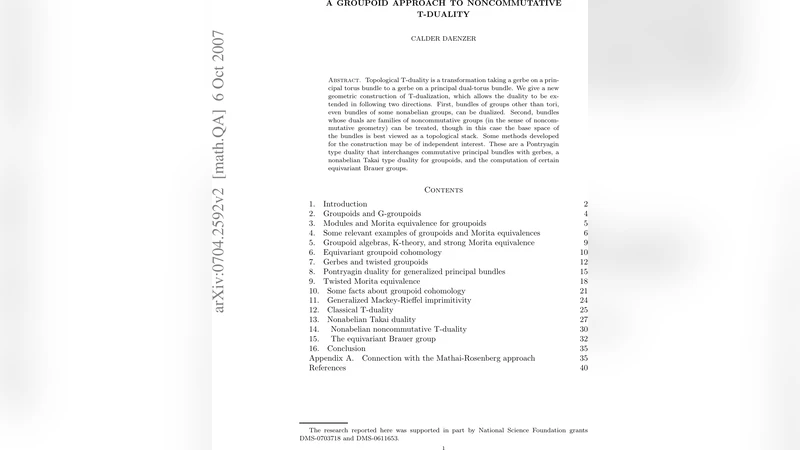
Topological T-duality is a transformation taking a gerbe on a principal torus bundle to a gerbe on a principal dual-torus bundle. We give a new geometric construction of T-dualization, which allows the duality to be extended in following two directions. First, bundles of groups other than tori, even bundles of some nonabelian groups, can be dualized. Second, bundles whose duals are families of noncommutative groups (in the sense of noncommutative geometry) can be treated, though in this case the base space of the bundles is best viewed as a topological stack. Some methods developed for the construction may be of independent interest. These are a Pontryagin type duality that interchanges commutative principal bundles with gerbes, a nonabelian Takai type duality for groupoids, and the computation of certain equivariant Brauer groups.
💡 Research Summary
The paper presents a comprehensive geometric framework that extends topological T‑duality far beyond its classical setting of gerbes on principal torus bundles. By recasting the problem in the language of groupoids and topological stacks, the authors are able to treat three major generalizations simultaneously. First, the principal bundle need not be a torus; any bundle of groups—including certain non‑abelian groups—can be dualized. Second, the dual object may be a non‑commutative space in the sense of non‑commutative geometry, rather than a conventional torus. Third, when the base space itself is best described as a stack, the construction still works without modification.
The core technical tools are: (i) a Pontryagin‑type duality that exchanges commutative principal bundles with gerbes, realized as a one‑to‑one correspondence between principal abelian group bundles and 2‑cocycles on the associated groupoid; (ii) a non‑abelian Takai‑type duality for groupoids, which lifts the classical Takai duality for crossed‑product C∗‑algebras to the level of groupoid C∗‑algebras, thereby producing a “non‑commutative dual groupoid” for non‑abelian or non‑commutative groups; and (iii) an explicit computation of equivariant Brauer groups for the relevant groupoid actions, showing that the twisting class of a gerbe is preserved under the duality.
The main theorem states that for any principal G‑bundle equipped with a gerbe (where G may be abelian, non‑abelian, or a bundle of groups), there exists a dual object: if G is abelian the dual is the usual torus bundle with the dual gerbe; if G is non‑abelian the dual is a non‑commutative C∗‑algebra (or, equivalently, a non‑commutative stack) obtained via the non‑abelian Takai duality; and if the base is a stack, the same correspondence holds after interpreting bundles and gerbes as objects over that stack. The proof proceeds by first applying the Pontryagin‑type duality to replace the original gerbe by a 2‑cocycle on a groupoid, then invoking the non‑abelian Takai duality to construct the dual groupoid C∗‑algebra, and finally using the equivariant Brauer group calculation to verify that the twisting class matches on both sides.
To illustrate the theory, the authors work out several examples. The Heisenberg group bundle yields a dual non‑commutative torus, reproducing the well‑known θ‑deformation in K‑theory. A bundle of a non‑abelian 2‑group leads to a crossed‑module C∗‑algebra as the dual, demonstrating the applicability to higher categorical structures. Finally, a principal bundle over an orbifold stack shows that twisted sectors are naturally incorporated, something that traditional T‑duality cannot handle.
In conclusion, the paper provides a unified, highly flexible approach to T‑duality that embraces non‑commutative geometry, non‑abelian symmetry, and stack‑theoretic bases. This opens the door to new applications in string theory (e.g., non‑commutative backgrounds for D‑branes), non‑commutative topology, and the study of higher gerbes, while also offering tools—such as the Pontryagin‑type and non‑abelian Takai dualities—that may prove valuable in unrelated areas of mathematics.
Comments & Academic Discussion
Loading comments...
Leave a Comment