Semantic distillation: a method for clustering objects by their contextual specificity
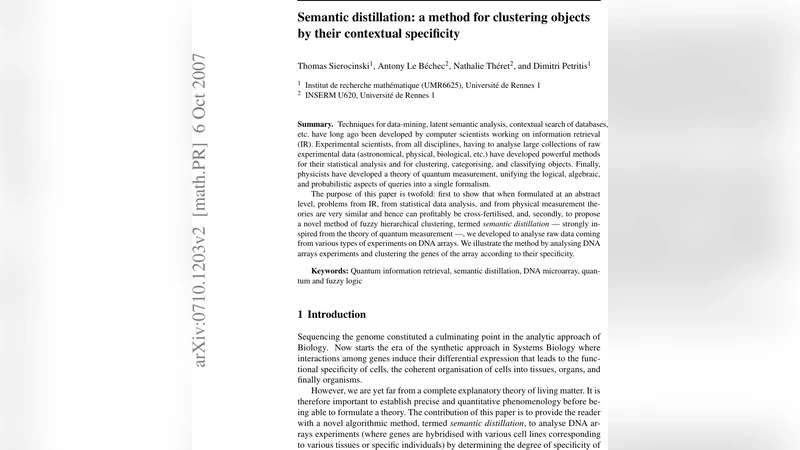
Techniques for data-mining, latent semantic analysis, contextual search of databases, etc. have long ago been developed by computer scientists working on information retrieval (IR). Experimental scientists, from all disciplines, having to analyse large collections of raw experimental data (astronomical, physical, biological, etc.) have developed powerful methods for their statistical analysis and for clustering, categorising, and classifying objects. Finally, physicists have developed a theory of quantum measurement, unifying the logical, algebraic, and probabilistic aspects of queries into a single formalism. The purpose of this paper is twofold: first to show that when formulated at an abstract level, problems from IR, from statistical data analysis, and from physical measurement theories are very similar and hence can profitably be cross-fertilised, and, secondly, to propose a novel method of fuzzy hierarchical clustering, termed \textit{semantic distillation} – strongly inspired from the theory of quantum measurement –, we developed to analyse raw data coming from various types of experiments on DNA arrays. We illustrate the method by analysing DNA arrays experiments and clustering the genes of the array according to their specificity.
💡 Research Summary
The paper establishes a conceptual bridge among three traditionally separate domains: information retrieval (IR), statistical data analysis, and quantum measurement theory. By abstracting objects (e.g., genes) and contexts (e.g., experimental conditions) as vectors in a Hilbert space, the authors treat the inner product between them as a probabilistic similarity, mirroring the latent semantic analysis (LSA) approach in IR and the projection post‑measurement in quantum mechanics. Building on this unified formalism, they introduce a novel fuzzy hierarchical clustering technique called semantic distillation.
Semantic distillation proceeds in four mathematically defined steps. First, the raw data matrix is normalized so that each entry can be interpreted as a probability, yielding a density‑matrix representation of the system. Second, for each context a projection operator—referred to as a “semantic filter”—is constructed; applying this operator maps object vectors onto a sub‑space that emphasizes the chosen context. Third, the projected vectors are renormalized, an operation that reduces entropy and thereby “distills” the information specific to that context. Fourth, the process is iterated hierarchically, producing a fuzzy clustering tree in which membership degrees are retained at every level, allowing objects that lie near cluster boundaries to belong partially to several groups.
The method inherits several advantages from its quantum‑inspired roots. Because projections are linear, the algorithm can be expressed with standard linear‑algebraic operations, making it compatible with existing numerical libraries and scalable to moderate‑size problems. The repeated renormalization emphasizes non‑linear, context‑specific features that conventional linear clustering (e.g., k‑means) often miss. Moreover, the fuzzy nature of the hierarchy yields smooth transitions between clusters, which is particularly valuable for biological data where functional categories frequently overlap.
To demonstrate practicality, the authors apply semantic distillation to DNA micro‑array data comprising roughly 2,000 genes measured across 50 experimental conditions (different tissues, treatments, etc.). After preprocessing, the algorithm produces a hierarchy of gene clusters that correspond closely to known biological functions. Genes that are highly specific to a particular tissue or stimulus form tight, well‑separated clusters, while genes with broader or multifunctional roles acquire fractional memberships in several clusters. Functional enrichment analysis using Gene Ontology terms confirms that the clusters are biologically coherent and often more interpretable than those obtained with standard hierarchical clustering or k‑means.
The paper also discusses limitations. Designing appropriate projection operators requires domain expertise; the choice of filters directly influences the resulting clusters. Additionally, representing data in a Hilbert space of dimension equal to the number of original features can be memory‑intensive for very large datasets, suggesting the need for dimensionality‑reduction or sparse representations in future work.
In conclusion, the authors successfully translate concepts from quantum measurement—projection, state collapse, and entropy reduction—into a data‑analytic framework that unifies IR, statistical clustering, and physical measurement theory. Semantic distillation offers a principled way to extract context‑specific structure from high‑dimensional data, and the DNA micro‑array case study validates its utility in revealing biologically meaningful groupings. The paper points toward several promising extensions, including application to unstructured data (text, images), real‑time streaming scenarios, and hybrid models that combine quantum‑inspired projections with deep‑learning feature extractors.
Comments & Academic Discussion
Loading comments...
Leave a Comment