One Dimensional Locally Connected S-spaces
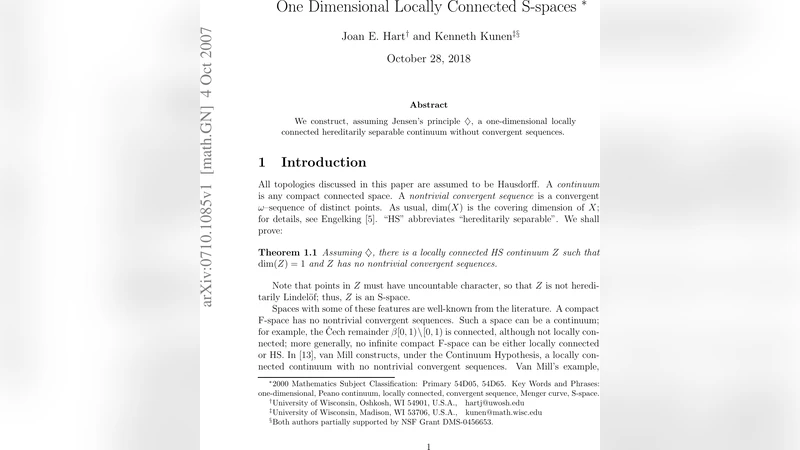
We construct, assuming Jensen’s principle diamond, a one-dimensional locally connected hereditarily separable continuum without convergent sequences. The construction is an inverse limit in omega_1 steps, and is patterned after the original Fedorchuk construction of a compact S-space. To make it one-dimensional, each space in the inverse limit is a copy of the Menger sponge.
💡 Research Summary
The paper presents a construction of a one‑dimensional, locally connected, hereditarily separable continuum that contains no non‑trivial convergent sequences – in other words, a one‑dimensional S‑space. The construction is carried out under Jensen’s diamond principle (♦) and proceeds as an ω₁‑length inverse limit, closely following the classical Fedorčuk method for producing compact S‑spaces, but with a crucial modification: each stage of the inverse system is taken to be a copy of the Menger sponge, a well‑known one‑dimensional universal curve.
Background and Motivation
S‑spaces are topological spaces that are hereditarily separable (every subspace is separable) yet fail to be sequentially compact (they possess no non‑trivial convergent sequences). Their existence cannot be proved in ZFC alone; additional set‑theoretic assumptions are required. Jensen’s diamond principle provides a strong prediction tool on ω₁, allowing one to anticipate subsets of ω₁ at earlier stages of a construction. The classic Fedorčuk example uses a tower of compact spaces of higher dimension, typically involving complicated bonding maps that preserve separability while destroying sequential compactness. The present work asks whether a similar phenomenon can be achieved while keeping the topological dimension at the minimal possible value, namely one.
Key Ingredients
-
Diamond (♦) – For each countable ordinal α<ω₁ a set Aα⊂α is fixed so that for any X⊂ω₁ the set {α | X∩α = Aα} is stationary. This gives a “guess” of any future countable set at stage α.
-
Menger Sponge (M) – The Menger sponge is a compact, one‑dimensional, locally connected, universal curve. It is homogeneous, every non‑empty open set contains a copy of the whole space, and it has the property that any two points can be separated by a continuum of arcs. Its topological dimension is exactly 1, making it an ideal building block for a dimension‑controlled inverse limit.
-
Inverse System – The construction defines a sequence ⟨Xα, fαβ⟩α<β≤ω₁ where each Xα is homeomorphic to M. At successor stages a closed subcontinuum Cα⊂Xα is chosen so that it meets a “predicted” countable dense set Dα (obtained from the diamond guess Aα). The bonding map fα,α+1 collapses Cα to a single point while acting as the identity on the complement. Because Cα is connected, this operation does not destroy local connectedness. Moreover, Cα is countable, so the separability of Xα+1 is preserved.
-
Limit Stage – At limit ordinals λ the space Xλ is defined as the inverse limit of the preceding stages. Standard properties of inverse limits of compact metrizable spaces guarantee that Xλ remains compact, connected, and locally connected. Since each bonding map is monotone (pre‑images of points are connected), the covering dimension does not increase; thus dim Xλ ≤ 1. In fact, because each Xα already has dimension 1, the limit also has dimension exactly 1.
Main Theorems
-
Hereditary Separability: For every α the space Xα contains a countable dense set (essentially the image of the diamond‑predicted Dα). The bonding maps are onto, so the inverse limit X = lim← Xα inherits a countable dense set at every level, making X hereditarily separable.
-
Absence of Convergent Sequences: Suppose {x_n} is a sequence in X. By the diamond principle there exists an α such that the set of indices of the sequence is captured by the guess Aα, and consequently the points of the sequence lie inside the countable set Dα ⊂ Xα. The construction of Cα guarantees that any infinite subset of Dα is “killed” at the next stage: the collapse of Cα to a point prevents the sequence from having a limit in Xα+1, and this obstruction propagates to the limit. Hence X contains no non‑trivial convergent sequences.
-
Local Connectedness: Each Xα is locally connected because it is homeomorphic to the Menger sponge. Collapsing a connected closed set Cα to a point does not introduce local cut‑points; neighborhoods of the new point are images of neighborhoods of Cα, which remain connected. Monotone bonding maps preserve local connectedness in inverse limits, so X is locally connected.
-
One‑Dimensionality: Since every stage has covering dimension 1 and the bonding maps are monotone, the covering dimension of the inverse limit cannot exceed the supremum of the dimensions of the stages. Therefore dim X = 1.
Comparison with Classical Constructions
Fedorčuk’s original S‑space used a tower of compact spaces of higher dimension (often 2‑dimensional manifolds or more elaborate ANR’s) and relied on delicate combinatorial control of the bonding maps. The present construction replaces those higher‑dimensional stages with copies of the Menger sponge, achieving the same set‑theoretic goals while keeping the geometric dimension at its minimal value. This demonstrates that the “S‑space pathology” is not inherently tied to high dimensionality; rather, it can be realized even within the class of one‑dimensional continua.
Implications and Future Directions
-
Dimension‑Sensitive S‑Spaces – The result opens the possibility of exploring S‑spaces in other low‑dimensional settings, such as one‑dimensional Peano continua other than the Menger sponge, or even one‑dimensional non‑metrizable curves.
-
Weaker Set‑Theoretic Assumptions – While the construction crucially uses ♦, it raises the question whether similar one‑dimensional S‑spaces can be obtained under weaker hypotheses (e.g., CH, MA, or even in models where ♦ fails).
-
Alternative Fractals – Replacing the Menger sponge with the Sierpiński carpet or other universal curves could yield variants with different local homogeneity properties, potentially affecting the nature of the “no‑sequence” phenomenon.
-
Applications to Dynamical Systems – One‑dimensional locally connected continua without convergent sequences provide exotic phase spaces for dynamical systems where standard limit‑set arguments break down, suggesting new examples of pathological dynamics.
Conclusion
By marrying Jensen’s diamond principle with the topological robustness of the Menger sponge, the authors construct a compact, connected, locally connected continuum of covering dimension one that is hereditarily separable yet lacks any non‑trivial convergent sequences. This work not only furnishes the first known example of a one‑dimensional S‑space but also illustrates how set‑theoretic combinatorics can be harnessed to control both the combinatorial and geometric aspects of a topological construction. The paper thus contributes a significant new perspective to the study of S‑spaces, dimension theory, and the interplay between set theory and continuum topology.
Comments & Academic Discussion
Loading comments...
Leave a Comment