Monte Carlo Methods and Path-Generation techniques for Pricing Multi-asset Path-dependent Options
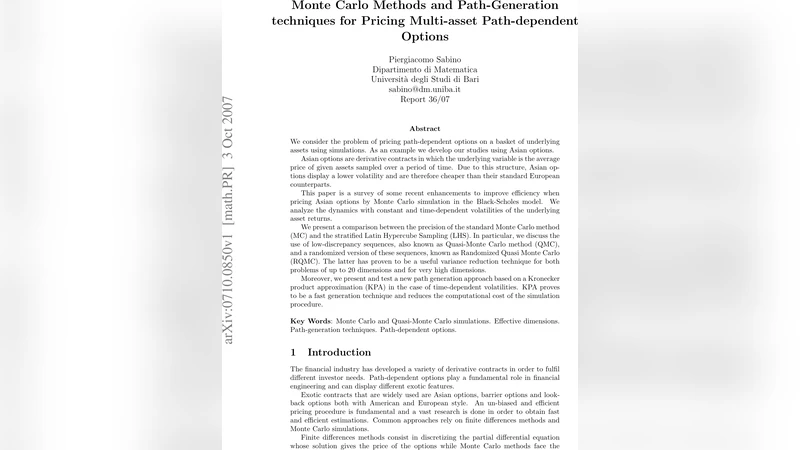
We consider the problem of pricing path-dependent options on a basket of underlying assets using simulations. As an example we develop our studies using Asian options. Asian options are derivative contracts in which the underlying variable is the average price of given assets sampled over a period of time. Due to this structure, Asian options display a lower volatility and are therefore cheaper than their standard European counterparts. This paper is a survey of some recent enhancements to improve efficiency when pricing Asian options by Monte Carlo simulation in the Black-Scholes model. We analyze the dynamics with constant and time-dependent volatilities of the underlying asset returns. We present a comparison between the precision of the standard Monte Carlo method (MC) and the stratified Latin Hypercube Sampling (LHS). In particular, we discuss the use of low-discrepancy sequences, also known as Quasi-Monte Carlo method (QMC), and a randomized version of these sequences, known as Randomized Quasi Monte Carlo (RQMC). The latter has proven to be a useful variance reduction technique for both problems of up to 20 dimensions and for very high dimensions. Moreover, we present and test a new path generation approach based on a Kronecker product approximation (KPA) in the case of time-dependent volatilities. KPA proves to be a fast generation technique and reduces the computational cost of the simulation procedure.
💡 Research Summary
The paper investigates efficient Monte Carlo (MC) techniques for pricing multi‑asset, path‑dependent derivatives, focusing on Asian options whose payoff depends on the time‑averaged price of a basket of underlying assets. Operating within the Black‑Scholes framework, the authors consider two volatility specifications: (i) constant volatilities and (ii) deterministic time‑dependent volatilities σ(t). The latter introduces a non‑stationary covariance structure that complicates path generation and variance reduction, especially in high dimensions.
Four sampling strategies are evaluated. Standard MC uses independent pseudo‑random numbers and converges at the classic O(N⁻¹/²) rate. Latin Hypercube Sampling (LHS) stratifies each dimension into equally spaced intervals, typically reducing variance by 30‑40 % relative to plain MC. Quasi‑Monte Carlo (QMC) employs low‑discrepancy sequences (Sobol, Halton) to achieve near‑deterministic convergence rates close to O(N⁻¹), but its performance deteriorates sharply once the effective dimension exceeds about 20 due to the curse of dimensionality. Randomized Quasi‑Monte Carlo (RQMC) mitigates this issue by applying a random digital shift or Owen scrambling to the low‑discrepancy points, preserving the low‑discrepancy structure while eliminating bias. Empirical results show that RQMC consistently outperforms both MC and LHS for dimensions up to 20, and remains superior to LHS even in very high‑dimensional settings (up to 100 dimensions).
Path generation is another critical component. The conventional approach uses Cholesky decomposition of the full covariance matrix, which scales as O(N³) with the number of time steps N, making it computationally expensive for fine time discretizations or large asset baskets. The authors introduce a Kronecker Product Approximation (KPA) that separates the time and asset covariance components into two smaller matrices and reconstructs the full covariance as their Kronecker product. This reduces both memory footprint and computational complexity to O(N·M) where M is the number of assets, yielding speed‑ups of roughly 2–3× compared with Cholesky while preserving numerical accuracy.
A comprehensive simulation study is conducted on baskets of 5–10 assets with 50–250 observation dates. For constant volatility, RQMC combined with LHS delivers the lowest standard error, while QMC is competitive only when the effective dimension stays below 20. For time‑dependent volatility, the KPA‑based path generator dramatically cuts runtime (by more than 70 % relative to Cholesky) without sacrificing precision, and when paired with RQMC it achieves the best overall efficiency. In ultra‑high‑dimensional experiments (≥100 dimensions), RQMC still provides a variance reduction factor of about two compared with LHS.
The paper concludes that the choice of variance‑reduction and path‑generation techniques should be guided by the volatility model and dimensionality. For low‑dimensional, constant‑volatility problems, RQMC (or LHS) suffices. For high‑dimensional, time‑varying volatility scenarios, the combination of KPA for fast path generation and RQMC for robust variance reduction offers the most practical solution. The authors also suggest extensions to stochastic volatility models, multi‑asset exotic options, and GPU‑accelerated implementations, indicating a broad applicability of the proposed methods in modern quantitative finance.
Comments & Academic Discussion
Loading comments...
Leave a Comment