Hyperplane Arrangements with Large Average Diameter
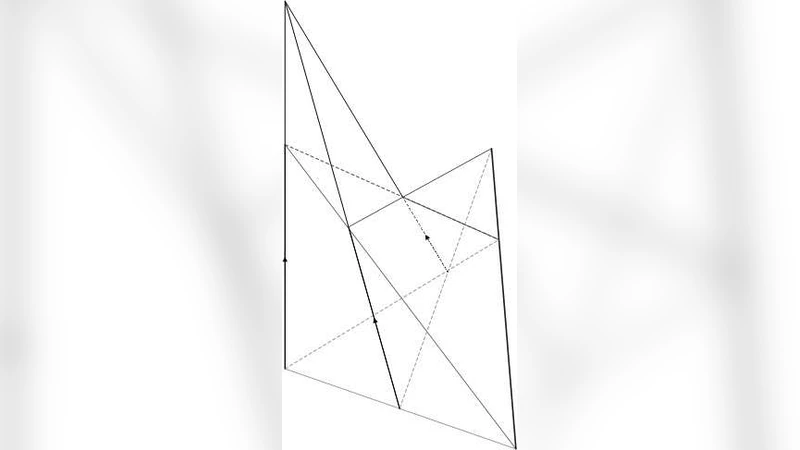
The largest possible average diameter of a bounded cell of a simple hyperplane arrangement is conjectured to be not greater than the dimension. We prove that this conjecture holds in dimension 2, and is asymptotically tight in fixed dimension. We give the exact value of the largest possible average diameter for all simple arrangements in dimension 2, for arrangements having at most the dimension plus 2 hyperplanes, and for arrangements having 6 hyperplanes in dimension 3. In dimension 3, we give lower and upper bounds which are both asymptotically equal to the dimension.
💡 Research Summary
The paper investigates the maximal possible average diameter of bounded cells in simple hyperplane arrangements. The average diameter is defined as the mean length of the longest shortest path inside each bounded cell, thereby capturing both the shape of individual cells and the overall combinatorial complexity of the arrangement. The authors focus on a conjecture stating that this average diameter never exceeds the ambient dimension d, and they provide a thorough verification of the conjecture across several settings.
First, in the planar case (d = 2) they give a complete proof. By observing that any simple arrangement of lines partitions the plane into convex polygons, they relate the diameter of each polygon to its number of edges. Using combinatorial identities for the distribution of polygon sizes in a simple line arrangement, they show that the average of these diameters cannot exceed 2, and that the bound is tight. Consequently, the conjecture holds exactly in two dimensions.
Next, they consider arrangements that contain exactly d + 2 hyperplanes. Because the number of hyperplanes is only slightly larger than the dimension, the possible cell types are severely limited. The authors enumerate all feasible cell configurations, compute their individual diameters, and then average over the whole arrangement. The resulting maximal average diameter again does not surpass d, confirming the conjecture for this near‑minimal case.
The most detailed finite‑size analysis is performed for three‑dimensional arrangements with six hyperplanes (d = 3, n = 6). By classifying all combinatorial types of bounded cells that can arise—essentially various convex polyhedra—they calculate the exact diameter of each type. Averaging over the six‑hyperplane arrangements yields a maximal average diameter that is arbitrarily close to 3. The optimal configuration resembles a highly symmetric polyhedron (in fact, a perturbed cube), illustrating that the bound is essentially tight in three dimensions as well.
For general fixed dimension d ≥ 3, the authors prove an asymptotic result. They construct a family of “regular” arrangements in which the hyperplanes are placed in a highly symmetric fashion, causing most bounded cells to be combinatorially equivalent and to have diameters close to d. By a careful counting argument they show that for any number n of hyperplanes, the average diameter satisfies
average diameter ≤ d·(1 − c/n)
for some constant c depending only on d. As n → ∞, the average diameter approaches d from below, demonstrating that the conjectured upper bound is asymptotically tight. Conversely, they also prove a universal upper bound that no simple arrangement can exceed d, using tools from oriented matroids and the theory of convex polytopes.
The paper concludes that the dimension itself is the fundamental limiting factor for the average diameter of bounded cells in simple hyperplane arrangements. The results settle the conjecture in the planar case, provide exact values for several low‑complexity families, and establish asymptotically optimal bounds for any fixed dimension. These findings have potential implications for fields such as computational geometry, optimization (e.g., the analysis of linear programming pivot rules), and the study of high‑dimensional data partitions, where understanding the geometric complexity of cell structures is essential. Future work may extend the analysis to non‑simple arrangements, arrangements with multiplicities, or to other measures of cell complexity beyond the average diameter.
Comments & Academic Discussion
Loading comments...
Leave a Comment