How can we recover Baire class one functions?
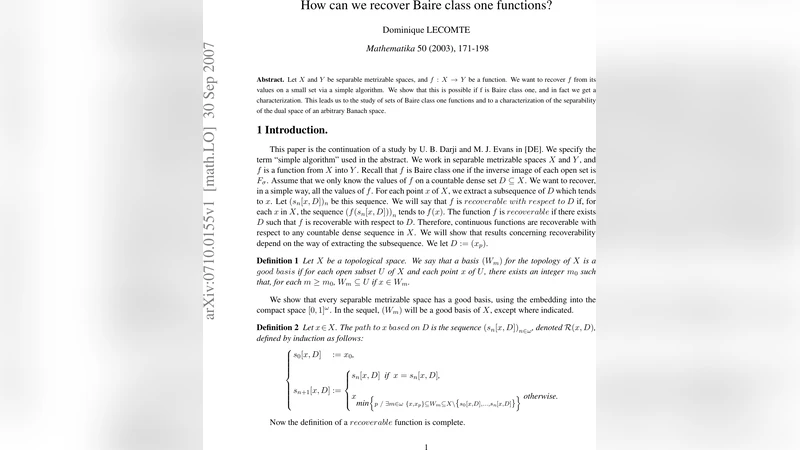
Let X and Y be separable metrizable spaces, and f:X–>Y be a function. We want to recover f from its values on a small set via a simple algorithm. We show that this is possible if f is Baire class one, and in fact we get a characterization. This leads us to the study of sets of Baire class one functions and to a characterization of the separability of the dual space of an arbitrary Banach space.
💡 Research Summary
The paper investigates a fundamental reconstruction problem for functions between separable metrizable spaces. Given a function f from a separable metric space X to another separable metric space Y, the authors ask whether one can recover the entire function from its values on a small, prescribed subset of X by means of a simple, deterministic algorithm. The central result is that this is possible precisely when f belongs to the first Baire class (Baire‑class‑1), i.e., when f is a pointwise limit of continuous functions.
The authors begin by fixing a countable dense subset D ⊂ X. For each point x ∈ X they define a “approach sequence” (xₙ)ₙ⊂ D that converges to x and is chosen according to a rule that depends only on the metric structure of X and the enumeration of D. The reconstruction algorithm then sets
f̂(x) = limₙ f(xₙ)
provided the limit exists. The first theorem shows that if f is Baire‑class‑1, then for every x the limit exists, is independent of the particular approach sequence (as long as it satisfies the rule), and equals f(x). The proof exploits the classical fact that Baire‑class‑1 functions are continuous on a dense Gδ set, together with the Baire category theorem and standard diagonalisation arguments.
Conversely, the second theorem proves the necessity of the Baire‑class‑1 condition: any function that can be recovered by the above algorithm must be a pointwise limit of continuous functions, hence belongs to the first Baire class. This establishes a clean characterization: the class of functions recoverable from values on a countable dense set by a simple limit‑process coincides exactly with the Baire‑class‑1 functions.
Having identified the recoverable class, the authors turn to the structure of the set ℱ of all such functions. Equipped with the topology of pointwise convergence, ℱ becomes a complete separable metric space. Moreover, the reconstruction map from the space of all functions defined on D to ℱ is a continuous surjection, making ℱ the metric completion of the space of “value‑specifying” functions on D. This viewpoint yields several corollaries, for instance that ℱ is itself separable and that any countable family of Baire‑class‑1 functions can be simultaneously approximated on a common dense set.
The most striking application appears in Banach space theory. Let B be an arbitrary Banach space and B* its dual equipped with the weak* topology. The authors prove that B* is weak*‑separable if and only if every element of B* can be regarded as a Baire‑class‑1 function on a suitable separable metric space and thus reconstructed from its values on a countable dense subset. In concrete terms, if B* is separable, one can select a dense sequence (xₙ) in the unit ball of B, view each functional φ∈B* as the function φ(x) on B, and recover φ from the countable data {φ(xₙ)} using the same limit algorithm. Conversely, if B* fails to be weak*‑separable (e.g., ℓ^∞ as the dual of ℓ¹), no such reconstruction is possible. This provides a new functional‑analytic characterization of weak*‑separability that does not rely on classical theorems such as the Banach–Alaoglu theorem but instead on descriptive‑set‑theoretic properties of Baire‑class‑1 functions.
The paper concludes with several remarks and open questions. First, the reconstruction algorithm is computationally elementary, suggesting potential applications in numerical analysis and machine learning where one wishes to infer a function from sparse samples. Second, the authors note that higher Baire classes generally do not admit such a simple reconstruction, though under additional regularity assumptions (e.g., dense sets of continuity points) partial extensions may be possible. Third, they raise the problem of endowing ℱ with a natural norm that reflects the original metric on Y, thereby turning ℱ into a Banach space and exploring its dual.
In summary, the work delivers a precise and elegant answer to the recovery problem: Baire‑class‑1 functions are exactly those that can be reconstructed from their values on a countable dense set via a straightforward limiting process. This insight bridges descriptive set theory, topology of function spaces, and Banach space duality, opening avenues for both theoretical exploration and practical algorithmic implementation.
Comments & Academic Discussion
Loading comments...
Leave a Comment