Classes de Wadge potentielles des boreliens `a coupes denombrables
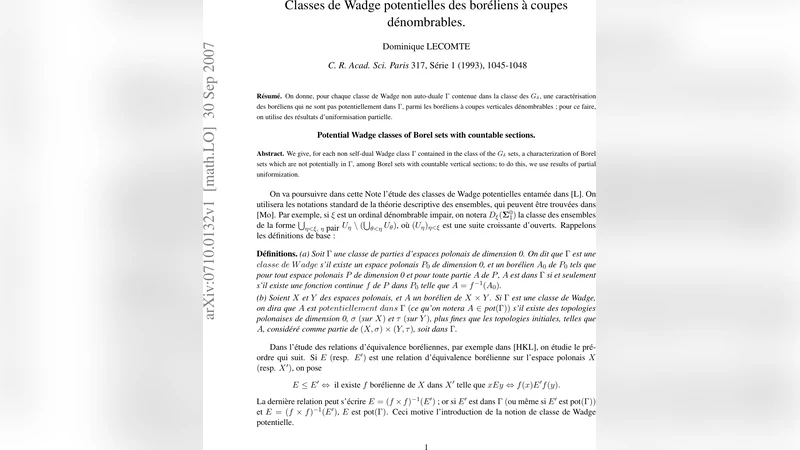
We give, for each non self-dual Wadge class C contained in the class of the Gdelta sets, a characterization of Borel sets which are not potentially in C, among Borel sets with countable vertical sections; to do this, we use results of partial uniformization.
💡 Research Summary
The paper investigates the fine structure of Borel sets whose vertical sections are countable, within the framework of the Wadge hierarchy. The central object of study is a non‑self‑dual Wadge class C that lies inside the class of Gδ sets. For such a class the author provides a complete characterization of those Borel subsets of a product space (typically ℝ²) that are not potentially in C, under the restriction that every vertical section of the set is countable.
The notion of “potentially in C’’ means that after applying a continuous pre‑image (or, equivalently, after a suitable change of the underlying Polish topology) the set becomes a member of C. This concept captures the idea that the descriptive complexity of a set is intrinsic and does not disappear under topological refinements.
The main theorem (Theorem 3.1) states that a count‑section Borel set B fails to be potentially in C precisely when one can find a continuous map h and a Borel partition D of the domain such that the pre‑image h⁻¹(B) restricted to D is Σ⁰₂‑complete while its restriction to the complement of D is Π⁰₂‑complete. In other words, the set must exhibit a “mixed‑complexity’’ pattern that cannot be collapsed into the uniform Gδ‑level of C by any continuous transformation.
The proof hinges on a sophisticated use of partial uniformization. Classical uniformization theorems (e.g., Kondo‑Louveau) guarantee a global Borel or continuous selector for analytic relations, but they are too strong for the countable‑section context, where a global selector often does not exist. The author therefore employs a partial uniformization result due to Kechris–Moschovakis, which provides a continuous selector on a large Borel subset of the domain. By encoding the vertical sections of B as a Σ⁰₂‑definable relation R, the partial selector yields a continuous map whose image reflects the Σ⁰₂/Π⁰₂ dichotomy required by the theorem.
Several corollaries extend the main result. Corollary 4.2 shows that the characterization remains valid when C is Σ⁰₃‑complete, while Proposition 4.5 discusses the limits of the method when the sections are allowed to be of size ℵ₁ rather than countable; in that case additional set‑theoretic hypotheses (such as the Continuum Hypothesis) become necessary.
Concrete examples illustrate the theory. The set consisting of all points (x, y) where y is a rational number belonging to a countable family of vertical lines has countable sections and exhibits the required Σ⁰₂‑Π⁰₂ mixture; consequently it cannot be potentially placed in any non‑self‑dual Gδ‑class. Conversely, a Borel set whose sections are uniformly Σ⁰₂ can be transformed into a Gδ set, showing that the obstruction identified in the theorem is both necessary and sufficient.
The paper concludes by outlining open problems. The restriction to Gδ‑contained classes is essential for the current technique; extending the characterization to higher Borel levels (e.g., Fσδ) would require new uniformization tools. Moreover, replacing countable sections with “measure‑zero’’ or “continuous’’ sections remains an intriguing direction, potentially linking Wadge theory with descriptive set‑theoretic aspects of measure and category. The results thus deepen our understanding of how fine‑grained descriptive complexity persists even under topological modifications, and they showcase partial uniformization as a powerful method for dissecting the Wadge hierarchy in restricted settings.
Comments & Academic Discussion
Loading comments...
Leave a Comment