Uniformisations partielles et crit`eres `a la Hurewicz dans le plan
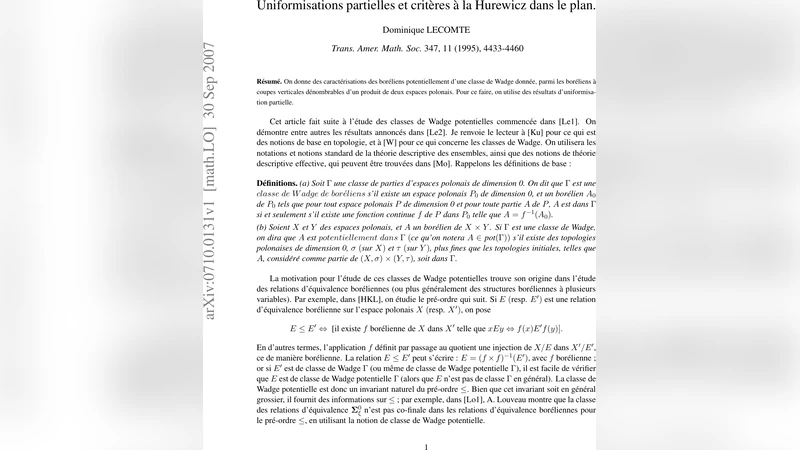
We give characterizations of the Borel sets potentially in some Wadge class, among the Borel sets with countable vertical sections of a product of two Polish spaces. To do this, we use some partial uniformization results.
💡 Research Summary
The paper investigates Borel subsets A of a product X × Y of two Polish spaces under the restriction that every vertical section Aₓ = { y ∈ Y | (x, y) ∈ A } is countable. The central problem is to characterize when such a set is “potentially” in a given Wadge class, i.e., when there exist continuous maps φ: X → X′, ψ: Y → Y′ such that (φ × ψ)⁻¹(A) belongs to a prescribed Borel class (Σ⁰_ξ or Π⁰_ξ). This notion of potential Wadge membership refines the classical Wadge hierarchy by allowing a change of topology through continuous reductions.
To address the problem the author develops a new partial uniformization theorem. Classical uniformization results (Jankov–von Neumann, Kuratowski–Ulam) guarantee a total Borel function f with graph ⊆ A only when the sections are non‑empty and “large”. In the countable‑section setting such a total function need not exist. The partial uniformization theorem shows that there is a Borel set C ⊆ X, co‑meager (or of full measure) in the projection of A, and a Borel function f: C → Y such that graph(f) ⊆ A. In other words, on a large Borel part of X the set A behaves like the graph of a Borel function, even though globally it may be far from functional.
Armed with this tool the author revisits the Hurewicz test, originally a criterion for a subset of ℝ to be G_δ (i.e., Σ⁰_2). The paper lifts the test to the planar setting: a Borel set A with countable vertical sections is potentially Σ⁰_2 (respectively Π⁰_2) if and only if two equivalent conditions hold. First, every vertical section is countable (the given hypothesis). Second, the partial uniformization described above is possible for A (respectively for its complement). Thus “countable sections + partial uniformization” becomes a precise Hurewicz‑type criterion for potential Σ⁰_2 or Π⁰_2 membership.
The author proves the necessity of both conditions by constructing counter‑examples: Borel sets with countable sections that nevertheless fail to admit any large Borel graph, showing that the uniformization part cannot be omitted. Conversely, sufficiency follows from the partial uniformization theorem together with standard arguments about Borel reducibility and the structure of the Wadge hierarchy.
The paper situates these results within the broader literature on potential Wadge classes (Louveau–Saint‑Raymond, Kechris–Louveau) and on Borel reducibility. It demonstrates that the new partial uniformization technique yields a complete and optimal characterization for the class of countable‑section Borel sets, something that was not accessible with previous global uniformization tools.
Finally, the author outlines future directions: extending the analysis to higher‑dimensional products, investigating measure‑theoretic analogues of the partial uniformization theorem, and exploring finer connections between potential Wadge classes and descriptive set‑theoretic invariants such as Borel rank and Borel reducibility. The work thus bridges a gap between classical uniformization theory, Hurewicz criteria, and modern Wadge‑theoretic classification, providing a robust framework for analyzing the descriptive complexity of planar Borel sets with countable sections.
Comments & Academic Discussion
Loading comments...
Leave a Comment