Tests `a la Hurewicz dans le plan
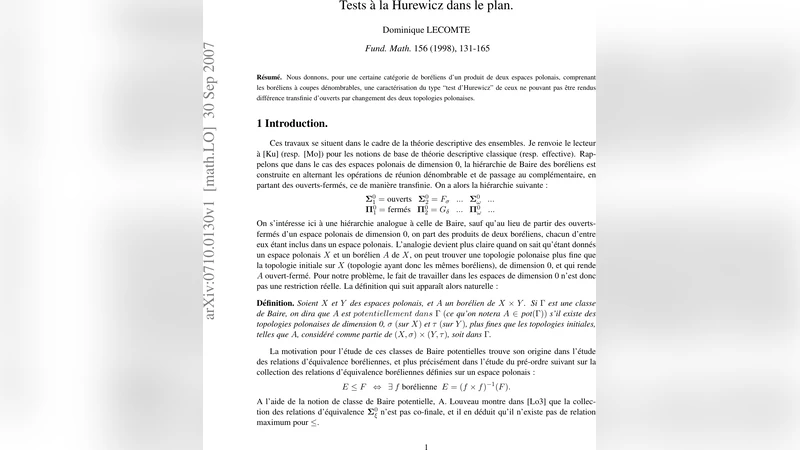
We give, for some Borel sets of a product of two Polish spaces, including the Borel sets with countable sections, a Hurewicz-like characterization of those which cannot become a transfinite difference of open sets by changing the two Polish topologies.
💡 Research Summary
The paper “Tests à la Hurewicz dans le plan” extends the classical Hurewicz test—originally a tool for detecting when a set of reals cannot be expressed as a countable union of closed sets or a countable intersection of open sets—to the setting of products of two Polish spaces. The author focuses on Borel subsets of a product space (X \times Y) that have countable vertical (or horizontal) sections, a natural class that includes many familiar examples such as graphs of countable‑valued functions, sets defined by rational differences, and many analytic sets with low section complexity.
The central problem is to determine, for a given Borel set (A \subseteq X \times Y), whether there exist alternative Polish topologies (\sigma_X) on (X) and (\sigma_Y) on (Y) (still generating the same Borel σ‑algebra) such that (A) becomes a transfinite difference of open sets—i.e., belongs to some (\Delta^0_\xi) class for a countable ordinal (\xi). In other words, the question asks whether the “complexity” of (A) can be lowered by a suitable change of the underlying topologies while preserving the Borel structure.
The main contributions are twofold:
-
A Hurewicz‑like characterization in the plane.
The author proves that for Borel sets with countable sections, the following are equivalent:- (i) No matter how one refines the Polish topologies on the two factors, the set (A) never belongs to any (\Delta^0_\xi) class (i.e., it cannot be written as a transfinite alternating difference of open sets).
- (ii) There exist continuous maps (\Phi : X \to 2^\omega) and (\Psi : Y \to 2^\omega) such that the product map (\Phi \times \Psi) reduces (A) to a classical Hurewicz test set (S \subseteq 2^\omega \times 2^\omega). The set (S) is known to be complete for the class of sets that are not (\Delta^0_\xi) for any countable (\xi). Consequently, (A) inherits the same non‑representability property.
The proof proceeds by first constructing a “complete” set (S) with the desired non‑difference property, then showing that any Borel set with countable sections can be continuously embedded into (S) via the maps (\Phi) and (\Psi). The embedding respects the Borel σ‑algebra, so any change of Polish topology on the factors leaves the reduction intact. Hence, if (S) cannot be expressed as a transfinite difference of opens, neither can (A).
-
A converse sufficient condition.
If a Borel set (A) fails the reduction condition (ii), the author demonstrates how to explicitly construct new Polish topologies on (X) and (Y) that make (A) a (\Delta^0_\xi) set for some countable (\xi). This part of the work shows that the obstruction identified in (i) is not only necessary but also essentially sufficient: the only barrier to lowering the complexity of a countable‑section Borel set by topological modification is the existence of a continuous reduction to the classical Hurewicz test set.
The paper also includes several illustrative examples. For instance, taking (X=Y=\mathbb{R}) with the usual topology and letting (A) be the set of pairs ((x,y)) such that (x-y) is rational yields a Borel set with countable vertical sections. By applying the main theorem, one sees that no matter how the real line’s Polish topology is altered (as long as the Borel σ‑algebra stays the same), this set cannot become a transfinite difference of open sets. Conversely, the author shows how a carefully designed “thickening” of the topology can render a more complicated Borel set (e.g., a union of countably many graphs of Borel functions) into a (\Delta^0_2) set.
Methodologically, the work relies on several standard tools from descriptive set theory: the theory of standard Borel spaces, continuous reductions, and the hierarchy of Borel classes (\Sigma^0_\xi), (\Pi^0_\xi), and (\Delta^0_\xi). A key technical device introduced is the notion of topological transferability, which captures the idea that certain Borel sets retain their descriptive complexity under any Polish refinement of the underlying spaces. This concept allows the author to separate the intrinsic combinatorial obstruction (the reduction to (S)) from the extrinsic effect of changing the topology.
In the concluding section, the author points out several directions for future research. One natural extension is to consider Borel sets whose sections are uncountable but still have low descriptive complexity (e.g., analytic sections). Another avenue is to explore higher projective levels, asking whether analogous Hurewicz‑type characterizations exist for (\Sigma^1_2) or (\Pi^1_2) sets under topological modifications. Finally, the interaction with measure theory—whether a set that is non‑representable as a transfinite difference of opens can become so after ignoring a null set—remains an open problem.
Overall, the paper provides a clean and powerful generalization of the Hurewicz test to two‑dimensional settings, clarifying precisely which Borel sets with countable sections are immune to simplification via Polish topology changes. It bridges a gap between classical one‑dimensional descriptive set theory and the richer landscape of product spaces, offering both deep theoretical insight and concrete tools for researchers working with complex Borel structures.
Comments & Academic Discussion
Loading comments...
Leave a Comment