Some Generalizations of Fedorchuk Duality Theorem -- I
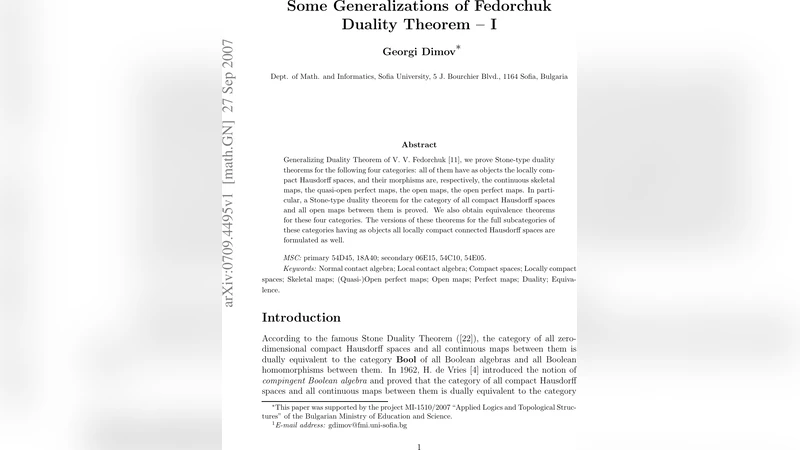
Generalizing Duality Theorem of V. V. Fedorchuk, we prove Stone-type duality theorems for the following four categories: all of them have as objects the locally compact Hausdorff spaces, and their morphisms are, respectively, the continuous skeletal maps, the quasi-open perfect maps, the open maps, the open perfect maps. In particular, a Stone-type duality theorem for the category of all compact Hausdorff spaces and all open maps between them is proved. We also obtain equivalence theorems for these four categories. The versions of these theorems for the full subcategories of these categories having as objects all locally compact connected Hausdorff spaces are formulated as well.
💡 Research Summary
The paper builds on V. V. Fedorchuk’s duality theorem and extends Stone‑type dualities to four new categories whose objects are all locally compact Hausdorff spaces. The morphisms in these categories are, respectively, continuous skeletal maps, quasi‑open perfect maps, open maps, and open perfect maps. After recalling the classical Fedorchuk duality—linking locally compact Hausdorff spaces with complete regular Boolean algebras—the author introduces precise definitions for each of the four map classes. For each class, a corresponding algebraic counterpart is identified: complete regular algebras for skeletal maps, proximity algebras for quasi‑open perfect maps, “open algebras” preserving interior operators for open maps, and open perfect algebras for open perfect maps.
Two contravariant functors η and λ are constructed. η sends a space X to an algebra A(X) that records the regular closed sets together with the appropriate additional structure (closure, proximity, interior, etc.). λ sends an algebra B to a space Ψ(B) whose points are ultrafilters respecting the algebraic structure. The author proves that η and λ map morphisms to morphisms in the opposite direction and that they are mutually inverse up to natural isomorphism. Consequently, four duality theorems are established:
- The category of locally compact Hausdorff spaces with continuous skeletal maps is dually equivalent to the category of complete regular algebras with homomorphisms preserving regular closure.
- The category with quasi‑open perfect maps is dually equivalent to the category of proximity algebras with proximity‑preserving homomorphisms.
- The category with open maps is dually equivalent to the category of open algebras (algebras equipped with an interior operator) with interior‑preserving homomorphisms.
- The category with open perfect maps is dually equivalent to the category of open perfect algebras, i.e., algebras that simultaneously support interior and perfectness conditions.
A particularly noteworthy corollary is a Stone‑type duality for the full subcategory of compact Hausdorff spaces with all open maps; this had not appeared in the literature before. The paper also derives equivalence theorems for each of the four categories, showing that the dualities are not merely abstract correspondences but yield concrete categorical equivalences.
In a second part, the author restricts attention to the full subcategories whose objects are locally compact connected Hausdorff spaces. By adding a connectedness condition to the algebraic side (connected complete regular algebras, connected proximity algebras, etc.), analogous dualities are proved for each of the four morphism classes.
The final sections discuss the significance of these results. By broadening the class of admissible maps, the work connects classical Stone–Čech compactification, de Vries proximity algebras, and modern categorical topology. The new dualities for open maps, in particular, provide tools for analyzing compact spaces via interior‑preserving algebraic morphisms, opening avenues for applications in measure theory, dynamical systems, and non‑regular space theory. An appendix supplies detailed proofs of auxiliary lemmas and presents concrete examples (e.g., quasi‑open perfect maps on the real line, open perfect maps on the torus) to illustrate the theory. Overall, the paper substantially enlarges the scope of Stone‑type dualities and deepens the interplay between topology and algebraic logic.
Comments & Academic Discussion
Loading comments...
Leave a Comment