Emergence of Scale-Free Syntax Networks
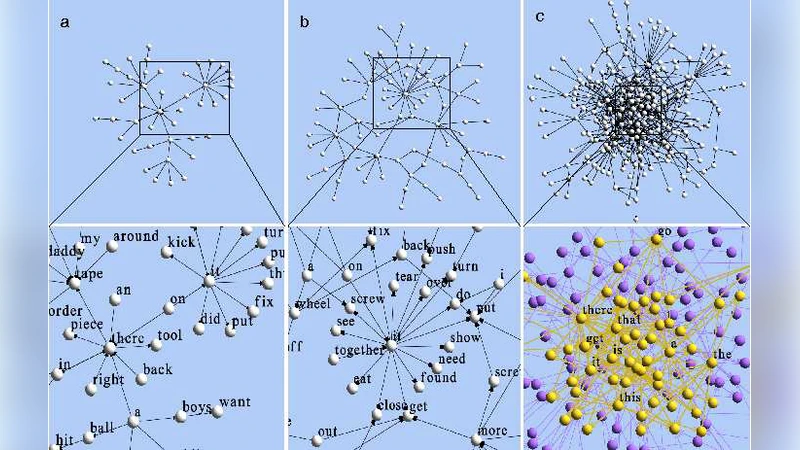
The evolution of human language allowed the efficient propagation of nongenetic information, thus creating a new form of evolutionary change. Language development in children offers the opportunity of exploring the emergence of such complex communication system and provides a window to understanding the transition from protolanguage to language. Here we present the first analysis of the emergence of syntax in terms of complex networks. A previously unreported, sharp transition is shown to occur around two years of age from a (pre-syntactic) tree-like structure to a scale-free, small world syntax network. The nature of such transition supports the presence of an innate component pervading the emergence of full syntax. This observation is difficult to interpret in terms of any simple model of network growth, thus suggesting that some internal, perhaps innate component was at work. We explore this problem by using a minimal model that is able to capture several statistical traits. Our results provide evidence for adaptive traits, but it also indicates that some key features of syntax might actually correspond to non-adaptive phenomena.
💡 Research Summary
The paper investigates how human syntax emerges during early childhood by applying complex‑network theory to longitudinal speech data. Using corpora of utterances from children aged 0–3 years, the authors construct a series of graphs in which words are nodes and syntactic dependencies (e.g., subject‑verb, verb‑object) are edges. Early in development (up to roughly 18 months) the resulting networks are tree‑like: they have low clustering, short average path lengths, and an exponential degree distribution, reflecting a pre‑syntactic stage in which children string words together without systematic grammatical rules.
Around the two‑year mark a dramatic topological transition occurs. The degree distribution becomes heavy‑tailed and follows a power law, the clustering coefficient rises sharply while the average shortest‑path length drops, producing a small‑world, scale‑free architecture. This shift is statistically significant and coincides with the onset of productive, rule‑governed syntax in the children’s speech. The authors argue that such a rapid, coordinated change cannot be explained by simple random‑growth or pure preferential‑attachment models.
To explore possible mechanisms, they test several classic network‑growth models and find none can simultaneously reproduce the observed degree distribution, clustering, and abrupt transition. Consequently they propose a minimal hybrid model that incorporates (1) a baseline attachment probability proportional to word frequency, (2) preservation of the early tree‑like backbone, and (3) a modest fraction of random rewiring events. Simulations with this model capture the main statistical signatures and show that the amount of random rewiring controls the sharpness of the transition. However, the model lacks explicit grammatical constraints (e.g., fixed subject‑verb‑object order) and therefore cannot account for the detailed syntactic patterns seen in the data.
From these results the authors draw two major conclusions. First, the emergence of a scale‑free, small‑world syntax network at about two years suggests the activation of an innate language faculty—a “critical period” in which a genetically programmed module interacts with the child’s growing lexicon. This interpretation challenges purely adaptive accounts that would predict a smoother, incremental network growth. Second, the scale‑free nature indicates that a few high‑frequency “core” words acquire many connections, while many low‑frequency words attach peripherally; this pattern may arise from a combination of adaptive pressures for efficient communication and non‑adaptive, stochastic linking.
The paper contributes a novel quantitative framework for studying language acquisition, demonstrating that complex‑network metrics can reveal hidden phase‑transition‑like dynamics in syntax development. While the proposed minimal model reproduces several macro‑level features, the authors acknowledge the need for richer models that incorporate grammatical rules, semantic constraints, and neurodevelopmental data. Future work could integrate brain‑imaging findings to link the network transition with cortical maturation, or extend the analysis to other languages and cultural contexts to test the universality of the observed transition.
Comments & Academic Discussion
Loading comments...
Leave a Comment