Positive definite collections of disks
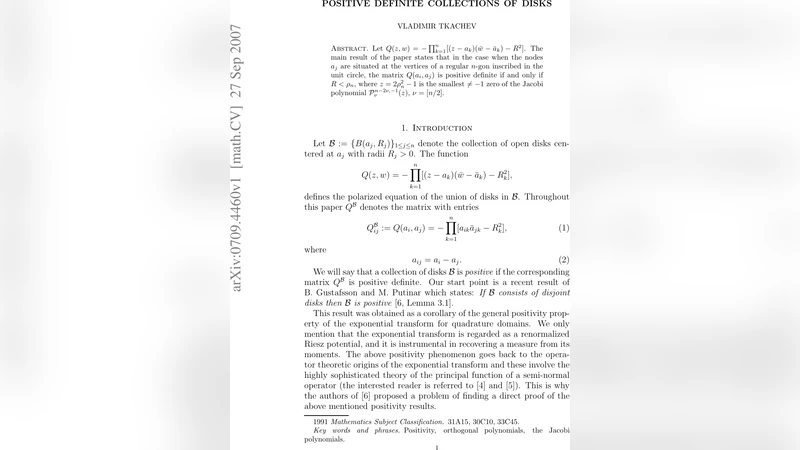
Let $Q(z,w)=-\prod_{k=1}^n [(z-a_k)(\bar{w}-\bar{a}k)-R_k^2]$. M. Putinar and B. Gustafsson proved recently that the matrix $Q(a_i,a_j)$, $1\leq i,j\leq n$, is positive definite if disks $|z-a_i|<R_i$ form a disjoint collection. We extend this result on symmetric collections of discs with overlapping. More precisely, we show that in the case when the nodes $a_j$ are situated at the vertices of a regular $n$-gon inscribed in the unit circle and $\forall i: R_i\equiv R$, the matrix $Q(a_i,a_j)$ is positive definite if and only if $R<\rho_n$, where $z=2\rho_n^2-1$ is the smallest $\ne-1$ zero of the Jacobi polynomial $\mathcal{P}^{n-2\nu,-1}\nu(z)$, $\nu=[n/2]$.
💡 Research Summary
The paper investigates the positive‑definiteness of a matrix constructed from a multivariate polynomial that encodes a family of disks in the complex plane. For points (a_1,\dots ,a_n) and radii (R_1,\dots ,R_n) the polynomial is defined as
\
Comments & Academic Discussion
Loading comments...
Leave a Comment