On the moduli stack of commutative, 1-parameter formal Lie groups
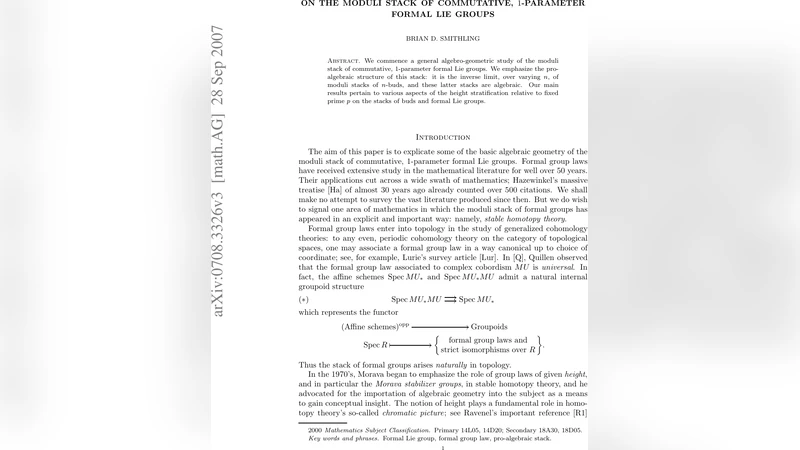
We attempt to develop a general algebro-geometric study of the moduli stack of commutative, 1-parameter formal Lie groups. We emphasize the pro-algebraic structure of this stack: it is the inverse limit, over varying n, of moduli stacks of n-buds, and these latter stacks are algebraic. Our main results pertain to aspects of the height stratification relative to fixed prime p on the stacks of buds and formal Lie groups. We conclude with a largely expository account of some foundational material on limits in bicategories.
💡 Research Summary
The paper undertakes a systematic algebro‑geometric study of the moduli stack 𝔽 of commutative, one‑parameter formal Lie groups. Its central observation is that 𝔽 is not a single algebraic stack but a pro‑algebraic object: it can be expressed as the inverse limit, taken over all natural numbers n, of algebraic stacks 𝔽ₙ that parametrize “n‑buds”, i.e. finite‑order truncations of formal group laws. Each 𝔽ₙ is an Artin stack; for n = 1 it coincides with the additive group 𝔾ₐ, while higher n incorporate increasingly intricate higher‑order terms. The transition morphisms ρₙ₊₁,ₙ : 𝔽ₙ₊₁ → 𝔽ₙ are smooth, surjective, and compatible with the group‑law structure, guaranteeing that the limit lim← 𝔽ₙ exists not merely as a set‑theoretic object but as a stack equipped with coherent 2‑morphisms. In categorical language, 𝔽 is a pseudo‑limit in the bicategory of stacks, which the authors call a “pro‑stack”.
Having established this pro‑algebraic framework, the authors turn to the height stratification relative to a fixed prime p. Classical theory tells us that a p‑typical formal group law possesses a well‑defined height h∈ℕ∪{∞}, determined by the degree of the first non‑vanishing term in the p‑series
Comments & Academic Discussion
Loading comments...
Leave a Comment