A Generalization of De Vries Duality Theorem
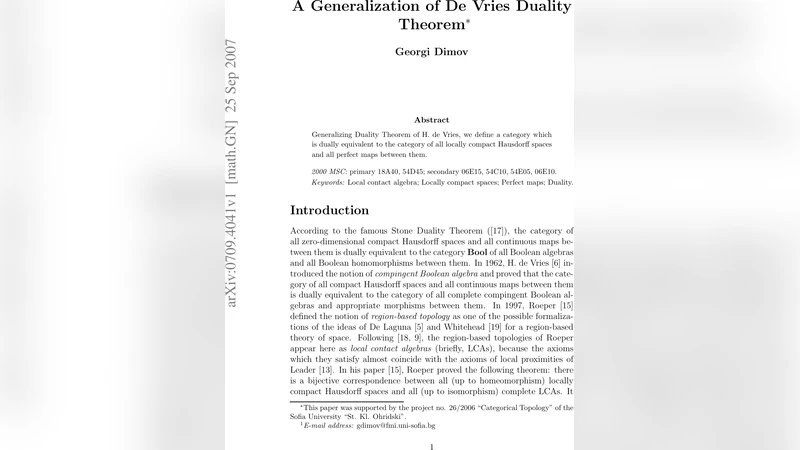
Generalizing Duality Theorem of H. de Vries, we define a category which is dually equivalent to the category of all locally compact Hausdorff spaces and all perfect maps between them.
💡 Research Summary
The paper presents a substantial generalization of de Vries’ duality theorem, extending the classical correspondence between compact Hausdorff spaces and de Vries algebras to the broader setting of locally compact Hausdorff spaces (LCH) and perfect maps. The authors achieve this by introducing two new categories. The first, denoted LCHPerf, has objects that are all locally compact Hausdorff spaces and morphisms that are perfect maps—continuous functions that are closed, proper, and whose inverse images of compact sets are compact. The second category, called cDeV, consists of “complete de Vries algebras”: Boolean algebras equipped with a proximity relation that satisfies the usual de Vries axioms together with additional completeness conditions (existence of arbitrary joins and meets) and a “local proximity” structure that respects the decomposition of a space into its compact subspaces. Morphisms in cDeV are proximity‑preserving complete lattice homomorphisms.
The core construction consists of two contravariant functors. Functor F maps an LCH space X to a complete de Vries algebra B(X). Elements of B(X) are equivalence classes of regular open subsets of X, and the proximity relation is defined by U ≪ V iff cl(U) ⊆ V. Completeness follows from the local compactness of X, which guarantees that every regular open set can be expressed as a join of “≪‑small” regular opens. For a perfect map f : X→Y, F(f) sends a class
Comments & Academic Discussion
Loading comments...
Leave a Comment