On the relation of Voevodskys algebraic cobordism to Quillens K-theory
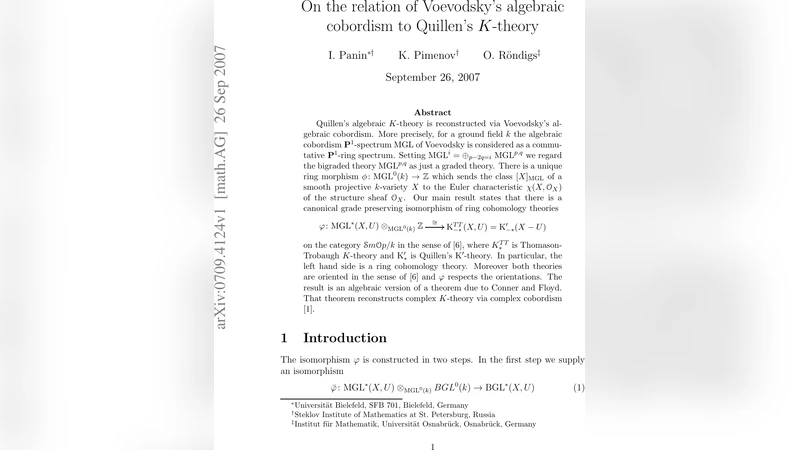
Quillen’s algebraic K-theory is reconstructed via Voevodsky’s algebraic cobordism. More precisely, for a ground field k the algebraic cobordism P^1-spectrum MGL of Voevodsky is considered as a commutative P^1-ring spectrum. There is a unique ring morphism MGL^{2*,}(k)–> Z which sends the class [X]_{MGL} of a smooth projective k-variety X to the Euler characteristic of the structure sheaf of X. Our main result states that there is a canonical grade preserving isomorphism of ring cohomology theories MGL^{,}(X,U) \tensor_{MGL^{2,}(k)} Z –> K^{TT}{- *}(X,U) = K’{- }(X-U)} on the category of smooth k-varieties, where K^{TT}_ is Thomason-Trobaugh K-theory and K’_ is Quillen’s K’-theory. In particular, the left hand side is a ring cohomology theory. Moreover both theories are oriented and the isomorphism above respects the orientations. The result is an algebraic version of a theorem due to Conner and Floyd. That theorem reconstructs complex K-theory via complex cobordism.
💡 Research Summary
The paper establishes a precise algebraic analogue of the classical Conner‑Floyd theorem, showing that Voevodsky’s algebraic cobordism spectrum MGL reconstructs Quillen’s K‑theory after a suitable base change. For a ground field k, MGL is regarded as a commutative P¹‑ring spectrum, and its bigraded coefficient ring MGL^{2*,}(k) is identified with the Lazard ring. The authors prove the existence of a unique ring homomorphism ϕ: MGL^{2,*}(k) → ℤ that sends the cobordism class of a smooth projective variety X to the Euler characteristic χ(𝒪_X). Using ϕ, they form the ℤ‑base change of the MGL‑cohomology of a pair (X,U) and obtain a graded ring
\
Comments & Academic Discussion
Loading comments...
Leave a Comment