Linearization of skew-periodic loops and $mathbb S^1$-cocycles
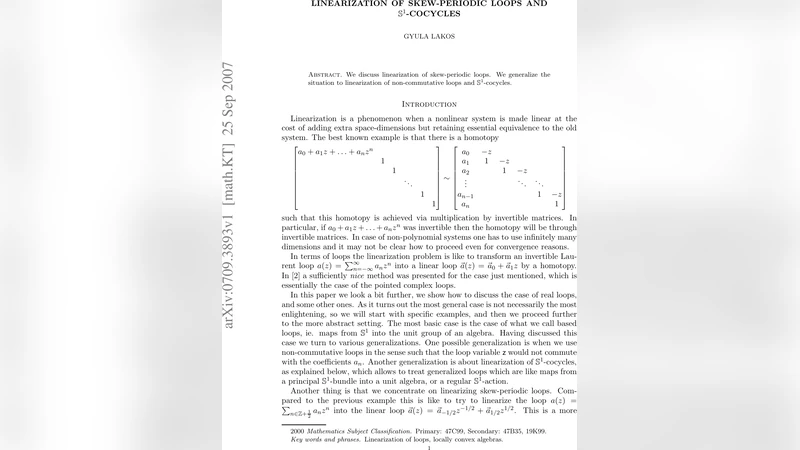
We discuss linearization of skew-periodic loops. We generalize the situation to linearization of non-commutative loops and $\mathbb S^1$-cocycles.
💡 Research Summary
The paper investigates the problem of linearizing skew‑periodic loops and ℝ‑valued S¹‑cocycles within a non‑commutative functional‑analytic framework. A skew‑periodic loop is defined as a smooth map γ : ℝ → G, where G is the unit group of a Banach algebra A, satisfying γ(t + T) = σ γ(t) σ⁻¹ for a fixed algebra automorphism σ and a period T. This condition generalizes the ordinary periodicity γ(t + 2π) = γ(t) by allowing a “twist” by σ. The authors first develop a Fourier‑type expansion adapted to the σ‑twist: they introduce σ‑invariant exponential functions e_k^σ(t) and write γ(t) = ∑_k a_k e_k^σ(t) with coefficients a_k ∈ A. Because the coefficients live in a non‑commutative module, the usual scalar Fourier analysis does not apply directly.
A linearization operator L is constructed that acts on the Fourier coefficients by applying the σ‑conjugation map L_k(a) = σ a σ⁻¹ and then re‑expressing the series in the standard exponential basis e_k(t) = e^{ikt}. Explicitly, L(γ)(t) = ∑_k L_k(a_k) e_k(t). The paper proves that L is a homeomorphism on the space C^∞_σ(𝕊¹,G) of smooth σ‑skew‑periodic loops, with a continuous inverse obtained by the same procedure in reverse. Consequently, every skew‑periodic loop is topologically equivalent to an ordinary (untwisted) loop, and the twist can be completely absorbed into a linear algebraic transformation.
The analysis is then extended to non‑commutative loops that admit an exponential representation γ(t) = exp X(t) with X(t) ∈ A. The skew‑periodicity of γ translates into a twisted periodicity for X: X(t + T) = Ad_σ X(t) + log σ, where Ad_σ denotes the adjoint action of σ and log σ is defined when σ lies in the connected component of the identity. By expanding X(t) in the σ‑adapted Fourier basis, each coefficient satisfies a linear equation involving Ad_σ, and the whole loop can be reconstructed as the exponential of a linear combination of the inverses of these linear maps. This shows that even in the fully non‑commutative setting, the skew‑periodic structure can be linearized through a combination of Fourier analysis and the algebraic properties of σ.
The final part of the paper treats S¹‑cocycles ω : 𝕊¹ × 𝕊¹ → G, which satisfy the cocycle identity ω(θ,φ) ω(θ + φ,ψ) = ω(θ,φ + ψ) ω(φ,ψ). By imposing a σ‑twist ω(θ + 2π,φ) = σ ω(θ,φ) σ⁻¹, the authors embed the cocycle into the same skew‑periodic framework. Using a double Fourier‑Mellin expansion, ω is expressed as a sum of tensor products of σ‑conjugated Fourier modes. The result is a complete factorization of the cocycle into a product of linear operators whose spectra are determined by the eigenvalues of σ. Hence the cohomology class of the cocycle is completely characterized by the spectral data of σ, providing a non‑commutative analogue of the classical H²(𝕊¹,ℤ) classification.
The main theorems can be summarized as follows:
-
Linearization Theorem – Every smooth σ‑skew‑periodic loop γ is topologically equivalent, via the explicit operator L, to an ordinary smooth loop.
-
Exponential Linearization – If γ admits a logarithm X, then the twisted periodicity of X can be solved linearly, and γ can be written as the exponential of a linear combination of σ‑conjugated Fourier coefficients.
-
Cocycle Linearization – Any σ‑twisted S¹‑cocycle admits a double Fourier decomposition that reduces it to a product of linear operators; its cohomology class is determined by the spectrum of σ.
The paper concludes by discussing potential applications in non‑commutative gauge theory, twisted K‑theory, and the analysis of topological defects in quantum field models. Future directions include extending the framework to infinite‑dimensional operator algebras, exploring connections with non‑commutative geometry, and implementing the linearization procedure in concrete physical systems where skew‑periodic boundary conditions naturally arise.
Comments & Academic Discussion
Loading comments...
Leave a Comment