Relating Neural Dynamics to Neural Coding
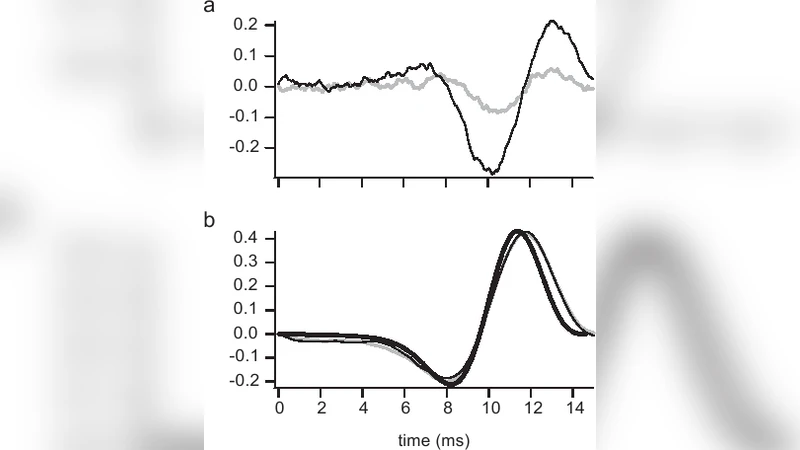
We demonstrate that two key theoretical objects used widely in Computational Neuroscience, the phase-resetting curve (PRC) from dynamics and the spike triggered average (STA) from statistical analysis, are closely related under a wide range of stimulus conditions. We prove that the STA is proportional to the derivative of the PRC. We compare these analytic results to numerical calculations for the Hodgkin-Huxley neuron and we apply the method to neurons in the olfactory bulb of mice. This observation allows us to relate the stimulus-response properties of a neuron to its dynamics, bridging the gap between dynamical and information theoretic approaches to understanding brain computations and facilitating the interpretation of changes in channels and other cellular properties as influencing the representation of stimuli.
💡 Research Summary
The paper establishes a rigorous quantitative link between two cornerstone concepts in computational neuroscience: the phase‑resetting curve (PRC), which captures how a periodic spiking neuron’s phase is shifted by a brief perturbation, and the spike‑triggered average (STA), which represents the mean stimulus preceding a spike under stochastic drive. By assuming a weak, broadband (white‑noise) stimulus, the authors model the neuron’s phase φ(t) and define the PRC Z(φ) through the linear relationship Δφ≈Z(φ)·I(t)dt for an infinitesimal input I(t). They then derive the STA s(τ)=⟨I(t_s−τ)⟩ by conditioning on spike times t_s and averaging over the stochastic input. Using the probability density of spike occurrence λ(φ)=r
Comments & Academic Discussion
Loading comments...
Leave a Comment