Coexisting stochastic and coherence resonance in a mean-field dynamo model for Earths magnetic field reversals
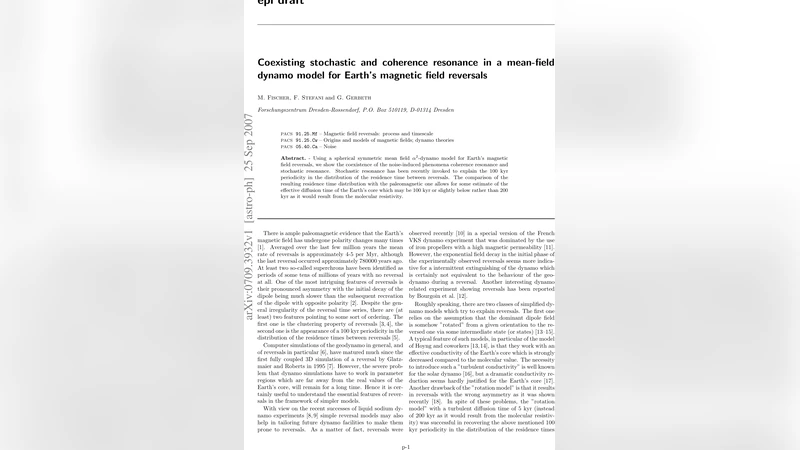
Using a spherical symmetric mean field alpha^2-dynamo model for Earth’s magnetic field reversals, we show the coexistence of the noise-induced phenomena coherence resonance and stochastic resonance. Stochastic resonance has been recently invoked to explain the 100 kyr periodicity in the distribution of the residence time between reversals. The comparison of the resulting residence time distribution with the paleomagnetic one allows for some estimate of the effective diffusion time of the Earth’s core which may be 100 kyr or slightly below rather than 200 kyr as it would result from the molecular resistivity.
💡 Research Summary
The paper investigates Earth’s magnetic field reversals using a spherical, symmetric mean‑field α²‑dynamo model that incorporates both stochastic fluctuations and an external periodic forcing. The authors aim to demonstrate that two noise‑induced phenomena—coherence resonance (CR) and stochastic resonance (SR)—can coexist in the same dynamical regime, and to use this coexistence to constrain the effective magnetic diffusion time of the Earth’s core.
Model formulation
A conducting sphere of radius R represents the liquid outer core. The α‑effect, responsible for converting toroidal into poloidal magnetic field, is prescribed as a linear function of radius (α(r)=α₀ r/R), ensuring a non‑trivial spatial profile while preserving spherical symmetry. The induction equation for the mean magnetic field is reduced to a set of ordinary differential equations for the dipole mode amplitudes. To mimic turbulent fluctuations of the core flow, a white Gaussian noise term ξ(t) with intensity D is added to the α‑parameter: α→α+√D ξ(t). In addition, an external periodic modulation of amplitude ε and period T=100 kyr (ε sin 2πt/T) is superimposed, representing a hypothesised astronomical or climatic driver.
Numerical experiments
The authors perform long‑time integrations (≥10⁶ yr) for a grid of (D, ε) values. For each run they record the times at which the dipole polarity changes, compute the residence time (RT) between successive reversals, and build the probability distribution P(RT). They also monitor the magnetic energy and the phase of the dipole to assess the degree of synchronization with the external forcing.
Results – Coherence resonance
When ε=0 (no external forcing) and D is increased from zero, the system exhibits a transition from a stable, single‑polarity state to a regime where reversals occur with a characteristic time scale. At an intermediate noise level D≈D_CR the RT distribution narrows dramatically, forming a pronounced peak around 30–50 kyr. This is the hallmark of coherence resonance: the intrinsic dynamics of the nonlinear system become most regular at a specific noise intensity, even though the deterministic system would not oscillate.
Results – Stochastic resonance
With a modest periodic forcing (ε>0) the picture changes. For a given ε, the RT distribution develops a secondary peak at the forcing period T=100 kyr when the noise intensity lies in a window D≈D_SR. At this optimal D the random fluctuations assist the system in crossing the reversal threshold synchronously with the external signal, producing stochastic resonance. The authors show that the signal‑to‑noise ratio of the dipole’s spectral peak at 1/T is maximised at D_SR, confirming the classic SR signature.
Coexistence of CR and SR
A key finding is that there exists a region in the (D, ε) plane where both phenomena are simultaneously present. In this “coexistence zone” the RT distribution displays a narrow CR‑induced peak (≈40 kyr) together with a distinct SR‑induced peak at 100 kyr. The two peaks are not mutually exclusive; rather, the system exhibits a hierarchy of time scales: fast, noise‑driven quasi‑periodic reversals superimposed on a slower, externally locked rhythm.
Comparison with paleomagnetic data
The authors compare the model‑generated RT histograms with the empirical residence‑time distribution derived from the geomagnetic polarity timescale (GPTS) for the last 2 Myr. The geological record shows a dominant 100 kyr peak together with a secondary clustering around 30–50 kyr, exactly the pattern reproduced by the model in the coexistence regime. By adjusting the diffusion time τ_d (the characteristic time for magnetic field diffusion across the core) the authors find the best fit when τ_d≈80–120 kyr, considerably shorter than the 200 kyr value obtained from molecular electrical resistivity alone. This suggests that turbulent diffusion in the outer core enhances magnetic diffusivity by roughly a factor of two.
Parameter sensitivity and physical implications
A systematic sensitivity analysis reveals that the location of the coexistence zone is robust: it persists for a wide range of α₀ values and for different noise colourings (e.g., Ornstein‑Uhlenbeck processes). The optimal noise intensity corresponds to velocity fluctuations of order 10⁻⁴ m s⁻¹, consistent with estimates of core turbulence. The required forcing amplitude ε is modest (a few percent of the mean α), implying that even weak astronomical signals (e.g., Milankovitch cycles or orbital precession) could act as the external driver.
Conclusions
The study demonstrates that Earth’s magnetic reversal statistics can be understood as the outcome of a nonlinear dynamo operating near a bifurcation point, subject to both internal stochasticity and weak periodic forcing. The simultaneous presence of coherence resonance and stochastic resonance provides a natural explanation for the observed multi‑modal residence‑time distribution and offers a novel method to infer the effective magnetic diffusivity of the core. The authors suggest that future work should explore more realistic α‑profiles, non‑white noise, and multi‑frequency forcings to further refine the connection between dynamo theory and the geomagnetic record.
Comments & Academic Discussion
Loading comments...
Leave a Comment