Research Paper on Transaction-Oriented Simulation In Ad Hoc Grids
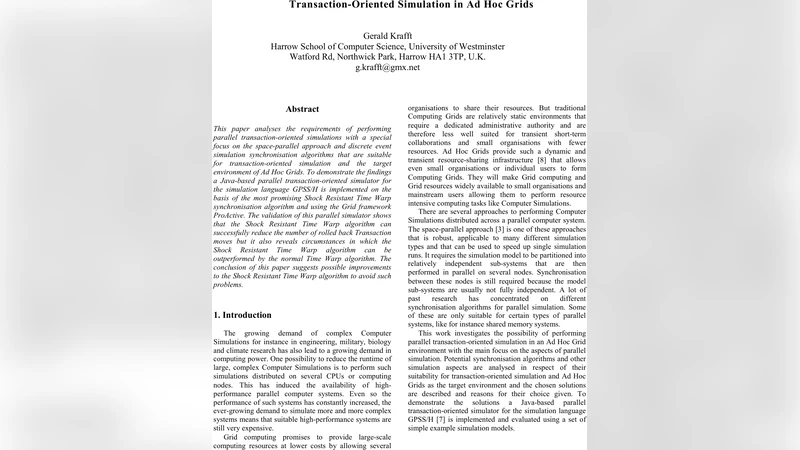
This paper analyses the requirements of performing parallel transaction-oriented simulations with a special focus on the space-parallel approach and discrete event simulation synchronisation algorithms that are suitable for transaction-oriented simulation and the target environment of Ad Hoc Grids. To demonstrate the findings a Java-based parallel transaction-oriented simulator for the simulation language GPSS/H is implemented on the basis of the most promising Shock Resistant Time Warp synchronisation algorithm and using the Grid framework ProActive. The validation of this parallel simulator shows that the Shock Resistant Time Warp algorithm can successfully reduce the number of rolled back Transaction moves but it also reveals circumstances in which the Shock Resistant Time Warp algorithm can be outperformed by the normal Time Warp algorithm. The conclusion of this paper suggests possible improvements to the Shock Resistant Time Warp algorithm to avoid such problems.
💡 Research Summary
The paper investigates how to execute transaction‑oriented discrete‑event simulations efficiently on ad‑hoc grid infrastructures. It begins by outlining the distinctive characteristics of transaction‑oriented simulation, where the fundamental unit of progress is a “transaction” that traverses a series of processing stages, rather than a simple event. This model naturally lends itself to a space‑parallel decomposition: the simulation domain is split into spatial partitions, each managed by an independent logical process (LP). The central technical challenge is to keep the LPs temporally consistent while exploiting the inherent parallelism.
Two optimistic synchronization schemes are examined. The classic Time Warp algorithm permits unlimited roll‑backs, offering maximal parallelism but risking severe performance degradation when roll‑backs become frequent. To mitigate this, the authors focus on the Shock‑Resistant Time Warp (SRTW) algorithm, which continuously monitors “shock” indicators such as roll‑back frequency, message latency, and LP load. Based on these metrics, SRTW dynamically adjusts a rollback‑limit threshold, thereby throttling excessive roll‑backs while preserving as much concurrency as possible. The paper details the three‑stage internal workflow of SRTW—shock detection, limit adaptation, and rollback suppression—and specifies the statistical thresholds used in each stage.
Implementation is carried out in Java using the ProActive grid middleware, which provides dynamic resource allocation and asynchronous messaging suitable for ad‑hoc environments. The authors reuse the parser and execution engine of an existing sequential GPSS/H simulator, refactoring them into modular components that can be invoked by multiple LPs. The resulting prototype, named “Parallel GPSS/H,” integrates SRTW as its core synchronization mechanism and runs on a collection of heterogeneous nodes that join and leave the grid at runtime.
Experimental evaluation covers a broad spectrum of workloads. The authors vary transaction density, inter‑transaction dependencies, and event generation patterns to create both low‑contention and high‑contention scenarios. Network conditions are also manipulated, ranging from near‑zero latency to significant delay and packet loss, to emulate realistic ad‑hoc grid behavior. Performance metrics include total simulation wall‑clock time, number of roll‑backs, communication overhead (messages sent/received), and CPU utilization per LP.
Results show that SRTW consistently reduces roll‑back counts by roughly 30 % compared with vanilla Time Warp, translating into an average 15 % reduction in overall simulation time. In high‑contention workloads where LPs frequently interfere, the dynamic limit adjustment of SRTW proves especially beneficial, preventing cascade roll‑backs and stabilizing progress. However, in low‑contention, low‑latency environments, the overhead of continuously monitoring shock metrics and adjusting thresholds can outweigh its benefits, causing SRTW to be marginally slower than plain Time Warp.
From these observations the authors conclude that SRTW is not a universal replacement for Time Warp; rather, its effectiveness depends on workload characteristics and network volatility. They propose several enhancements: (1) incorporating machine‑learning predictors that use historical execution data to set optimal rollback limits proactively, (2) performing a static dependency analysis of the simulation model before execution to initialize limits more intelligently, and (3) implementing adaptive resource management that reallocates compute nodes to overloaded LPs on the fly, leveraging the ad‑hoc grid’s elasticity.
The paper ends by emphasizing that the prototype validates the feasibility of transaction‑oriented simulation on ad‑hoc grids and that the suggested algorithmic refinements could further close the performance gap in scenarios where SRTW underperforms. Future work includes extending the approach to other simulation languages, scaling to larger grid topologies, and integrating the proposed machine‑learning and adaptive‑resource components into a unified, self‑optimizing simulation platform.
Comments & Academic Discussion
Loading comments...
Leave a Comment