Larticolo di Ettore Majorana su "Il valore delle Leggi Statistiche nella Fisica e nelle Scienze Sociali" (Ettore Majoranas article on "The value of Statistical Laws in Physics and in Social Sciences")
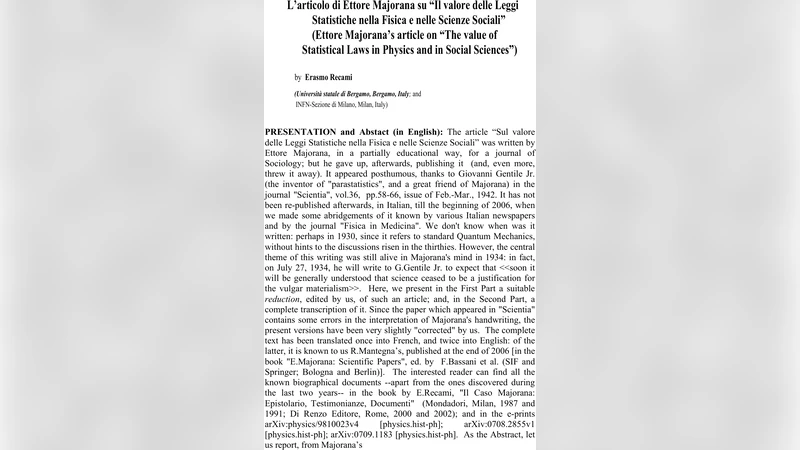
The mentioned article was written by Ettore Majorana, in a partially educational way, for a journal of Sociology; but he gave up publishing it (and threw it away). It appeared posthumous, thanks to Giovanni Gentile Jr. (the inventor of “parastatistics”) in “Scientia” 36 (1942) 58-66. It has not been re-published, in Italian, till the beginning of 2006, when we made known some abridgements of it by Italian newspapers and by the journal “Fisica in Medicina”. We don’t know when was it written: perhaps in 1930. However, its central theme was still alive in Majorana’s mind in 1934: in fact, on July 27, 1934, he will write to G.Gentile Jr. to expect that «soon it will be generally understood that science ceased to be a justification for the vulgar materialism». Here, in Part I, we present a suitable reduction, edited by us, of Majorana’s article; while in Part II we add a complete transcription of it. [Since the paper which appeared in “Scientia” contains some errors in the interpretation of Majorana’s handwriting, the present versions have been very slightly “corrected” by us]. For the translations into English of Majorana’s paper, see Refs.[5,6] below. A more extended Summary (in English, besides in Italian) can be found at the beginning of the present e-print. The interested reader can found all the known biographical documents –apart from the ones discovered during the last two years– in the book by E.Recami, “Il Caso Majorana: Epistolario, Testimonianze, Documenti” (Mondadori, Milan, 1987 and 1991; Di Renzo Editore, Rome, 2000 and 2002); and in the e-prints arXiv:physics/9810023v4 [physics.hist-ph]; arXiv:0708.2855v1 [physics.hist-ph]; and arXiv:0709.1183 [physics.hist-ph].
💡 Research Summary
Ettore Majorana’s unpublished manuscript “The value of Statistical Laws in Physics and in Social Sciences” was written in the early 1930s, intended for a sociology journal, but never saw the light of day during his lifetime. The text resurfaced posthumously when Giovanni Gentile Jr. published a heavily edited excerpt in Scientia (Vol. 36, 1942, pp. 58‑66). The present paper supplies a two‑part edition that corrects the transcription errors of the original publication, provides a concise edited version (Part I), and reproduces the full handwritten manuscript (Part II).
The core of Majorana’s argument is a philosophical and methodological bridge between the statistical foundations of modern physics and the emerging quantitative approaches in the social sciences. He begins with a historical overview of statistical thinking in physics: from the kinetic theory of gases and Boltzmann’s statistical interpretation of entropy, through the rise of thermodynamics as a macroscopic law derived from microscopic randomness, to the quantum revolution. In particular, he emphasizes that the Heisenberg uncertainty principle does not merely limit measurement precision; it reveals a deeper epistemic indeterminacy that is already implicit in any statistical law.
Having established that statistical laws are expressions of fundamental indeterminacy, Majorana asks whether the same conceptual framework can be transferred to the study of societies. He acknowledges the obvious differences – human behavior is far more complex, non‑linear, and context‑dependent than the motion of particles – yet he argues that when one looks at large populations, “collective average behavior” emerges, which can be described by probability distributions, mean values, and entropy‑like measures. In this sense, social indicators (birth rates, unemployment, crime statistics, etc.) play the role of macroscopic observables, while the underlying individual motives remain “unobservable” in the same way that a particle’s exact position and momentum are inaccessible.
Majorana’s methodological proposal anticipates what later became known as “social physics” or “sociophysics.” He suggests that the tools of statistical mechanics—distribution functions, fluctuation theory, and the concept of entropy—could be adapted to quantify social uncertainty, to model diffusion of ideas, and to study phase‑transition‑like phenomena in collective decision‑making. Although he does not develop a formal model, his qualitative insight that the statistical description of a many‑body system is a universal language for any complex ensemble is remarkably forward‑looking.
Beyond the technical discussion, the manuscript contains a strong philosophical stance. In a letter dated July 27 1934 to Gentile Jr., Majorana warned that “science will soon be generally understood as having ceased to be a justification for vulgar materialism.” In the paper he repeats this sentiment, criticizing the prevailing materialist‑positivist view that reduces scientific inquiry to a mere description of matter. He argues that science must expand to incorporate human values, ethical considerations, and the meaning of existence. In this respect, statistical laws are not only mathematical tools but also a bridge toward a more humane, reflective science that respects both the indeterminate nature of reality and the dignity of human agents.
Part I of the present edition offers a carefully edited, readable version of Majorana’s text, preserving his original Italian phrasing while correcting the misreadings that plagued the 1942 publication. Part II presents a faithful transcription of the handwritten manuscript, allowing scholars to examine the exact wording, marginal notes, and the occasional self‑correction that reveal Majorana’s thought process. The authors of the edition note that the original manuscript contains a few minor scribal errors, but these do not affect the overall argument.
The scholarly significance of this work is threefold. First, it restores Majorana’s voice as an early pioneer of interdisciplinary statistical thinking, predating the modern field of econophysics and network science by several decades. Second, his identification of statistical laws with the principle of indeterminacy anticipates contemporary discussions in quantum information theory about the role of entropy and uncertainty in complex systems, including social networks. Third, his philosophical critique of materialist reductionism provides a rare glimpse into a physicist’s humane worldview at a time when the scientific community was largely preoccupied with the formalism of quantum mechanics.
In conclusion, Majorana’s “The value of Statistical Laws” is not merely a historical curiosity; it is a forward‑looking treatise that argues for a unified statistical language capable of describing both physical and social phenomena, while simultaneously urging a re‑orientation of science away from narrow materialism toward a broader, ethically informed understanding of reality. The present edition makes this seminal text accessible to contemporary readers, invites renewed interdisciplinary dialogue, and underscores Majorana’s lasting relevance to both the philosophy of science and the emerging quantitative study of societies.
Comments & Academic Discussion
Loading comments...
Leave a Comment