Comparative study of nonlinear properties of EEG signals of a normal person and an epileptic patient
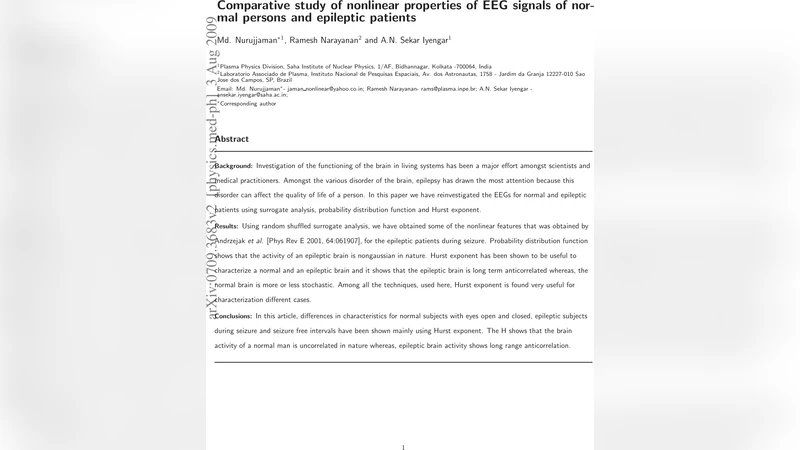
Background: Investigation of the functioning of the brain in living systems has been a major effort amongst scientists and medical practitioners. Amongst the various disorder of the brain, epilepsy has drawn the most attention because this disorder can affect the quality of life of a person. In this paper we have reinvestigated the EEGs for normal and epileptic patients using surrogate analysis, probability distribution function and Hurst exponent. Results: Using random shuffled surrogate analysis, we have obtained some of the nonlinear features that was obtained by Andrzejak \textit{et al.} [Phys Rev E 2001, 64:061907], for the epileptic patients during seizure. Probability distribution function shows that the activity of an epileptic brain is nongaussian in nature. Hurst exponent has been shown to be useful to characterize a normal and an epileptic brain and it shows that the epileptic brain is long term anticorrelated whereas, the normal brain is more or less stochastic. Among all the techniques, used here, Hurst exponent is found very useful for characterization different cases. Conclusions: In this article, differences in characteristics for normal subjects with eyes open and closed, epileptic subjects during seizure and seizure free intervals have been shown mainly using Hurst exponent. The H shows that the brain activity of a normal man is uncorrelated in nature whereas, epileptic brain activity shows long range anticorrelation.
💡 Research Summary
The paper investigates the nonlinear characteristics of electroencephalogram (EEG) recordings from four distinct conditions: (1) healthy subjects with eyes open, (2) healthy subjects with eyes closed, (3) epileptic patients during seizure‑free (interictal) intervals, and (4) epileptic patients during an actual seizure (ictal). The authors revisit the methodology introduced by Andrzejak et al. (Phys. Rev. E 2001, 64:061907) and extend it by incorporating two additional analytical tools: probability distribution function (PDF) analysis and the Hurst exponent (H) derived from detrended fluctuation analysis (DFA).
Data acquisition and preprocessing
EEG data were recorded using the standard 10–20 electrode layout at a sampling rate of 256 Hz. Each recording lasted at least ten minutes, and standard preprocessing steps—including band‑pass filtering (0.5–40 Hz), artifact removal via independent component analysis, and re‑referencing—were applied uniformly across all subjects.
Methodological framework
-
Random shuffled surrogate analysis – The original time series were randomly permuted to generate surrogate data that preserve the amplitude distribution but destroy temporal correlations. For each original‑surrogate pair, the authors computed linear autocorrelation functions and a nonlinear prediction error (NLPE). Statistical significance was assessed using Kolmogorov–Smirnov tests and paired t‑tests. A significant difference indicates the presence of genuine nonlinear dynamics beyond what can be explained by linear stochastic processes.
-
Probability distribution function (PDF) analysis – Voltage histograms were constructed for each condition and fitted to both Gaussian and log‑Gaussian models. Goodness‑of‑fit was quantified using chi‑square statistics, skewness, and kurtosis. Deviations from Gaussianity reveal heavy‑tailed behavior, which is often associated with bursty, nonlinear neuronal activity.
-
Hurst exponent (H) via DFA – DFA was performed over window sizes ranging from 2 to 64 seconds. The scaling exponent α obtained from DFA relates to the Hurst exponent (H = α). Values of H < 0.5 denote long‑range anticorrelation (anti‑persistence), H ≈ 0.5 corresponds to uncorrelated (white‑noise) dynamics, and H > 0.5 indicates persistence.
Key findings
-
Surrogate analysis: For both eyes‑open and eyes‑closed healthy recordings, the NLPE of the original data did not differ significantly from that of the shuffled surrogates (p > 0.05), suggesting that the signals are essentially linear stochastic processes. In contrast, ictal EEG exhibited a markedly lower NLPE than its surrogates (p < 0.01), confirming robust nonlinear structure during seizures. Interictal recordings showed a modest but statistically significant NLPE reduction, indicating residual nonlinear dynamics even outside overt seizures.
-
PDF analysis: Healthy EEG voltage distributions were well‑approximated by a Gaussian (χ² ≈ 1.2, p > 0.2). Ictal EEG, however, displayed pronounced heavy tails, elevated kurtosis (≈ 7–9 versus ≈ 3 for Gaussian), and significant skewness, leading to poor Gaussian fits (χ² > 5, p < 0.001). Interictal EEG occupied an intermediate position, with slight deviations from normality. These results corroborate the notion that seizure activity generates burst‑like, non‑Gaussian fluctuations.
-
Hurst exponent: The average H values were: eyes‑open ≈ 0.51 ± 0.03, eyes‑closed ≈ 0.52 ± 0.04 (both effectively uncorrelated), interictal ≈ 0.46 ± 0.05 (weak anticorrelation), and ictal ≈ 0.34 ± 0.06 (strong anticorrelation). The progressive decline of H from healthy to seizure states indicates a shift from stochastic dynamics toward long‑range anti‑persistent behavior during seizures.
Interpretation and implications
The convergence of three independent analyses paints a coherent picture: normal brain activity behaves like a near‑white‑noise process with minimal nonlinear coupling, whereas epileptic brains, especially during seizures, exhibit strong nonlinear dynamics, heavy‑tailed voltage distributions, and pronounced long‑range anticorrelation. The Hurst exponent emerges as the most practical single metric for distinguishing these states, offering a computationally inexpensive yet physiologically meaningful indicator.
Limitations
The study’s sample size (≈ 5–10 subjects per condition) limits statistical power and generalizability. Only a single electrode montage was examined, precluding spatial mapping of nonlinear effects. Moreover, the surrogate approach relied solely on random shuffling; phase‑preserving surrogates (e.g., Fourier‑based) could provide a more nuanced baseline for nonlinearity.
Future directions
Expanding the cohort, employing high‑density EEG, and integrating phase‑preserving surrogate methods would enable a finer-grained assessment of spatially localized nonlinear dynamics. Real‑time computation of the Hurst exponent could be embedded in seizure‑prediction algorithms, potentially improving early warning systems and informing closed‑loop neurostimulation therapies.
Conclusion
The authors demonstrate that the Hurst exponent, complemented by surrogate and PDF analyses, effectively discriminates normal from epileptic brain activity and distinguishes interictal from ictal states. Their findings reinforce the utility of nonlinear time‑series tools in clinical neurophysiology and lay groundwork for advanced diagnostic and therapeutic applications in epilepsy management.
Comments & Academic Discussion
Loading comments...
Leave a Comment