Non-commutative residue of projections in Boutet de Monvels calculus
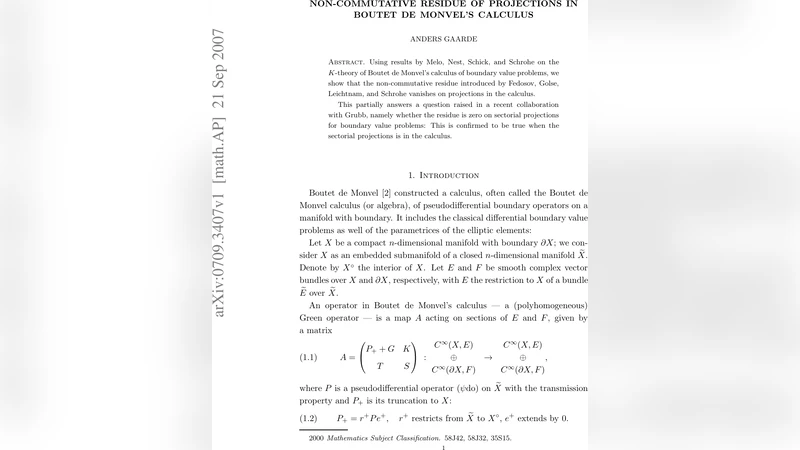
Using results by Melo, Nest, Schick, and Schrohe on the K-theory of Boutet de Monvel’s calculus of boundary value problems, we show that the non-commutative residue introduced by Fedosov, Golse, Leichtnam, and Schrohe vanishes on projections in the calculus. This partially answers a question raised in a recent collaboration with Grubb, namely whether the residue is zero on sectorial projections for boundary value problems: This is confirmed to be true when the sectorial projections is in the calculus.
💡 Research Summary
The paper investigates the behavior of the non‑commutative residue, originally introduced by Fedosov, Golse, Leichtnam, and Schrohe, on projection operators that belong to Boutet de Monvel’s calculus of boundary value problems. Boutet de Monvel’s calculus provides a unified operator algebra for interior pseudodifferential operators, boundary operators, and singular Green operators on manifolds with boundary. Within this algebra one can define a trace‑like functional – the non‑commutative residue – which extends the classical Wodzicki residue to the boundary setting.
A central motivation comes from a question raised in a recent collaboration with Grubb: does the residue vanish on sectorial (spectral) projections associated with boundary value problems? The authors answer this affirmatively in the special case where the sectorial projection lies inside Boutet de Monvel’s algebra.
The technical backbone of the argument relies on the K‑theoretic analysis of the Boutet de Monvel algebra performed by Melo, Nest, Schick, and Schrohe. They established a short exact sequence
(0\to\mathcal K\to\mathcal B\to\mathcal S\to0)
where (\mathcal K) denotes the compact operators, (\mathcal B) the full Boutet de Monvel algebra, and (\mathcal S) the symbol algebra. This yields a six‑term exact sequence in K‑theory, showing that (K_{0}(\mathcal B)) splits as a direct sum of the K‑groups of interior pseudodifferential operators and of boundary operators. Consequently every projection (P\in\mathcal B) can be written as a sum (P=P_{\mathrm{int}}+P_{\mathrm{bdry}}) with each summand belonging to one of the two sub‑algebras.
The non‑commutative residue (\operatorname{Res}) is a linear functional on (\mathcal B) that factors through the symbol algebra (\mathcal S); it vanishes on compact operators and on any operator whose total symbol has no homogeneous component of order (-n) (the dimension of the underlying manifold). For interior pseudodifferential projections the classical Wodzicki residue is known to be zero, and for boundary projections the symbol of order (-n) is absent, so their residues also vanish. By linearity, (\operatorname{Res}(P)=\operatorname{Res}(P_{\mathrm{int}})+\operatorname{Res}(P_{\mathrm{bdry}})=0).
The main theorem therefore states: Every projection belonging to Boutet de Monvel’s calculus has vanishing non‑commutative residue. As a corollary, any sectorial projection that can be expressed within this calculus (for instance, those arising from elliptic boundary value problems with a spectral cut) also has zero residue. The paper notes that projections lying outside the calculus remain an open problem.
Beyond answering the specific question, the result reinforces the compatibility between the analytic index theory for boundary problems and the algebraic structure of non‑commutative residues. The vanishing of the residue on projections indicates that these operators do not contribute to the “global anomaly” measured by the residue, which aligns with expectations from the index theorem and from physical interpretations where such residues often represent regularized traces of divergent quantities. The authors suggest that future work could extend the analysis to more general spectral projections, possibly using refined K‑theoretic tools or cyclic cohomology, to achieve a complete answer to the original question.
Comments & Academic Discussion
Loading comments...
Leave a Comment