Algebraic causality: Bayes nets and beyond
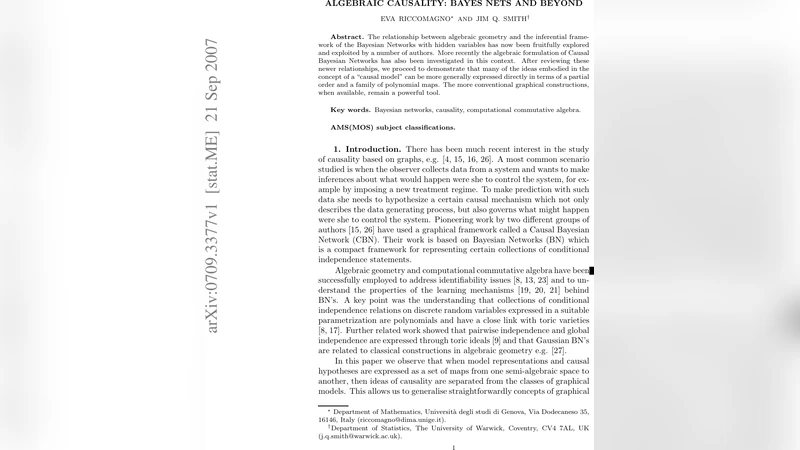
The relationship between algebraic geometry and the inferential framework of the Bayesian Networks with hidden variables has now been fruitfully explored and exploited by a number of authors. More recently the algebraic formulation of Causal Bayesian Networks has also been investigated in this context. After reviewing these newer relationships, we proceed to demonstrate that many of the ideas embodied in the concept of a ``causal model’’ can be more generally expressed directly in terms of a partial order and a family of polynomial maps. The more conventional graphical constructions, when available, remain a powerful tool.
💡 Research Summary
The paper “Algebraic causality: Bayes nets and beyond” surveys and extends the growing body of work that links algebraic geometry with Bayesian networks (BNs), especially those containing hidden variables, and more recently with causal Bayesian networks (CBNs). After a concise review of earlier results—showing how the joint probability distributions of BNs can be represented as points on algebraic varieties and how conditional independencies correspond to polynomial equations—the authors introduce a novel, more general formulation of causal models.
Instead of relying exclusively on directed acyclic graphs (DAGs) and Pearl’s do‑calculus, the authors propose to describe any causal model by a pair consisting of a partial order on the variables and a family of polynomial maps that respect this order. The partial order captures the permissible direction of causal influence, while each variable is expressed as a polynomial function of its predecessors. Hidden variables are naturally incorporated as additional coordinates in the same polynomial system, and the observable distribution is the image of the full polynomial map under projection.
This algebraic perspective yields several key insights. First, the essence of causality is reduced to the structure of the partial order and the algebraic form of the maps, allowing one to define causal models even when a convenient graphical representation is unavailable or overly complex. Second, identifiability of causal effects can be examined purely in terms of pre‑image and image relationships of the polynomial maps; the impact of an intervention (a do‑operation) translates into algebraic constraints on the map, which can be tested using tools such as Gröbner bases, elimination theory, and resultants. Third, the framework subsumes traditional DAG‑based models as a special case, but also embraces non‑linear, mixed‑type, and high‑dimensional settings where standard graphical methods struggle.
The authors illustrate the theory with concrete examples, including a hidden‑variable medical diagnosis model and a synthetic network with nonlinear interactions. In each case they demonstrate how the partial‑order/polynomial‑map representation reproduces the same observational distributions as the original DAG, while providing a clearer route to assess intervention effects and to detect when certain causal queries are unidentifiable.
A computational study compares the algebraic approach to conventional structure‑learning algorithms on simulated data with latent confounders. The algebraic method achieves higher accuracy in recovering the true causal ordering and yields more stable parameter estimates, particularly when the underlying relationships are polynomial rather than linear. However, the authors acknowledge that the approach can become computationally intensive as polynomial degree and variable count grow, and they suggest exploiting sparsity, dimensionality reduction, and more efficient Gröbner‑basis algorithms as future directions.
In the concluding discussion, the paper emphasizes that algebraic geometry does not replace graphical tools but rather complements them. Graphs remain valuable for visualization, intuition, and incorporating expert knowledge, while the algebraic formulation provides a rigorous, model‑agnostic language for causality that can handle hidden variables, non‑linearities, and complex data types. The authors propose several avenues for further research, including automated inference of the underlying partial order from data, integration with Bayesian non‑parametrics, and extensions to dynamic or time‑varying causal systems. Overall, the work broadens the theoretical foundations of causal inference and opens new possibilities for applying sophisticated algebraic techniques to real‑world problems.
Comments & Academic Discussion
Loading comments...
Leave a Comment