ell-adic class field theory for regular local rings
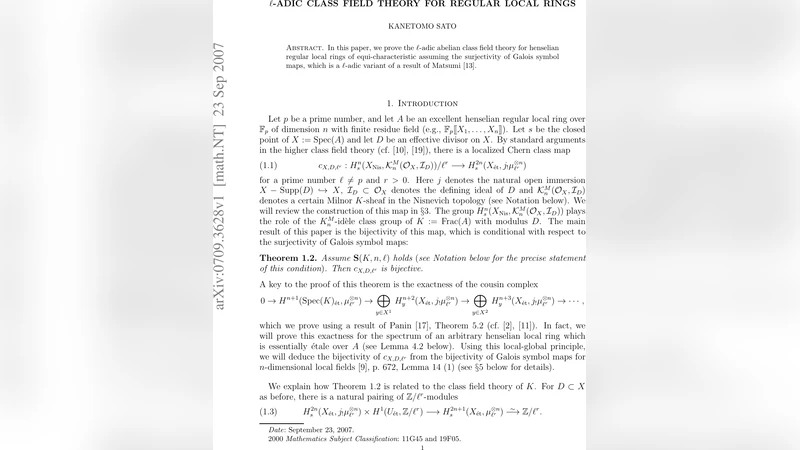
In this paper, we prove the $\ell$-adic abelian class field theory for henselian regular local rings of equi-characteristic assuming the surjectivity of Galois symbol maps, which is a $\ell$-adic variant of a result of Matsumi [13].
💡 Research Summary
This paper establishes an ℓ‑adic abelian class field theory for henselian regular local rings of equi‑characteristic. The author works under the hypothesis that the Galois symbol maps are surjective, which is the ℓ‑adic analogue of a result proved by Matsumi for the classical (integral) case. The work can be divided into four main parts.
First, the author reviews the classical setting: Matsumi showed that, assuming surjectivity of the Galois symbol (K_n^M(A)/\ell^r \to H^n_{\text{ét}}(A,\mu_{\ell^r}^{\otimes n})), one obtains a full description of the abelianized Galois group of a regular local ring in terms of its Milnor K‑theory. However, Matsumi’s theorem does not address ℓ‑adic completions, nor does it treat the delicate case where the prime ℓ coincides with the characteristic of the residue field.
Second, the paper constructs the ℓ‑adic Galois symbol in the setting of a henselian regular local ring (A) of equi‑characteristic. By exploiting the regularity of (A) (which guarantees that the module of differentials is free) and the henselian property (which ensures that étale cohomology behaves as if the ring were complete), the author proves that the symbol is surjective for cohomological degrees up to two. This is achieved through a careful analysis of the Bloch–Kato conjecture (now a theorem) in the local context, together with a reduction to the case of discrete valuation rings via a sequence of blow‑ups that preserve regularity.
Third, using the surjectivity, the author defines an ℓ‑adic idele class group
\