Evolution of solitary waves and undular bores in shallow-water flows over a gradual slope with bottom friction
This paper considers the propagation of shallow-water solitary and nonlinear periodic waves over a gradual slope with bottom friction in the framework of a variable-coefficient Korteweg-de Vries equation. We use the Whitham averaging method, using a …
Authors: ** - **G. A. El** (주요 저자, 변조 이론 및 비선형 파동 분야의 권위자) - **M. A. Hoefer** (Whitham 평균화와 KdV 변형 연구) - **A. M. Kamchatnov** (섬광 적분가능 시스템 섭동 이론) - **R. S. Johnson** (수리학·해양학 전통적 KdV 연구) *(※ 실제 논문에 명시된 저자 목록이 없으므로, 본 논문의 연구 분야와 인용된 선행 연구를 토대로 추정한 저자 예시입니다.)* **
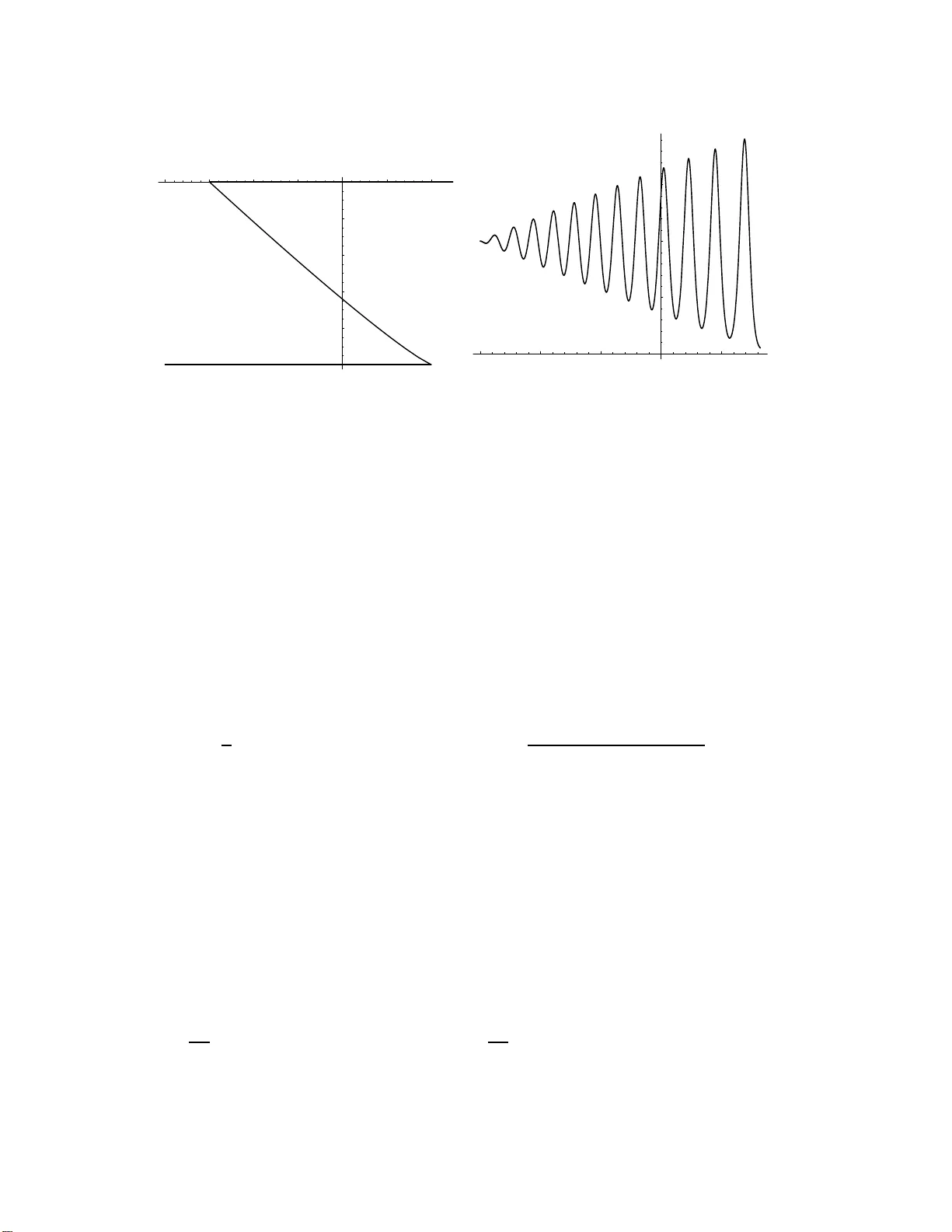
Ev olution of solitary w a v es and undular b ores in shallo w-w ater flo ws o v er a gradual slop e with b ottom friction G.A. El 1 , R.H.J. Grim shaw 2 Department of Mathemati cal Sciences, Loug h b orough Universit y , Loughbor ough LE11 3T U, UK 1 e-mail : G.El@lb oro.ac. uk 2 e-mail : R.H.J.Grimshaw@lb oro.ac.uk A.M. Kamc hatnov Institut e of Sp ectroscop y , Russian Academ y of Sciences, T roit sk, Mosco w Region, 1421 9 0 Russ ia e-mail : k am ch@isan.tro itsk.ru Abstract This pap er co nsiders the pr o p a gation of shallo w-wa ter solitary an d nonlinear p eri- o dic wa v es o v er a gradual slop e w ith b ott om fricti on in the fr amew ork of a v ariable- co efficien t Kortewe g-de V ries equation. W e use the Whitham av eraging method , u sing a r ecen t dev elopment of this theory for p ertur b ed inte grable equatio ns. This general approac h enables us n ot only t o imp ro ve kno wn results on the adiabatic ev olution of isolated solitary w a ves and p erio dic wa v e trains in th e p r esence of v ariable top ograph y and b ottom fr iction, mo deled b y the Chezy la w, b ut also imp ortan tly , to stu dy the effects of these factors on the propagation of undu lar b ores, wh ic h are essentia lly un- steady in the system u nder consideration. I n particular, it is shown that the co m b in ed action of v ariable top ography and b ottom friction generally imp oses certain global restrictions on the undular b ore p ropagation so that the ev olution of the leading soli- tary w a ve can b e su b stan tially different from that of an isolat ed solitary w av e with the same in itial amp litude. Th is non-lo cal effect is due to nonlinear wa v e int eractions within the und u lar b ore and can lead to an additional solitary wa v e amplitude gro wth, whic h cannot b e predicted in the framew ork of the traditional adiabatic approac h to the prop agation of solitary w av es in slo wly v arying media. 1 In tro duc tion There ha v e b een man y studies of the propa g ation of water w a ve s ov er a slop e, sometimes also sub ject to the effects of b ottom friction. Man y of these works hav e considered linear w av es, o r ha v e been numeric al sim ulations in the fr amew ork of v arious nonlinear long-w av e mo del equations. Our interes t here is in the propagation of weakly no nlinear long water 1 w av es ov er a slop e, sim ultaneously sub ject to b ottom friction, a com bination apparently first c onsidered b y Mile s (1983a,b) alb eit for the sp ecial case of a s ing le s o litary w a ve , or a p erio dic w a vetrain. An appropriate mo del equation for this scenario is the v ariable-co efficien t p erturb ed Kortew eg-de V ries (KdV) e quation (see Grimshaw 1981, Johnson 197 3a,b), A t + cA x + c x 2 A + 3 c 2 h AA x + ch 2 6 A xxx = − C D c h 2 | A | A. (1) Here A ( x, t ) is the free surface elev ation ab ov e t he undisturb ed depth h ( x ) and c ( x ) = p g h ( x ) is the linear long wa v e phase sp eed. The b ottom friction term on the rig h t- ha nd side is represen ted b y the Chezy law, mo delling a turbulen t b oundary lay er. Here C D is a non-dimensional dra g coefficien t, of ten a ssumed to hav e a v alue aro und 0 . 0 1 (Miles 1983 a ,b). Other forms of friction could b e used (see, for instance G r imsha w et al 200 3 ) but the Chezy la w seems to b e the most appropriate for w at er w a ve s in a shallow depth. In (1) the first t wo terms on t he left-hand side are the dominant terms, and by themselv es describ e the propagation of a linear long w av e with sp eed c . The remaining terms on the left-ha nd side represen t, resp ectiv ely , the effect of v arying depth, w eakly nonlinear effects and w eak linear dis p ersion. The equation is deriv ed using t he usual K dV balance in whic h the linear disp ersion, represen ted b y ∂ 2 /∂ x 2 , is balanced b y nonlinearit y , represen ted b y A . Here w e ha ve added to this balance w eak inhomogeneit y so that c x /c sc ales as h 2 ∂ 3 /∂ x 3 , and w eak friction so tha t C D scales with h∂ /∂ x . Within this basic balance of terms, w e can cast (1) in to the asymptotically eq uiv a len t form A τ + h τ 4 h A + 3 2 h AA X + h 6 g A X X X = − C D g 1 / 2 h 3 / 2 | A | A, (2) where τ = Z x 0 dx ′ c ( x ′ ) , X = τ − t. (3) Here w e hav e h = h ( x ( τ )), explicitly dep endent on the v ariable τ which describ es ev olution along the path of the w av e. The gov erning equation (2) can b e cast in to sev eral equiv alen t forms. That most com- monly used is the v ariable-co efficien t KdV equation, obtained here by putting B = ( g h ) 1 / 4 A (4) so tha t B τ + 3 2 g 1 / 4 h 5 / 4 B B X + h 6 g B X X X = − C D g 1 / 4 h 7 / 4 | B | B . (5) This form shows that, in the a bsence of friction term, i.e. when C D ≡ 0, equation (2) has t wo integrals of motion with t he densities prop ortional to h 1 / 4 A a nd h 1 / 2 A 2 . These are oft en referred to as la ws for the conserv a tion of “mass” and “momentum”. Ho we v er, these densities do not necess arily corresp ond to the correspo nding ph ysical en tities. Indeed, to leading order, the “ mo mentum” density is prop ortional to the wa v e action flux, while the “mass ” densit y differs slightly fro m the actual mass densit y . This latter issue has b een explored by Miles (1979), where it was sho wn that the difference is smaller than the error incurred in the deriv ation of equation (4), and is due to reflected w a ve s. Our main concern in this pap er is with the b eha viour o f an undular b ore o ve r a slop e in the presenc e of b ottom friction, using the p erturb ed KdV equation (2), where w e w ere 2 originally motiv ated b y the p ossibilit y that the b ehav iour of a tsunami appro a c hing the shore migh t b e mo deled in this w ay . The undular b or e solutio n to the unp erturb ed KdV equation can b e constructed using the w ell-known Gurevic h-Pitaevskii (GP) (19 74) approach (see also F or nberg and Whitham 1978) . In this approach, the undular bo re is represen ted as a mo dulated nonlinear p erio dic w av e train. The main feature of this unsteady undular b ore is the presence of a solitary w av e (whic h is the limiting w a ve form of t he p erio dic cnoidal w av e) at its leading edge. The original initial- v alue pro blem for t he KdV equation is then replaced by a certain b oundary- v alue pro blem for the asso ciat ed mo dulation Whitham equations. W e note, ho w ev er, that so far, the simplest, “( x/t )”-similarity solutions of the mo dulation equations ha ve been used for the mo delling of undular b ores in v arious con texts (see Grimshaw and Smyth 1986, Sm yth 1987 or Ap el 2003 for instance). These solutions, while effectiv ely describing man y features o f undular b o r es, are degenerate and fail to cap- ture, ev en qualitativ ely , some imp ortant effects a sso ciated with non-self-similar mo dulation dynamics. In pa rticular, in the classical GP solution for the resolution of an initial jump in the unp erturb ed KdV equation, the amplitude of the lead solitary w a v e in the undular b ore is constant (t wice the v alue of the initial j ump). On the other hand, t he mo dulation solution for the undular bore ev olving from a general monotonically decreasing initial pro file sho ws that the lead solita ry wa v e amplitude in fact grows with time (Gurevic h, Krylov and Mazur 1989 ; Gurevic h, Krylo v and El 1992 ; Kamchatno v 200 0). As w e shall see, the v ery p ossibilit y of su c h v ariations in the mo dulated solutions of the unp erturb ed KdV equation has a ve ry imp ort an t fluid dynamics implication: in a gener al setting, the undular b or e le ad solitary wave c annot b e tr e ate d as an individ ual KdV solitary wave but r ather r epr esents a p art of the glo b al no nline ar wave structur e . In other w ords, while at eve r y particular momen t of time the lead solitary w a v e has the spatial pro file of the familiar K dV s oliton, generally , the temp oral dep endence of its amplitude cannot b e obtained in the framew ork of single solitary wa v e p erturbation theory . In the unp erturb ed KdV equation, the gr owth of the lead solitary w av e amplitude is caused b y the spatial inhomogeneit y of the initial data . Here, how ev er, the presence of a p erturbation due to top ography and/or friction serv es as a n alternative and/or additional cause for v ariation of the lead solitary w av e amplitude. Th us, in the presen t case, the v ariation in the a mplitude will hav e t w o componen ts (whic h generally , of course, cannot b e separated b ecause of the nonlinear nature of the problem); one is lo cal, describ ed by the adiabatic perturbation theory for a single solitary w a v e, and the other one is nonlo cal, whic h in principle requires the study of the full mo dulation solution. D ep ending on t he relativ e v alues of the small parameters asso ciated with the slop e, friction and spatial non-uniformit y of the initial mo dulations, w e can tak e in to accoun t only one of these comp onents, or a com bination of them. The structure o f the pap er is as follow s. First, in Section 2, we reform ulate the basic mo del (1) as a constan t-co efficien t KdV equation p erturb ed b y terms represen ting top ogra ph y and friction. Then w e deriv e in Section 3 the asso ciated p erturb ed Whitham mo dulation equations using metho ds recen tly dev elop ed b y Kamc hatnov ( 2004). Next, in Section 4, this Whitham system is in tegrated in the solita ry-w av e limit. Our purp ose here is primarily to obtain the equation of a multiple c haracteristic, whic h defines the leading edge o f a shoaling undular b o r e in the case when the mo dulations due t o the com bined action of the slop e and b ottom friction are small compared to the existing spatial mo dulatio ns due to non-uniformit y of the initial data. As a b y-pro duct of this in tegration, w e repro duce and extend the kno wn 3 results on the adiabatic v ariation o f a single solitary w av e (Miles 1 9 83a,b). Then, in Section 5, w e carry out an analogous study of a cnoidal w a ve, propagating ov er a g r adual slop e and sub ject to friction, a case studied previously b y Mile s (1983 b) but under the r estriction of zero mean flow , whic h is r emo v ed here. Finally , in Section 6 w e study effects of a gradual slop e and b ottom friction on the fro n t of an undular b ore whic h represen ts a mo dulated cnoidal w av e transforming in to a system of w eakly inte racting solitons near its leading edge. 2 Problem form ulati o n F o r the purp ose of the presen t pap er it is con v enien t to recast (2) into the standard KdV equation form with constan t co efficien ts, mo dified b y certain perturbation terms. Th us w e in tro duce the new v ariables U = 3 g 2 h 2 A, T = 1 6 g Z τ 0 hdτ = 1 6 g 3 / 2 Z x 0 p h ( x ) dx. (6) so that U T + 6 U U X + U X X X = R = F ( T ) U − G ( T ) | U | U, (7) where F ( T ) = − 9 h T 4 h , G ( T ) = 4 C D g 1 / 2 h 1 / 2 . (8) In this f orm, the gov erning equation (7) has the structure of the in tegrable KdV equation on the left- hand side, while the separate effects of the v arying dep th and the b ottom friction are represen ted b y the tw o terms on the righ t- hand side. This structure enables us to use the general theory dev elop ed in K a mc hatnov (2004) for p erturb ed in tegrable systems. F o r m uch of the subse quen t discussion, it is useful to a ssume that h ( x ) = constan t , C D = 0 for x < 0 in the original equation (1), whic h correspo nds to F ( T ) = G ( T ) = 0 for T < 0 in (7). W e shall also a ssume tha t A = 0 f o r x > 0 at t = 0, whic h correspo nds to U = 0 for X > 0 on X = τ ( T ) (see (6)). Then w e shall prop ose tw o t yp es of initial-v a lue problem for (1), and corresp o ndingly for (7 ) . (a) Let a solitary w a ve of a giv en amplitude a 0 initially propagating o v er a flat bottom without friction ( i.e a s oliton describ ed b y an unp erturb ed KdV equation), en ter the v ariable top ogra phy and b ottom friction region at t = 0, x = 0 (Fig. 1 a) . (b) Let a n undular b or e of a giv en in tensit y propagate ov er a flat b ottom without friction (the corresp onding solution of the unperturb ed KdV equation will b e discuss ed in Section 5). Let the lead solitar y w av e of this undular b ore ha ve the same amplitude a 0 and ente r the v ariable top ography and b ottom friction region at t = 0, x = 0 (Fig. 1b). In par t icular, w e shall b e inte rested in the comparison of the slow ev olution of these t wo, initially iden t ical, solitary w av es in the t w o different problems described ab ov e. The exp ected essen tial difference in the ev olution is due to the fact that the lead solitary wa v e in the undular b ore is g enerally not independen t of the remaining part of t he bo r e and can exhibit features that cannot b e captured by a lo cal perturbation analysis. The w ell-know n example of s uc h a b eha viour, whe n a solita ry w av e is constrained b y the condition of b eing a part of a global nonlinear w a ve structure, is pro vided by the undular bore solution of the KdV-Burgers (KdV-B) equation u t + 6 uu x + u xxx = µ u xx , µ ≪ 1 . (9) 4 ( ) h x x 0 a) ( ) h x x 0 b) Figure 1: Isolated solitary w av e (a) and undular b ore (b) en tering the v aria ble to p ogra- ph y/b o t tom frictio n region. Indeed, the undular b ore solution of the KdV-B equation (9) is kno wn to ha ve a solitary w av e at its leading edge (se e Johnson 1970; Gurevic h & Pitaevskii 1987; Avilo v, Krichev er & No viko v 1987) and this solitary w av e: (a) is a symptotically close to a soliton solution of the unp erturb ed KdV equation; and (b) has the amplitude, sa y a 0 , that is constan t in time. A t the same time, it is clear that if one takes a n isolated KdV soliton of the same amplitude a 0 as initial data for the KdV-Burgers equation it w ould damp with t ime due to diss ipation. The ph ysical e xplanation of suc h a drastic difference in the b eha viour of an isolated soliton and a lead solitary wa v e in the undular b ore for the same we akly dissipativ e KdV-B equation is that the action of w eak dissipation on an expanding undular b ore is t wofold: on the one hand, the dissipation tends to decrease the amplitude of the w a ve lo cally but, on the other hand, it “squeezes” the undular b ore so that the interaction (i.e. momen tum exc hange) b et wee n separate solitons within the bo re b ecomes stronger than in the absence of dissipation and this acts as the amplitude increasing factor. The additional momen tum is extracted from the upstream flow with a g r eater depth (see Benjamin and Ligh thill 1 954). As a result, in the case of the KdV-B equation, an equilibrium non-zero v alue for the lead solitary w av e amplitude in the undular b ore is established. Of course, for o ther t yp es of dissipation, a stationary v a lue o f the lead soliton amplitude w ould not necessarily exis t, but in gene ral, due to the exp ected increase of the soliton in teractions near the leading edge, the amplitude of the lead soliton of the undular b ore w ould deca y slo w er than that of an isolated solito n. Indeed, the presence here of v ar ia ble t o p ography as w ell can result in an additional “nonlocal” amplitude growth. While the pro blem (a) can be solv ed using traditional p erturbation analysis for a s ingle solitary w a v e, which leads to an ordinary differen tial equation along the solitary w a ve path (see Miles 198 3a,b), t he undular b ore evolution problem (b) requires a more general appro ac h whic h can b e deve lop ed on the basis of Whitham’s mo dulation theory leading to a system of three nonlinear h yp erb o lic pa r tial differen tial equations of the first o r der. Since the Whitham 5 metho d, b eing equiv a len t to a nonlinear m ultiple scale p erturbation pro cedure, contains the adiabatic theory o f slow ev olution of a single s o litary w av e as a particular (a lb eit singular) limit, it is instructiv e for the purp o ses of this paper to treat b oth problems (a) and (b) using the general Whitham theory . 3 Mo dulation equatio n s The original Whitham metho d ( Whitham 1965, 1974) was dev elop ed for conserv ativ e constan t- co efficien t nonlinear disp ersive e quations a nd is bas ed o n the a v eraging of appropriate c on- serv atio n law s of the o riginal system ov er the p erio d of a single-phase p erio dic t r a velling w av e solution. The resulting system of quasi-linear equations describ es the slo w ev olution of the mo dulat ions (i.e. of the mean v alue, the w a v en um b er, the amplitude etc.) of the p e- rio dic tra v elling w a v e. Here, that a pproac h is extended to the perturb ed KdV equation (6) follo wing the general approach of Kamch atno v (2004), whic h extends earlier res ults for cer- tain sp ecific cases (see Gurevic h and Pitaevskii (1987, 1991), Avilo v, Kr ichev er and No vik o v (1987) and Myin t and G r imshaw (1995) for instance). W e suppose that the ev olution of the nonlinear w a ve is adiabatically slo w, that is, the w av e can b e lo cally represen ted as a solution of the corresp onding unp erturb ed KdV equation (i.e. (7) with zero o n the righ t- hand side) with it s parameters s lo wly v arying with space a nd time. The one-phase p erio dic solution of the KdV equation can b e written in the form U ( X , T ) = λ 3 − λ 1 − λ 2 − 2( λ 3 − λ 2 )sn 2 ( p λ 3 − λ 1 θ , m ) (1 0 ) where sn( y , m ) is the Jacobi elliptic sine function, λ 1 ≤ λ 2 ≤ λ 3 are parameters and the phase v ariable θ and the mo dulus m are giv en b y θ = X − V T , V = − 2( λ 1 + λ 2 + λ 3 ) , (11) m = λ 3 − λ 2 λ 3 − λ 1 , (12) and L = I dθ = Z λ 3 λ 2 dµ p − P ( µ ) = 2 K ( m ) √ λ 3 − λ 1 , (13) where K ( m ) is t he complete elliptic integral of the first kind, L is the “ wa v elength” along the X -a xis (whic h is actually a retarded time rather than a true spatial co-ordinate). Here w e ha ve used the represen tat io n of the basic ordinary differen tial equation fo r the KdV trav elling w av e solution (10) in the form (see Kamch atno v (2000) for a general motiv ation b ehind this represen tation) dµ dθ = 2 p − P ( µ ) , (14) where µ = 1 2 ( U + s 1 ) , s 1 = λ 1 + λ 2 + λ 3 (15) and P ( µ ) = 3 Y i =1 ( µ − λ i ) = µ 3 − s 1 µ 2 + s 2 µ − s 3 , (16) 6 that is the solution (10) is para meterized b y the zero es λ 1 , λ 2 , λ 3 of the p olynomial P ( µ ) . In a mo dula t ed wa v e, the pa r ameters λ 1 , λ 2 , λ 3 are allow ed to b e slo w functions of X a nd T , and their evolution is gov erned b y the Whitham equations. F or the unp erturb ed KdV equation, the ev olutio n of the mo dulation para meters is due to a spatia l no n-uniformit y of the initial distributions f o r λ j , j = 1 , 2 , 3 and the t ypical spatio- temp oral scale of the mo dulation v ariations is determined by the scale of the initial data. In the case of the p erturb ed KdV eq uation (7), the ev olution of the parameters λ 1 , λ 2 , λ 3 is caused not only b y their initial spatial non- unifo rmit y , but also b y the action of the w eak p erturbation, so that, generally , at least t w o independent spatio-temp oral scales for the mo dulations can b e in v olv ed. How ev er, at this p oint w e shall not in tro duce a n y scale separation within the mo dulation theory and deriv e general perturb ed W hitham equations assuming that the ty pical v alues o f F ( T ) a nd G ( T ) are O ( ∂ λ j /∂ T , ∂ λ j /∂ X ) within the mo dulation theory . It is instructive to first in tro duce the Whitham equations for the p erturb ed KdV equation (7) using the traditional approac h of a veraging the (p erturb ed) conserv ation la ws. T o this end, w e intro duce the av eraging o v er the p erio d (13) of the cnoidal w av e (1 0) b y h F i = 1 L I F dθ = 1 L Z λ 3 λ 2 F dµ p − P ( µ ) . (17) In particular, h U i = 2 h µ i − s 1 = 2 ( λ 3 − λ 1 ) E ( m ) K ( m ) + λ 1 − λ 2 − λ 3 , (18) h U 2 i = 8[ − s 1 6 ( λ 3 − λ 1 ) E ( m ) K ( m ) − 1 3 s 1 λ 1 + 1 6 ( λ 2 1 − λ 2 λ 3 )] + s 2 1 , (19) where E ( m ) is the complete elliptic in tegral of the second kind. Now , o ne represen ts the KdV equation (7) in the form o f the p erturb ed conserv ation laws ∂ P j ∂ T + ∂ Q j ∂ X = R j , j = 1 , 2 , 3 , R j ≪ 1 , (20) where P j and Q j are the standard expressions for the conserv ed densities (Krusk al integrals) and “fluxes” o f the unp erturb ed KdV equation. Just as in the Whitham (1965) theory fo r unp erturb ed disp ersiv e syste ms, the n umber of conserv ation la ws required is equal to the n umber o f free parameters in the trav elling w a ve solution, whic h is three in the presen t case. Next, one applies the av eraging (17) t o the system (20) to obtain (see Dubrovin and Nov ik ov 1989) ∂ h P j i ∂ T + ∂ h Q j i ∂ X = h R j i , j = 1 , 2 , 3 . (21) The system (21) describes slo w e v olution of the par a meters λ j in the cnoidal w a ve solution (10). Along with these deriv ed perturb ed conserv ativ e form of the Whitham equations, w e in tro duce the w av e conserv ation la w which is a general condition for the existence of slowly mo dulated s ing le-phase trav elling w av e s olutions (10) (see for instance Wh itham 1974) and m ust be consisten t with the mo dulation system (21). This conserv atio n la w has the form ∂ k ∂ T + ∂ ω ∂ X = 0 , (22) 7 where k = 2 π L , ω = kV (23) are the “w av en um b er” and the “frequency” resp ectiv ely (w e hav e put quotation marks here b ecause the actual w a v en umber and fr equency related to the phy sical v ariables x, t ar e differen t qu an tities from those in (23), but are related through the transfor ma t io ns (3 , 6) ). The w a v e conserv ation la w (22) can b e in tro duced instead of a n y of three inho mo g eneous a veraged conserv ation la ws comprising the Whitham system (21). It is kno wn that the Whitham system for the homogeneous constan t-co efficien t KdV equation can b e r epresen ted in diagonal (Riemann) form (Whitham 1965, 1974) b y an ap- propriate c hoice of the three parameters c haracterising the p erio dic tra velling w a ve solution. In fact, in o ur solution (7) the parameters λ j ha ve a lr eady b een c hosen so that they coincide with the Riemann in v arian ts of the unp erturb ed KdV mo dulation system. In tro ducing them explicitly in to the p erturb ed system (21) we obtain (see Kamch atno v 2004) ∂ λ i ∂ T + v i ∂ λ i ∂ X = L ∂ L/∂ λ i · h (2 λ i − s 1 − U ) R i 4 Q j 6 = i ( λ i − λ j ) , i = 1 , 2 , 3 , (24) where R is the p erturbation term on the right-hand side of the KdV equation ( 7) a nd v i = − 2 X λ i + 2 L ∂ L/∂ λ i , i = 1 , 2 , 3 , (25) are the Whitham c ha racteristic velocities corresp o nding to the unp erturb ed KdV equation. It should b e not ed that the straig htforw ard realisation of the a b ov e lucid general algo- rithm for obtaining p erturb ed mo dulation system in diago na l form is quite a lab orious task. In fact, to derive system (24), the s o-called finite-gap integration metho d incorp orating the in tegrable structure of the unp erturb ed KdV equation has b een used. The m o dulation sys- tem (24) in a more particular f o rm corresp onding to sp ecific c hoices of the p erturbation term w as obtained b y Myin t and Grimsha w (1995) using a m ultiple-scale p erturbation expans ion. In that latter setting, the w av e conserv ation law (22) is an inherent pa rt of the construction, while in the av eraging approac h used here, it can b e obtained as a conseq uence of the system (24). T o o btain an explicit represen tation of the Whitham equations for the presen t case o f equation (7), w e mus t substitute the p erturbation R f rom the right-hand side of (7) and p erform the integration (17 ) with U giv en b y ( 1 0). F r o m now on, w e are go ing to consider only the flows where U ≥ 0 so that the p erturbation term assumes the form R ( U ) = G ( T ) U − F ( T ) U 2 . (26) Substituting (26) in to (24) we obtain, after some detailed calculations (see App endix), the p erturb ed Whitham system in the for m ∂ λ i ∂ T + v i ∂ λ i ∂ X = ρ i = C i [ F ( T ) A i − G ( T ) B i ] , i = 1 , 2 , 3 (27) where C 1 = 1 E , C 2 = 1 E − (1 − m ) K , C 3 = 1 E − K ; (28) 8 A 1 = 1 3 (5 λ 1 − λ 2 − λ 3 ) E + 2 3 ( λ 2 − λ 1 ) K , A 2 = 1 3 (5 λ 2 − λ 1 − λ 3 ) E − ( λ 2 − λ 1 ) 1 3 + λ 2 λ 3 − λ 1 K, A 3 = 1 3 (5 λ 3 − λ 1 − λ 2 ) E − λ 3 + 1 3 ( λ 2 − λ 1 ) K ; (29) B 1 = 1 15 ( − 27 λ 2 1 − 7 λ 2 2 − 7 λ 2 3 + 2 λ 1 λ 2 + 2 λ 1 λ 3 + 22 λ 2 λ 3 ) E − 4 15 ( λ 2 − λ 1 )(3 λ 1 + λ 2 + λ 3 ) K , B 2 = 1 15 ( − 7 λ 2 1 − 27 λ 2 2 − 7 λ 2 3 + 2 λ 1 λ 2 + 22 λ 1 λ 3 + 2 λ 2 λ 3 ) E + 1 15 λ 2 − λ 1 λ 3 − λ 1 (7 λ 2 1 + 15 λ 2 2 + 11 λ 2 3 − 6 λ 1 λ 2 − 18 λ 1 λ 3 + 6 λ 2 λ 3 ) K , B 3 = 1 15 ( − 7 λ 2 1 − 7 λ 2 2 − 27 λ 2 3 + 22 λ 1 λ 2 + 2 λ 1 λ 3 + 2 λ 2 λ 3 ) E + 1 15 (7 λ 2 1 + 11 λ 2 2 + 15 λ 2 3 − 18 λ 1 λ 2 − 6 λ 1 λ 3 + 6 λ 2 λ 3 ) K ; (30) and the c har a cteristic ve lo cities are: v 1 = − 2 X λ i + 4( λ 3 − λ 1 )(1 − m ) K E , v 2 = − 2 X λ i − 4( λ 3 − λ 2 )(1 − m ) K E − (1 − m ) K , v 3 = − 2 X λ i + 4( λ 3 − λ 2 ) K E − K . (31) The equations (27) – (31) pro vide a general se tting for studying the nonlinear mo dulated w av e ev olution ov er v ariable top ography with b ottom friction. In the absence of the p ertur- bation terms (i.e. when F ( T ) ≡ 0, G ( T ) ≡ 0), the system (27), (31) indeed coincides with the original Whitham equations (Whitham 1965) for the inte grable KdV dynamics. In that case the v ariables λ 1 , λ 2 , λ 3 b ecome Riemann inv ariants, so in this g eneral (p erturb ed) case w e s ha ll call them Riemann v ariables. It is imp ortan t t o study the structure of the p erturb ed Whitham equations (27) – (31) in t wo limiting cases when the underlying cnoidal wa v e degenerates in to (i) a small-amplitude sin usoidal w av e (linear limit), when λ 2 = λ 3 ( m = 0) , and (ii) into a solitary w av e when λ 2 = λ 1 ( m = 1). Since in b o th these limits the oscillations do not con tribute to the mean flo w (they are infinitely small in t he linear limit and the distance b et wee n them b ecomes infinitely long in the solitary wa v e limit) one should exp ect that in b oth cases one of the Whitham equations will tra nsfor m in to the disp ersionless limit of the original p erturb ed KdV equation (7) i.e. U T + 6 U U X = F ( T ) U − G ( T ) U 2 , (32) 9 Indeed, using formulae (2 7) – (31 ) w e o bta in for m = 0: λ 2 = λ 3 , ∂ λ 1 ∂ T − 6 λ 1 ∂ λ 1 ∂ X = λ 1 F + λ 2 1 G, ∂ λ 3 ∂ T + (6 λ 1 − 12 λ 3 ) ∂ λ 3 ∂ X = λ 1 F + λ 2 1 G . (33) Similarly , for m = 1, one has λ 2 = λ 1 , ∂ λ 1 ∂ T − (4 λ 1 + 2 λ 3 ) ∂ λ 1 ∂ X = 1 3 (4 λ 1 − λ 3 ) F + 1 15 (7 λ 2 3 − 24 λ 1 λ 3 + 32 λ 2 1 ) G, ∂ λ 3 ∂ T − 6 λ 3 ∂ λ 3 ∂ X = λ 3 F + λ 2 3 G . (34) W e see that, in b oth case s, one of the Riemann v ariables (take n with inv erted sign) coincides with the solution of the disp ersionless equation (32) (recall that in the deriv ation of the Whitham equations we assumed U ≥ 0 eve rywhere), name ly U = h U i = − λ 1 when λ 2 = λ 3 ( m = 0) and U = h U i = − λ 3 when λ 2 = λ 1 ( m = 1). T o conclude this section, w e presen t ex pressions for the ph ysical w a ve parameters su c h as the surface elev ation wa v e amplitude a , mean elev ation h A i sp eed and w av en um b er in terms of the mo dulat io n s olution λ j ( X , T ). Using (6) and (10) we obta in for the w a v e amplitude (p eak to tro ugh) and the mean elev a tion a = 4 h 2 3 g ( λ 3 − λ 2 ) , h A i = 2 h 2 3 g h U i , (35) where the dep endence of h U i on λ j ( X , T ) , j = 1 , 2 , 3 is give n b y (1 8) and X = X ( x, t ), T = T ( x, t ) b y (3, 6). In order to obtain the ph ysical w av en um b er κ and the frequency Ω w e first note that the phase function θ ( X , T ) defin ed in (11) is replaced b y a more general expression defined so that k = θ X and k V = − θ T are the “w av en um b er” and “frequency” in the X − T co ordinate system. Then we define the ph ysical phase function Θ( x, t ) = θ ( X , T ) so that w e get κ = Θ x , Ω = − Θ t . (36) It no w f ollo ws that κ = k c (1 − hV 6 g ) , Ω = k , and Ω κ = c 1 − hV / 6 g . (37) Note t ha t the phy sical frequency is the “w a ve n umber” in the X − T coo rdinate system , and that the phys ical phase sp eed is Ω /κ . Since the v alidit y of the KdV mo del (1) requires inter alia that the w a ve b e righ t -going it follo ws from this expres sion tha t the mo dulation solution remains v alid o nly when hV < 6 g . Of course, the v alidity of (1 ) also requires that the amplitude remains small, a nd this w ould normally a lso ensure that V remains small. 10 4 Mo dulation solu tion in the solitary w a v e limit In this section, we shall in t egr a te the p erturb ed modulat io n system (27) along the m ultiple c haracteristic corresp onding to the merging of t w o Riemann v ariables λ 2 and λ 1 . As w e shall see later, this c haracteristic sp ecifies the motion of the leading edge of the shoaling undular b ore in the case when the p erturbations due to v ar iable top ography and b otto m friction can b e considered as small compared with the existing sp atial mo dula t io ns within t he bo r e. At the same time, as the case λ 2 = λ 1 ( i.e. m = 1) corresponds to the solitary w a ve limit in the tra velling w av e solutio n ( 1 0), our results here are exp ected to b e consisten t with the results from the traditional p erturbatio n approac h to the adiabatic v ariation of a solitary w av e due to top o graph y and b ottom friction (see Miles 1983a ,b). In the limit m → 1 the p erio dic solution (10) o f the KdV equation go es ov er to its solitary w av e solution U ( X , T ) = U 0 sec h 2 [ p λ 3 − λ 1 ( X − V s T )] − λ 3 , (38) where U 0 = 2 ( λ 3 − λ 1 ) , V s = − (4 λ 1 + 2 λ 3 ) (39) are the solitary w av e amplitude and “v elo city” resp ectiv ely . The solution (38) dep ends on t w o parameters λ 1 and λ 3 whose a dia batic slow ev o lution is gov erned b y the reduced modulation system (34). It is imp ortan t that the second equation in this system is decoupled fr o m the first one. Hence, ev olution of the p edestal − λ 3 on whic h the solitary w av e r ides, can b e fo und from the solution of this disp ersionless equation b y the metho d of c har a cteristics. When λ 3 ( X , T ) is kno wn, ev o lution of the parameter λ 1 can be found from the solution of the first equation (34). As a result, we arriv e at a complete description of adiabatic slo w ev olution of the solitary w av e parameters taking a ccoun t of its interaction with t he (give n) p edestal. Ho we v er, it is imp ortan t to note here that while this description of the a dia batic ev olution of a solita ry w av e is complete as far as the solita r y w av e itself is concerned, it f ails to describ e the ev olution o f a trailing shelf, whic h is needed to conserv e total “mass” (see, for instance, Johnson 1973b, Grimshaw 1979 or Grimshaw 2006). This trailing shelf has a v ery small amplitude, but a very large length scale, and he nce can carry the same order of “mass” as the solitary wa v e. But note that the “momen tum” of the trailing shelf is muc h smaller than that of the solitary wa v e, whose adiabatic de formation is in fact gov erned to leading o rder b y conserv atio n of “momentum”, or more precisely , b y conserv ation of w av e action flux (strictly sp eaking, conserv ation only in the absence of friction). The situation simplifies if the solitary w av e pro pagates into a region of still w ater so that there is no p edestal ahead of the w av e, t ha t is λ 3 = 0 in X > τ ( T ). But then, since λ 3 = 0 is a n exact solution of the degenerate Whitham system (34) f or this solitary w av e configuration, w e can put λ 3 = 0 b oth in the solitary wa v e s olution, U ( X , T ) = − 2 λ 1 sec h 2 [ p − λ 1 ( X − V s T )] , V s = − 4 λ 1 , (40) and in equation (34) for the para meter λ 1 to obtain, ∂ λ 1 ∂ T − 4 λ 1 ∂ λ 1 ∂ X = 4 3 F λ 1 + 32 15 Gλ 2 1 , (41) 11 As w e see, the solitary wa v e mo v es with the instan t v elo city dX dT = − 4 λ 1 , (42) and the parameter λ 1 c hanges with T along the solitary w av e tra jectory according to the ordinary differen tial equation dλ 1 dT = 4 3 F ( T ) λ 1 + 32 15 G ( T ) λ 2 1 . (43) It can b e sho wn that eq uation (43) is consisten t with the equation for the solitar y w a ve half- width γ = √ − λ 1 obtained b y the traditional perturbation approac h (see Grimsha w (1979) for instance). Next, w e re-write equation (43) in terms the original independen t x -v ariable. F or that, w e fin d from (6), that dT = ( h 1 / 2 / 6 g 3 / 2 ) dx (44) and F = − 27 2 g h 3 / 2 dh dx , G = 4 C D g h 1 / 2 . (45) Then substituting these expressions into (43) yields the equation dλ 1 dx = − 3 1 h dh dx λ 1 + 64 45 C D g λ 2 1 (46) whic h can b e easily in tegrated to giv e 1 λ 1 = h 3 − C 0 − 64 45 C D g Z x 0 dx h 3 , (47) where C 0 is an in tegra t ion constan t and x = 0 is a reference p oin t where h = h 0 . According to (40), U 0 = − 2 λ 1 is the a mplitude of the soliton expressed in terms of v ariable U ( X , T ) . Returning to the original surface displacemen t A ( x, t ) b y means of (6) and denoting C 0 = 4 / (3 g a 0 h 0 ), we find the dep endence of the surface elev ation soliton amplitude a = (2 h 2 / 3 g ) U 0 on x in the form a = a 0 h 0 h 1 + 16 15 C D a 0 h 0 Z x 0 dx h 3 − 1 , (48) where a 0 is t he solitary w a ve amplitude at x = 0. W e note that for C D = 0 t his reduces to the classical Boussinesq (1872 ) result a ∼ h − 1 , while for h = h 0 it reduces to the w ell-know n algebraic deca y la w a ∼ 1 / (1 + constant x ) due to Chezy friction. Miles (1 983a,b) obtained this expression for a linear depth v ariation, a lthough we note tha t there is a factor of 2 difference from (48) (in Miles (1983a,b) the factor 16 C D / 15 is 8 C D / 15). The tra jectory of the soliton can b e now fo und from (42) and (47): X = Z x 0 dx √ g h − t = a 0 h 0 2 √ g Z x 0 dx ′ h − 5 / 2 ( x ′ ) " 1 + 16 15 C D a 0 h 0 Z x ′ 0 dx h 3 ( x ) # − 1 . (49) This expression determines implicitly the dep endence of x o n t along the solitary w a ve path and pro vides the desired equation for the m ultiple c haracteristic o f the mo dulation system for the case m = 1. 12 It is instructiv e to deriv e an explicit express io n for the solitary w a ve speed b y computing the deriv a tiv e dx/dt f r om (49), or more simply , directly from (3 7), v s = dx dt = c 1 − a/ 2 h . (50) The form ula (50) yields the restriction for the relativ e amplitude γ = a/h < 2 whic h is clearly b ey ond the applicabilit y of the KdV approximation (wa v e breaking o ccurs a lr eady at γ = 0 . 7 (see Whitham 1974)). In the frictionless case ( C D = 0) equation (48) giv es a/h = a 0 h 0 /h 2 , and so the expression (50) for the sp eed mus t f ail as h → 0. It is in teresting to note that this failure of the KdV mo del as h → 0 due t o app earance o f infinite (and further negativ e!) solita ry w av e sp eeds is not apparen t from the expression (48) for the solitary w a ve amplitude, and the implication is that the mo del cannot b e con tinue d as h → 0. Curiously this res triction of the KdV mo del see ms nev er to ha ve been noticed b efore in spite of n umerous w orks o n this sub j ect. Note that taking a ccount of b ottom friction leads to a more complicated form ula for the solitar y w av e speed as a function of h but t he qualitativ e res ult remains the same. It is straigh tforward to show fro m ( 46) or (48) that a x a = − h x h − 16 15 C D a 0 h 0 h 3 1 + 16 15 C D a 0 h 0 Z x 0 dx h 3 − 1 . (51) It follow s immediately tha t fo r a w a ve adv a ncing into increasing depth ( h x > 0 ), the ampli- tude decreases due to a com bination of increasing depth and bot t o m friction. How ev er, for a w a ve adv ancing in to decreasing de pth, there is a tendency to increase the amplitude due to the depth decreas e, but to decrease the amplitude due to b ottom friction. Hence whether or not the amplitude increases is determined b y whic h of these effects is larger, and this in turn is determined by the slop e, t he depth, and the consolidated drag parameter C D a 0 /h 0 . T o illustrate, le t us consider the b ot tom top ography in the form h ( x ) = h 1 − α 0 ( h 0 − δ x ) α , α > 0 , (52) whic h satisfies the condition h (0) = h 0 ; the parameter δ c haracterizes the slop e of the b ot- tom. In this case the form ula (48) b ecomes a = a 0 h 0 h " 1 + 16 15 C D a 0 δ (3 α − 1) h 0 ( h 0 h (3 α − 1) /α − 1 )# − 1 (53) if α 6 = 1 / 3 . One can see now that if α < 1 / 3 , then the b ottom friction t erm is relativ ely unimp ortant due to the smallness of C D . Of course, for this case w e again reco ve r the Boussinesq result, now sligh tly mo dified, a ≈ a 0 h 0 h 1 + 16 15 C D a 0 δ (1 − 3 α ) h 2 0 − 1 , 0 < α < 1 3 , h ≪ h 0 . (54) Of course , this result is impractical in the KdV con text as the K dV appro ximation used here requires the ratio a/h to remain small. 13 If α > 1 / 3 no w o bta in asymptotic formula a ≈ 15(3 α − 1) δ 16 C D h 0 h 0 h 1 α − 2 , h ≪ h 0 , (55) whic h is indep enden t of the initial amplitude a 0 . This expression is consisten t with the small- amplitude KdV approximation as long as (3 α − 1 ) δ / C D is order unit y . Simple insp ection of (55) sho ws that the solitary wa v e amplitude • increases as h → 0 if 1 3 < α < 1 2 , • is constan t as h → 0 if α = 1 2 , • decreases as h → 0 if α > 1 2 . Th us for 1 / 3 < α < 1 / 2, as for the case α < 1 / 3 , the amplitude will increase as the depth decreases, in spite of the presence of (sufficien tly small) friction. Ho wev er, for α > 1 / 3, ev en although there is usually some initial gro wth in t he amplitude, ev en tua lly ev en small b ottom friction will tak e effect and the amplitude de creases to zero. W e note that if α = 1 / 3 the n the in tegral R x 0 h − 3 dx in (48 ) dive rges logarithmically as h → 0, whic h just sligh tly mo difies the result (55) for h ≪ h 0 and implies growth of the amplitude ∝ ln h/h as h → 0. Of particular in terest is the case α = 1. In tha t case formula (53) b ecomes a = a 0 h 0 h " 1 + 8 15 C D a 0 δ h 0 ( h 0 h 2 − 1 )# − 1 . (56) and a ≈ 15 8 δ C D h , h ≪ h 0 (57) These express io ns (56, 57) w ere obt a ined b y Miles (1983a,b) us ing w a ve energy conse rv ation (as ab ov e, note, ho wev er, that in Miles (198 3 a,b) the numerical co efficien t is 15 / 4 rather than 15 / 8). Thus , these results obtained from the Whitham theory a re indeed consisten t, at the leading order, with the traditional p erturbation a pproac h for a slo wly-v arying solitary w av e. 5 Adiabatic defo rmation of a cnoidal w a v e Next we consider a mo dulated cnoidal w av e (10) in the sp ecial case when the mo dulation do es not dep end on X . While this case is, strictly sp eaking, impractical as it a ssumes there is an infinitely long w av etrain, it can nev ertheless pro vide some useful insigh ts in to the qualitative effects of gradual slop e and frictio n on undular bores which are lo cally represen ted as cnoidal w av es. In the absence of friction, the slow dep endence of the cnoidal w a ve pa r ameters on T w as obtained b y Ostrovs ky & P elinovs ky (19 70, 19 75) and Miles (197 9) (see also Grimshaw 2006), assuming that the surface displacemen t had a zero mean (i.e. h U i = 0), while, the effects of friction w ere tak en into account b y Miles (1983b) using the same zero-mean displacemen t assumption. Ho w ever, this assumption is inconsisten t with our aim to study undular b ores where the v alue of h U i is essen tially nonzero. Hence, w e need to dev elop a 14 more general theory enabling us to tak e into accoun t v ariations in all the parameters in the cnoidal w av e. Suc h a general setting is provided b y t he mo dulation system (27). Th us w e consider the case when the Riemann v ariables in (27) do not dep end on the v ariable X so that t he g eneral Whitham equations b ecome ordinary differen tial equations in T , whic h can b e con ven ien tly reform ulated in terms of the original spatial x -co ordinate using the relationship (44 ) : dλ i dx = C i − 9 4 1 h dh dx A i − 2 C D 3 g B i , i = 1 , 2 , 3 , (58) where a ll v ariables are defined a b ov e in se ction 3 (see 28, 29, 30). This sy stem can b e readily solv ed numeric ally . But it is ins t r uctive, how ev er, to first indicate some general prop erties of the solution. First, the solution to the sys t em (58) m ust ha v e the pr o p ert y o f conserv ation of “ wa v e- length” L (or “w av en umber” k=2 π / L ) L = 2 K ( m ) √ λ 3 − λ 1 = constant (59) Indeed, the wa v e conserv ation law (22) in absence of X -dep endence assumes t he f orm ∂ k ∂ T = 0 , (60) whic h yields (59). Th us the syste m of three equations (58) can be reduced to t w o equations. Next, applying Whitham av eraging directly to (7) yields dM dx = − 9 4 1 h dh dx M − 2 C D 3 g ˜ P , M = h U i , ˜ P = h| U | U i . (61) dP dx = − 9 2 1 h dh dx P − 4 C D 3 g ˜ Q , P = h U 2 i , ˜ Q = h| U | 3 i . (62) The equation set (59), (61), (62) comprise a closed mo dulation system for three indep enden t mo dulation parameters, sa y M , ˜ P and m . While this system is not as con ve nien t for further analysis a s the system (27) in Riemann v a riables, it do es not hav e a restriction U > 0 inheren t in (27), and a llo ws for some straigh tfo rw ard inf erences regar ding the p o ssible existence of mo dulation solutions with zero mean elev a tion, that is with M = 0 . Indeed, one can see that the solution w ith the zero mean is actually not generally p ermissible when C D 6 = 0, a situation ov erlo ok ed in Miles (19 83b). Indeed, M = 0 immediately then implies that ˜ P = 0 b y (61). But then due to (59) w e ha v e all three mo dulation parameters fixed whic h is clearly inconsisten t with the remaining equation (62) (except for the trivial case M = 0, P = 0, ˜ Q = 0). Ho wev er, in the absence of friction, when C D = 0, equation (61) uncouples and p ermits a non trivial solution with a zero mean. In general, when C D = 0 equations (61), (62) can b e easily integrated to g iv e d = M h 9 / 4 = constan t; σ = P h 9 / 2 = constan t . (63) Then, using (18, 19, 59) one readily gets the formula for the v ariation of t he mo dulus m , and hence of all the other w a ve parameters, as a function of h K 2 [2(2 − m ) E K − 3 E 2 − (1 − m ) K 2 ] = 4 3 5 ( σ − d 2 ) L 4 h 9 / 2 . (64) 15 200 400 600 800 0. 2 0. 4 0. 6 0. 8 m C = 0 C = 0.01 D D x Figure 2: Dep endence o f the mo dulus m on the ph ysical space co ordinate x in the cases without and with b ott om friction in the X -indep enden t modulat io n solution. F o rm ula (64) g eneralises to the case M 6 = 0 (i.e. d 6 = 0) the expressions of Ostrov sky & P elinov sky (1970, 1975), Miles (19 7 9) and Grimsha w (2 006) (note that in Grimsha w (20 06) the zero mean restriction in actually not necessary). W e not e here that, again with C D = 0, equation (5) implies conserv ation of h B i and h B 2 i (the av eraged w av e a ctio n flux), whic h, together with (59), also yield (64 ). The phy sical frequency Ω and wa v en um b er κ in t he mo dulated p erio dic wa v e under study are giv en b y the formula (37), and w e recall here that k = 2 π /L is constant (see (59)). As discusse d b efore at the end o f Section 3 w e m ust require that t he phase sp eed sta ys p ositiv e as the w av e ev olves , and here that requires that the ph ysical w av en umber κ > 0. Since a/h (and hence hV / 6 g ) is supp o sed to b e small within the range of applicabilit y of the KdV equation (2) the expression (37) implies the b eha viour κ ≃ Ω / √ g h whic h of course agrees with the w ell k no wn res ult for linear wa v es on a sloping b eac h (see Johns on 1997 for instance). This effect will b e sligh tly attenuated for the nonlinear cnoidal w av e, since V h/ 6 g > 0, but the o verall effect will b e a “squeezing” of the cnoidal w av e, a result imp orta n t for o ur further study of undular b ores. Next we study n umerically the com bined effect of slop e and friction on a cnoidal w av e. As we hav e sho wn, in the presence of Chezy friction M 6 = 0, and we ha ve also assumed that U > 0, whic h is necessary when we come to study undular b ores. Now w e use the stationary mo dulation system (5 8) in Riemann v ariables, whic h w as deriv ed using this as- sumption. W e solv e the coupled ordinary differential equation system (58 ) for the case of a linear slop e h ( x ) = h 0 − δ x (65) with h 0 = 10, δ = 0 . 01, and w it h the initial conditions λ 1 = − 0 . 4 41 , λ 2 = 0 . 147 , λ 3 = 0 . 294 at x = 0 , (66) whic h corresp o nds to a nearly harmonic w av e with m = 0 . 2 , a/h 0 = 0 . 2, h A i / h 0 ≈ 0 . 3 at x = 0 (see (35)). Also w e note that f o r the chos en pa r a meters we hav e V = 0, so at x = 0 w e ha v e κ = Ω / √ g h 0 as in linear theory . It is instructiv e to compare solutions with ( C D = 0 . 01) and without ( C D = 0) friction. In Fig. 2 the dep endence of the mo dulus m 16 100 200 300 400 500 2. 8 3. 2 3. 4 C = 0 C = 0.01 D D x 100 200 300 400 500 4. 2 4. 4 4. 6 4. 8 5 5. 2 h 1/4 C = 0 C = 0.01 D D x Figure 3: Left: Dep endence of the mean v alue h A i in the X -indep enden t mo dulation solution on t he phys ical space co ordinate x without (da shed line) a nd with (solid line) b ottom friction; Righ t: Same but multiplied b y t he G reen’s la w factor , h 1 / 4 100 200 300 400 500 1. 4 1. 6 1. 8 2. 2 2. 4 C = 0 C = 0.01 a(x) x D D Figure 4: Dep endence of the surface elev at ion amplitude a on the space co ordinate x . Dashed line corresp onds to the frictionless case and solid line to the case with b otto m friction. on x is sho wn for b oth cases. W e see that for the frictionless case m → 1 with decrease of depth, i.e. the w av e crests ass ume the shap e of s o litary w av es when o ne approac hes the shoreline. When C D 6 = 0 the mo dulus also grows with decrease of de pth but nev er reac hes unit y . The dep endence on x of the mean surface elev ation h A i for the cases without and with friction is sho wn in Fig . 3. W e hav e chec k ed that the “wa v elength” L (59) is cons tan t for b oth solutions. Also, one can see from Fig. 3 (rig ht) that the v alue h 1 / 4 h A i ∝ d is indeed conserv ed in the frictionless case but is not constant if fr iction is presen t (the same ho lds true for the v alue h 1 / 2 h A 2 i ∝ σ but w e do not presen t the graph here). Fina lly , in Fig. 4 the dep endence of the ph ysical elev ation w av e amplitude a on the spatial co ordinate x is sho wn. One can see that the amplitude adiabatically gro ws with distance in the frictionless case due to the effect of the slope (without friction) but, not unexpectedly , gradually decreases in t he case when b otto m friction is presen t, w here the decrease for these parameter settings is comparable in magnitude to the effect of t he slop e. In b oth cases t he main qualitativ e 17 c hanges occur in the wa v e shap e and the w a ve length. Ov erall, we can infer from these results that the main lo cal effect of a slop e a nd b o ttom friction on a cnoidal w a ve, along with the adiabat ic a mplitude v a riations, is tw ofold: a w av e with a m < 1 at x = 0 tends to transform in to a sequenc e of solitary w a ves as x decreases, and at the same time the distance b etw een subs equen t w av e cres ts tends to dec rease. This is in sharp con trast with the b ehaviour of mo dulated cnoidal w av es in problems described b y the unperturb ed KdV equation, where grow th of the mo dulus m is accompanied by an incr e ase of the distance b etw een the wa v e crests. Generally , in the study of b eha viour of unsteady undular b ores in the presence of a slop e and b ott o m friction w e will hav e to deal with the comb ination of these tw o opp osite tendencies. 6 Undular b ore propagation o v er v ariable top ograph y with b ottom friction 6.1 Gurevic h-Pitaevskii problem for flat-b ottom zero-friction case W e no w turn to the problem (b) outlined in Sec tion 2 . W e study the ev olution of a n undular b ore deve loping from an initial surface elev atio n jump ∆ > 0, lo cated at some p oint x 0 < 0. As discussed b elo w, the undular b ore will expand w ith time so that at some t = t 0 its le ad solitary w a ve enters the gra dual slop e region, whic h b egins at x = 0 (see Fig. 1b). W e assume that f o r x < 0 o ne has h = h 0 = constan t a nd C D ≡ 0. W e shall first presen t a formu lation of the Gurevic h-Pitaevskii problem for the p erturbat io n-free KdV equation and repro duce the w ell-kno wn similarit y mo dulation solution describing the ev olution of the undular b o r e un til the momen t it en ters the slop e. W e emphasize that , althoug h this form ula t io n and, esp ecially , this similarit y solution are kn o wn v ery w ell and ha v e b een used by many authors, some of the inferenc es impo r tan t for the presen t application to fluid dynamics ha v e not been widely appreciated, as far a s w e c an discern. P ertinent to our main o b jectiv e in t his pap er, w e undertak e a detailed study of the c haracteristics of the Whitham mo dulation s ystem in the vicinit y of the leading edge of the undular b ore solution, and sho w that the b o undary con- ditions of Gurevic h-Pitaevskii t yp e p ermit only t wo possible characteristics configurations, implying t w o qualitative ly differen t t yp es of the leading solitary w a ve b eha viour. Next, w e shall sho w ho w this Gurevic h-Pitaevskii formulation of the problem applies to the perturb ed mo dulation system in the form (2 7) and finally w e will study the effects of the p erturbation on the mo dulatio ns in the vicinit y of the leading edge of the undular b ore. In the case o f a flat, fr ictionless bo ttom the original equation (1) b ecomes the constant- co efficien t KdV equation whic h can b e cast in t o the standard f orm η ζ + 6 η η ξ + η ξ ξ ξ = 0 (67) b y in tro ducing the new v ariables η = 2 3 h 0 A , ξ = 3 2 h 0 ( x + x 0 − p g h 0 t ) , ζ = 9 16 r g h 0 t , (68) where x 0 < 0 is an arbitra ry constan t. In the Gurevic h-Pitaevskii (GP) approac h, one considers a lar ge-scale initial disturbance η ( ξ , 0) = f ( ξ ), in the form of a decreasing pro file, 18 f ′ ( ξ ) < 0 (e .g. a smo oth step: f ( ξ ) → 0 as ξ → + ∞ ; f ( ξ ) → η 0 > 0 as ξ → −∞ ) , whose initial ev olution until some critical (breaking) time ζ b can b e describ ed b y the dispersionless limit of the KdV equation, i.e. b y the Hopf equation, ζ < ζ b : η ≈ r ( ξ , ζ ) , r ζ + 6 r r ξ = 0 , r ( ξ , 0) = f ( ξ ) . (69) The ev olution (69) leads to w a ve-breaking of the r ( ξ )-profile at some ζ = ζ b , with the consequenc e that the dispersiv e term in the KdV equation then comes into play , and a n undular b ore forms, whic h can b e lo cally represen ted as a single-phase tra v elling wa v e. This tra velling wa v e is mo dulated in suc h a w a y that it acquires the form of a solitary w a ve at the leading edge ξ = ξ + ( ζ ) and gradually degenerates, via the nonlinear cnoidal-w a v e regime, to a linear wa v e pack et at the trailing edge ξ = ξ − ( ζ ) . It is importa n t that this undular b ore is essen tially unsteady , i.e. the region ξ − ( ζ ) < ξ < ξ + ( ζ ) expands with time ζ . The single-phase trav elling w a ve solutio n of the KdV equation (67) has the fo r m (cf. (10)) η ( ξ , ζ ) = r 3 − r 1 − r 2 − 2( r 3 − r 2 )sn 2 ( √ r 3 − r 1 θ , m ) (70) θ = ξ + 2( r 1 + r 2 + r 3 ) ζ , m = r 3 − r 2 r 3 − r 1 . (71) The parameters r 1 ≤ r 2 ≤ r 3 ≤ 0 in the undular b ore are slowly v arying functions of ξ , ζ , whose ev olution is gov erned b y the Whitham equations ∂ r j ∂ ζ + v j ( r 1 , r 2 , r 3 ) ∂ r j ∂ ξ = 0 , j = 1 , 2 , 3 . (72) The c hara cteristic v elo cities in (7 2) are giv en by (3 1 ). W e stress that, alt hough analytical expressions (70) and (10 ) ( a s w ell a s (72) and the homogeneous v ersion of (27)) are identical, they are written for completely differen t sets o f v a r iables, b oth dep enden t a nd indep enden t. The Riemann in v ariants r j ( ξ , ζ ) are sub ject to sp ecial match ing conditions at the free b oundaries, ξ = ξ ± ( ζ ) defined b y the c onditions m = 0 (trailing edge) and m = 1 (leading edge), fo rm ulated in Gurevic h a nd Pitaevsk ii (1974) (see also Kamc hatno v (2000) or El (2005) for a detailed description). A t the trailing (harmonic) edge, where the w av e amplitude a = 2( r 3 − r 2 ) v anishes and m = 0, one has ξ = ξ − ( ζ ) : r 2 = r 3 , − r 1 = r . (73) A t the leading (soliton) edge, where m = 1 one has ξ = ξ + ( ζ ) : r 2 = r 1 , − r 3 = r . (74) In b oth (73) and (74), r ( ξ , ζ ) is the solutio n of the Hopf equation (69) . The curv es ξ = ξ ± ( ζ ) are defined for the solution of the GP problem (72) , (73), (74) b y the ordinary differen tia l equations dξ − dζ = v − ( ξ − , ζ ) , dξ + dζ = v + ( ξ + , ζ ) , (75) where v ± are calculated as the v alues of double c haracteristic v elo cities of the mo dulation system at the undular b o r e edges, v − = v 2 ( r 1 , r 3 , r 3 ) | ξ = ξ − ( ζ ) = v 3 ( r 1 , r 3 , r 3 ) | ξ = ξ − ( ζ ) , ( 7 6) 19 v + = v 2 ( r 1 , r 1 , r 3 ) | ξ = ξ + ( ζ ) = v 1 ( r 1 , r 1 , r 3 ) | ξ = ξ + ( ζ ) (77) These equations (75) essen tially represen t kinematic b oundary conditions for the undular b ore (see El 2005). Indeed, the double c hara cteristic v elo cit y v 2 ( r 1 , r 3 , r 3 ) = v 3 ( r 1 , r 3 , r 3 ) can b e show n to coincide with the linear group v elo cit y of the small-amplitude KdV w a v epac k et while the double c ha r a cteristic ve lo cit y v 2 ( r 1 , r 1 , r 3 ) = v 1 ( r 1 , r 1 , r 3 ) is the soliton sp eed. One migh t infer from this GP form ulatio n of the problem that, since the leading edge of the un dular b ore sp ecified b y (75), (77) is a c har acteristic of the mo dulation s ystem, then the v alue of the do uble Riemann inv ariant r + ≡ r 2 = r 1 is constant. Then, on considering a n undular b o r e propagating into still w ater, where r = 0, one w ould o bt a in from the matc hing condition (7 4) at the leading edge that r 3 | ξ = ξ + = 0 and th us, the a mplitude of the lead solitary w av e a + = 2( r 3 − r 1 ) | ξ = ξ + = − r + w ould alw ays b e constant as well. Ho w ev er, this contradicts the general phy sical reasoning tha t t he amplitude o f the lead solitary w a ve should b e allow ed to change in the case of general initial data. The a ppa r en t con tradiction is resolv ed b y no t ing that the leading edge sp ecified by (75), (77) can b e an envelop e of the characteristic family , i.e. a caustic, rather than necessarily a regular c haracteristic, and hence there is no necessit y for the double Riemann inv ariant r + to b e constan t along the curv e ξ = ξ + ( ζ ) in general case. On the other hand, since the leading edge is defined by the condition m = 1, the wa v e form at the leading edge will coinc ide with the spatial profile o f the standard KdV soliton. Th us w e arriv e at the conclusion that, in general, the amplitude of the leading KdV solitary w a v e will v a r y , ev en in the absen ce of the p erturbation terms. Of course, in the unp erturb ed KdV equation, suc h v arying solitary w av es cannot not exist o n their o wn, a nd require the pres ence of the rest of the undular b ore. W e also stress that these v a riations of the leading solita ry w av e in the undular b o re, as describ ed here, hav e a completely differen t ph ysical nature to the v a riations of the para meters of an individual solitary w av e due to small p erturbat ions as described in Section 4 . They are caused b y nonlinear wa v e in teractions within the undular b ore rather than b y a lo cal adiaba t ic resp onse of the s olitary w a ve to a p erturbation induced b y top ogr a ph y and friction. Imp ortantly for our study , how ev er, it will transpire that the action of these same p erturbation terms on t he undular b ore can lead to b oth a lo cal and a nonlo cal resp onse of the leading solitary wa v e. 6.2 Undular b ore dev eloping from an initial jump Next w e consider the simplest solution of the mo dulation system, whic h des crib es an undular b ore deve loping from a n initial discon tin uity placed at the p oin t x = − x 0 . In ( η ; ξ , ζ ) - v ariables w e hav e the initial conditions η ( ξ , 0) = ∆ for ξ < 0 ; η ( ξ , 0) = 0 for ξ > 0 , (78) where ∆ > 0 is a constan t. Then, o n using (69), the initial conditions (78) are readily translated into the free-b oundary matc hing conditio ns (73), (74) for the Riemann in v arian ts. Because of the absence of a length scale in this problem, the corresp onding solution of the mo dulation system mus t dep end on the self-similar v ariable τ = ξ /ζ alone, whic h reduces the mo dulation system to the ordinary differential equations ( v i − τ ) dr i dτ = 0 , i = 1 , 2 , 3 . (79) 20 -4 0 -3 0 -2 0 -1 0 10 20 -1 -0.8 -0.6 -0.4 -0.2 r r r 3 2 1 ξ -3 0 -2 0 -1 0 10 0. 5 1 1. 5 ξ η ( ξ , ζ = 5) Figure 5: Left: Riemann in v arian ts behaviour in the similarity mo dulation solution for the flat-b ott o m zero- friction case ; Righ t: corresp onding undular bore pro file η ( ξ ). The b oundary conditions for (7 9) f o llo w fr om the matc hing conditions (73), (74) using the initial condition (78) : τ = τ − : r 2 = r 3 , r 1 = − ∆ τ = τ + : r 2 = r 1 , r 3 = 0 . (80) where τ ± are self-similar co ordinates (sp eeds) of the leading and trailing edges , ξ ± = τ ± ζ . T aking in to accoun t the inequalit y r 1 ≤ r 2 ≤ r 3 one obtains t he w ell-known mo dulation solution of Gurevic h and Pitaevskii (197 4 ) (see a lso F ornberg and Whitham 1978) in the form r 1 = − ∆ , r 3 = 0 , r 2 = − m ∆ , (81) ξ ζ = v 2 ( − ∆ , − m ∆ , 0) = 2∆[(1 + m ) − 2 m (1 − m ) K ( m ) E ( m ) − (1 − m ) K ( m ) ] . (82 ) This mo dulation solution (81 ) , (82) (see Fig. 5a) repres ents the replacemen t , due to a v era g - ing o ve r t he oscillations, of the unphys ical formal three-v alued solution of the disp ersionless KdV equation (i.e. of t he Hopf equation) whic h would ha v e tak en place in the absence of the disp ersiv e regularisation b y the undular b ore. W e see that (82) describ es an expansion fan in the c haracteristic ( ξ , ζ ) -plane and th us is a global solution. Substituting (8 1), (82) in to the trav elling w a v e solution (70) one o bt a ins the as ymptotic wa v e form of the undular b ore (see Fig. 5b), whic h t hen can b e readily represen ted in terms of the orig inal ph ysical v ariables using the relationships (68) . The equations of the trailing and leading edges of the undular b ore are determined from (82) b y putting m = 0 and m = 1 resp ectiv ely ξ − ζ = τ − = v 2 ( − ∆ , 0 , 0) = − 6∆ , ξ + ζ = τ + = v 2 ( − ∆ , − ∆ , 0) = 4∆ . ( 83) The leading solitar y w av e a mplitude is η 0 = 2 ( r 3 − r 1 ) = 2∆, whic h is exactly t wice the heigh t of the initia l jump. This corresp onds to the amplitude of the surface elev ation a = 3 h 0 ∆ (see (68)). No te that, to get the leading solitar y wa v e of the same initial amplitude a 0 as for the 21 separate solitary w a v e c onsidered in Section 4, o ne should use the jump v alue ∆ 0 = a 0 / 3 h 0 , whic h of course is just 2 ˜ ∆, where ˜ ∆ = 3 h 0 ∆ / 2 is the initia l discon tinuit y in the surface elev atio n. 6.3 Structure of the undular b ore fron t W e are esp ecially interes t ed in the b eha viour of the mo dulation solution (81), (82) in the vicinit y of the leading edge ξ = ξ + ( ζ ) . This b eha viour is essen tially determined by the manner in which the pair of c haracteristics corres p onding to the v elo cities v 2 and v 1 merge in to a multiple eigenv alue v + of the mo dulation system at ξ = ξ + ( ζ ) . First, one can readily infer from the mo dulation solution ( 8 1), (8 2) that the phase v elo city c = − 2( r 1 + r 2 + r 3 ) = 2∆(1 + m ) > v 2 ( − ∆ , − m, 0) for m < 1 and c = v 2 for m = 1. Th us, an y individ ual wa v e crest generated at the tra iling edge of the undular bore mov es tow ards the leading edge , i.e. for an y crest m → 1 as ζ → ∞ . Th us, for an y particular w a ve cres t , except for t he very first one, the solitary wa v e ‘status’ is achiev ed only asymptotically as ζ → ∞ . Without loss of g enerality w e assume in this s ection that ∆ = 1 in (81), (82). First, as w e ha v e a lr eady mentioned, the c haracteristic f a mily Γ 2 : dξ /dζ = v 2 is an expansion fan in the ξ , ζ - plane, Γ 2 : ξ = C 2 ζ , (84) parameterised by a constan t C 2 , − 6 ≤ C 2 ≤ 4 . Next, in (82) we make an asymptotic expansion of v 2 ( − 1 , − m, 0) fo r small (1 − m ) ≪ 1, to get 2(1 − m ) ln(16 / (1 − m )) ≃ τ + − ξ /ζ (85) or, with logarithmic a ccuracy , ( τ + − ξ /ζ ) ≪ 1 : 1 − m ≃ τ + − ξ /ζ 2 ln[1 / ( τ + − ξ /ζ )] . (86) Next, expanding v 1 ( − 1 , − m, 0) for (1 − m ) ≪ 1 and using (86) we get the asymptotic equation for the characteris tics fa mily Γ 1 , dξ dζ = v 1 = τ + + ( τ + − ξ /ζ ) + O (1 − m ) , (87) whic h is readily integrated to leading order to g iv e Γ 1 : ξ ≃ τ + ζ − C 1 ζ , (88) where C 1 ≥ 0 is an arbitrar y constan t ‘lab eling’ the c haracteristics; C 1 = 0 corresponds to the leading edge of the undular b o re. This asymptotic formu la (88) is v alid as long as ζ ≫ 1. The b ehav iour of the characteris tics b elonging to the families Γ 1 and Γ 2 near the leading edge is sho wn in Fig. 6a. Next, expanding the equation for the third c har a cteristic family , Γ 3 : dξ /dζ = v 3 ( − 1 , − m, 0) for (1 − m ) ≪ 1, w e get on using (86) dξ dζ = τ + − ξ /ζ ln(1 / ( τ + − ξ /ζ )) + O ( τ + − ξ /ζ ) . (89) 22 2 * ] [ [ W ] 1 * a) ] [ [ W ] 3 * b) 0 d d [ ] Figure 6: Characteristics b eha viour for the similarit y mo dulation solution near the le ading edge ξ + ( ζ ) : (a) families Γ 1 : dξ /dζ = v 1 and Γ 2 : ξ = C 2 ζ , (b) family Γ 3 : dξ /d ζ = v 3 . In tegrating (89) w e obtain to first order Γ 3 : ξ ≃ C 3 − g ( ζ ) , (90) where g ( ζ ) = Z 1 ζ τ + ζ − C 3 ln | τ + ζ − C 3 | − ln ζ dζ , g ( C 3 /τ + ) = 0 , ( 9 1) C 3 b eing an arbitrary constant. The asymptotic f o rm ula (90) is v alid as long as g ( ζ ) /C 3 ≪ 1. Since the c haracteristics Γ 3 in tersect the leading edge ξ = τ + ζ w e must indicate their b eha viour outside the undular b or e. It follo ws from the matching condition (74) and the limiting structure (34) o f the c haracteristic v elo cities of the Whitham system, that the c haracteristics from the family Γ 3 matc h with the Hopf equation c ha r a cteristics dξ /dζ = 6 r carrying the v alue of the Riemann inv arian t r = 0 corresp onding to still water upstream the undular bo re. Therefore, the sought external c haracteristics are simply ve rtical lines ξ = C 3 . The qualitativ e behaviour of the c haracteristics from the family Γ 3 is sho wn in Fig. 6b. It is clear from the a symptotic b eha viour of the c haracteristics that the edge ch aracteristic ξ = τ + ζ corresponding to the motion of the leading solitary wa v e in tersects only with c haracteristics of the family Γ 3 carrying the Riemann in v ariant v alue r 3 = 0 in to the undular b ore domain. Since, according to the matc hing condition (8 0), r 3 ≡ 0 ev erywhere along the edge c hara cteristic o ne can infer that the leading solitary w av e motion is completely sp ecified b y its amplitude at ζ = 0. Indeed, in this case, the leading edge represen ts a genuine m ultiple c haracteristic of the mo dulation system, along whic h the Riemann in v ariant r + = r 2 = r 1 is a constan t. G iv en t he constan t v a lue o f r 1 = − 1 for the solution (82), one infers that the amplitude of the lead s oliton of the self-similar undular b o re, η 0 = 2( r 3 − r + ) = 2 is also a constan t v alue. Th us, in the undular b ore ev olving from an initial jump, the leading solitary w av e represen ts an indep enden t soliton of the KdV equation. Of course, this fact follo ws directly from the modulation solution (82) but no w we hav e established its meaning in the con text of the c ha racteristics, whic h will pla y a n imp ortant role b elo w. Next w e discuss the structure of the undular b o re front in the case when the initial profile η ( ξ , 0) is not a simple jump discon tinuit y , and instead has the form of a monotonically decreasing function, for instance, ( − ξ ) 1 / 2 when ξ ≤ 0 and η ( ξ , 0) = 0 for ξ > 0. In that case, the mo dulatio n solution for the undular b ore no longer p o ssesses x/t -similarit y as in the 23 ( ) [ ] [ ] 2 d v d [ ] 1 d v d [ ] a) [ 1 r 3 r 2 r [ b) Figure 7: a) Le ading edge ξ + ( ζ ) of non-self-similar undular b ore as an en v elop e of pairwise merging c hara cteristics f r o m the families dξ /dζ = v 1 and dξ /dζ = v 2 ; b) behav iour of the Riemann inv ariants in non-self-similar mo dulation solution with r 3 ≡ 0. jump resolution case and, as a re sult, the sp eed (and therefore, the amplitude) of the lead solitary w av e is not constan t. F or instance, for the afore- mentioned square-ro ot initial pro file the amplitude of the lead solitary w av e gro ws as ζ 2 (see Gurevic h, Krylov and M azur 1989, or Kamc ha t nov 2000). Clearly , suc h an amplitude v ariation is imp ossible if the leading edge ξ + ( ζ ) w as a regular c haracteristic carrying a constan t v alue of the Riemann inv ariant r + . As discusse d abov e, ho we v er, the GP ma t c hing conditions (73) -(77) admit another p ossibilit y; the leading edge curv e is the envelop e of the ch aracteristic families Γ 1 : dξ /dζ = v 1 and Γ 2 : dξ /d ζ = v 2 merging wh en m = 1 . This configuration is sho wn in F ig. 7a . In this c ase, the b eha viour of the mo dulus m in the vicinit y of the leading edge is giv en b y the asymptotic form ula found in G urevic h & Pitaevskii (197 4): (1 − m ) 2 ln 16 1 − m + 1 2 = 2 ( r + ) 2 dr + dζ ( ξ + − ξ ) (92) where the function r + ( ζ ) 6 = constant is assume d to b e kno wn. Another sp ecific feature o f this (general) configuration is that dr 1 , 2 /dξ → ± ∞ as ξ → ξ + (see Fig. 7b - also found in Gurevic h & Pitaevskii 1974, see also Kamc hatnov 2000), whic h is in drastic con tra st with similarit y solution (see F ig . 6a). This pa rticular difference w as discussed in relation with undular b ores in the KdV-Burgers equation in Gurevic h and Pita evskii (1987). In summary , we see from (92) that the structure of the mo dulation solution in the vicin- it y of the leading edge of an undular b ore defined as a c haracteristic env elop e is qualitatively differen t compared to that f or the similarit y case (see (85)). The more g eneral ( but qual- itativ ely similar to (92)) asymptotic form ula whic h tak es in to account small p erturbations due to a v ariable top o graph y and b ottom friction will b e deriv ed later. At the moment, it is imp ortant for us t ha t in this configuration, when the leading edge is a c ha r a cteristic en v elop e rather tha n just a characteristic, the v alue r + , and thu s, the leading solitary wa v e amplitude are allow ed to v ary . The analysis of the corresp onding mo dulation solution in G urevic h, Krylo v and Mazur (1989) sho wed that, while in the case of an initial jump the wa v e crests generated at the trailing edge reac h the leading edge (and therefore, transform into solitary w a ves ) only asymptotically as t → ∞ , for t he mor e g eneral case of decreasing initial data eac h w av e 24 crest generated at the trailing edge reaches the leading edge in finite time and r eplaces (o vertak es) the existing leading solitary w av e. This pro cess is manifested as a con tin uous amplitude gr owth of the (apparen t) leading solitary wa v e. As in classical soliton t heory , an alternat ive explanation of the leading solita ry w a ve amplitude growth can b e made in terms of the momen tum exc hange b etw een the “instan ta neous” leading solitary wa v e and solitary wa v es of gr eat er a mplitude coming from the left. Indeed, as the rigorous analysis of Lax, Lev ermore and V enakides sho wed (see Lax, Lev ermore and V enakides (1 994) and the references therein), the whole mo dulated structure o f the undular b or e can b e asymptotically described in terms of the in teractions of a large n umber of KdV solitons initially ‘pac ked’ in to a non- o scillating la rge-scale initial profile. This latter interpretation is esp ecially instructiv e for our purp oses. Our p oint is that the s p ecific cause of the enhanced soliton interactions resulting in amplitude gro wth at the leading edge is not essen tial; it can b e large-scale spatial v ariations of the initial pro file a s just described, but it could also equally w ell b e an effect of small p erturbations in the KdV equation itself. Indeed, in the weakly p erturb ed KdV equation, t he lo cal w av e structure of the undular bo re mu st b e describ ed to leading o rder b y the p erio dic solution (70) of the unp erturb e d KdV equation, so if one assumes the GP b oundar y conditions a nalogous to (73) – (77) for the perturb ed mo dulation system (27) , one in v a riably will hav e to deal with one of t he tw o p ossible ty p es of the c haracteristics b eha viour ( shown in Figs. 7a and 8a) in the vicinit y o f the leading edge o f the undular b ore, b ecause this qualitativ e b eha viour is determined only by the structure of the GP b oundary conditions and by the asso ciated asymptotic structure of the c har acteristic v elo cities of the Whitham s ystem for (1 − m ) ≪ 1, whic h are the same for b o th unp erturb ed and p erturb ed mo dulation systems. Next, we will sho w that, b y using the knowled ge of this qualitativ e b eha viour of the c haracteristics, one is able to construct the asymptotic mo dula t ion solution for the undular b ore front in the presence of v ariable t o p ography and b ottom friction ev en if the full solution o f the p erturb ed mo dulation system is not av ailable. 6.4 Gurevic h-Pitaevskii problem for p erturb ed mo dulation sys- tem W e inv estigate no w how the GP mat c hing problem applies to the p erturb ed mo dulatio n system (27). As in the or ig inal GP problem, w e p ostulate the natural ph ysical req uiremen t that the mean v a lue h U i is con tin uous across the undu lar b ore edges, whic h represen t free b oundaries and are defined by the conditions m = 0 (tr a iling edge X = X − ( T )) and m = 1 (leading edge X = X + ( T )). Also, we consider propa gation of the undular b ore in to still w ater, hence h U i| X = X + ( T ) = 0. Now, using the e xplicit expression (18) for h U i in terms of complete elliptic integrals and calculating its limits a s m → 0 and m → 1 one has X = X − ( T ) : λ 2 = λ 3 , h U i = − λ 1 = u , X = X + ( T ) : λ 2 = λ 1 , h U i = − λ 3 = 0 , (93) where u ( X , T ) is solution of the disp ersionless p erturb ed KdV equation (7) , i.e. u T + 6 uu X = F ( T ) u − G ( T ) u 2 , (94) 25 with the b o undar y conditions u τ , 1 6 g Z τ 0 hdτ = 9 g 2 h 0 ∆ 0 if τ < τ 0 ; u τ , 1 6 g Z τ 0 hdτ = 0 if τ > τ 0 , (95) where τ 0 = − x 0 / √ g h 0 . The boundary conditions (95) c orresp ond t o a dis con tinuous initial surface elev ation A ( x, t ) a t x = − x 0 , obtained b y using transformations (3) and (6) where one sets t = 0. As earlier, ∆ 0 = a 0 / (3 h 0 ) is the v alue of the discon tin uity in A , ch osen in suc h a w a y that the a mplitude of the lead s olitary w av e in the und ular b ore was exactly a 0 in the flat-b o ttom zero-friction region (see Section 6.2). This f r ee-b oundary matc hing pro blem is then complemen ted by the kine matic conditions explicitly defining the b oundaries X = X ± ( T ). These are formulated using the m ultiple c haracteristic directions of the p erturb ed mo dulation system (27) in the limits as m → 0 and m → 1 (cf. (7 5) - (77)), dX − dT = V − ( X − , T ) , dX + dT = V + ( X + , T ) , (96) where V − = v 2 ( u, λ − , λ − ) = v 3 ( u, λ − , λ − ) , (97) V + = v 2 ( λ + , λ + , 0) = v 1 ( λ + , λ + , 0) , (98) and λ − = λ 2 ( X − , T ) = λ 3 ( X − , T ) , λ + = λ 2 ( X + , T ) = λ 1 ( X + , T ) . (99) Th us, for the p erturb ed KdV equation the leading and trailing edges of the undular b o re a r e defined mathematically in the same w a y a s for the unp erturb ed one, alb eit for a differen t set of v ariables. 6.5 Deformation of the undular b ore fron t due to v ariable top og- raph y and b ottom friction Finally w e study the effects of gr adual slop e and b otto m friction on t he leading fron t of the self-similar expanding undular b ore described in Sections 6.2, 6.3. The result will essen tially dep end o n the relative v alues of the small pa rameters app earing in the problem. W e note that in general there are t hree distinct relev an t small parameters, ǫ = h 0 x 0 ≪ 1 , δ = max ( h x ) ≪ 1 , C D ≪ 1 (100) The first small pa rameter is determined b y the ratio of the equilibrium depth in the flat b ottom region, to the distance f rom the b eginning of the slop e region to the lo cation of the initial jump discon tin uity in the surface displacemen t. This measures the t ypical relative spatial v aria tions of the mo dulation parameters in the undular b ore when it r eac hes the b eginning of the slop e. The second and third parameters are con ta ined in the KdV equation (1) itself a nd measure the v alues of the slop e and b ottom friction resp ective ly . In terms of the transformed v ar ia bles app earing in (7), | F ( T ) | ∼ δ , | G ( T ) | ∼ C D (see (8)). Generally w e assume δ ∼ C D (the p o ssible orderings δ ≪ C D or C D ≪ δ can b e then considered a s particular cases). 26 T o o btain a quan titat ive description of the vicinit y of the leading edge of the undular b ore w e p erfo rm an expansion of the Whitham mo dulation system (27) fo r (1 − m ) ≪ 1. W e first intro duce the substitutions λ i ( X , T ) = λ + ( T ) + l i ( ˜ X , T ) , v i = V + + v ′ i , ρ i = ρ + + ρ ′ i , i = 1 , 2 . (101) where ˜ X = X + − X , V + = − 4 λ + , ρ + = 4 3 F ( T ) λ + + 32 15 G ( T )( λ + ) 2 . (102) Since λ 2 ≥ λ 1 , v 2 ≥ v 1 one alw ays has l 2 ≥ l 1 , v ′ 2 ≥ v ′ 1 . Assuming ˜ X /X + ≪ 1 ⇔ 1 − m ≪ 1 and using that λ 3 = 0 to leading order in the vicinit y of the leading edge (see the match ing condition (93)), we hav e from asymptotic expansions of (28) – (31) as (1 − m ) ≪ 1 v ′ 1 = M 1 ( l 2 − l 1 ) ≡ − 2 1 + ln(16 / (1 − m )) 1 + 1 4 (1 − m ) ln(16 / (1 − m )) ( l 2 − l 1 ) , v ′ 2 = M 2 ( l 2 − l 1 ) ≡ − 2 1 − ln(16 / (1 − m )) 1 − 1 4 (1 − m ) ln(16 / (1 − m )) ( l 2 − l 1 ) , (103) ρ ′ 1 = N 1 ( l 2 − l 1 ) ≡ ( − 1 3 1 + ln l 2 − l 1 − 16 λ + F − 4 15 2 λ + ln l 2 − l 1 − 16 λ + − 3 λ + G ) ( l 2 − l 1 ) ρ ′ 2 = N 2 ( l 2 − l 1 ) ≡ ( 1 3 5 + ln l 2 − l 1 − 16 λ + F + 4 15 2 λ + ln l 2 − l 1 − 16 λ + + 13 λ + G ) ( l 2 − l 1 ) . (104) Naturally , v ′ i and ρ ′ i v anish when l 2 = l 1 . Now, substituting (10 1 ), (102 ) into the mo dulatio n system (27) w e obtain dλ + dT + ∂ l i ∂ ˜ X dX + dT − ( V + + v ′ i ) ∂ l i ∂ ˜ X = ρ + + ρ ′ i , i = 1 , 2 . ( 1 05) On using the kinematic condition (9 6) a t the leading e dge, this reduces to dλ + dT − v ′ i ∂ l i ∂ ˜ X = ρ + + ρ ′ i , i = 1 , 2 . (106) There are tw o qualitativ ely differen t cases to consider: (i) lim ˜ X → 0 | dl i /d ˜ X | < ∞ , i = 1 , 2 (Fig. 8a ) (ii) lim ˜ X → 0 | dl i /d ˜ X | = ∞ , i = 1 , 2 (Fig. 8b) The case (i) implies that to leading order (106) reduces to dλ + dT = ρ + , (107) whic h, to gether with the kinematic condition d X + /dT = − 4 λ + , defines the leading edge curv e X + ( T ). One can observ e that this system coincides with (4 3 ), (42) defining the 27 X 0 X 1 l 2 l a) X 0 X 1 l 2 l b) Figure 8: Riemann v ariables b eha viour in t he vicinit y of the leading edge of the undular b ore pro pagating o v er gr adual slop e with b otto m friction (a) Adiabatic v ar ia tions of the similarit y GP regime, δ ≪ ǫ , C D ≪ ǫ ; (b) General case, δ ∼ C D ∼ ǫ . motion of a separate solitary wa v e ov er a gradual slope with b ot tom friction. Its integral expresse d in terms of original ph ysical x, t -v ariables is given b y (49). Therefore, in the case (i) the lead solitary wa v e in the undular b ore to leading order is not restrained by interactions with the remaining part of the bore and b eha ves as a separate solitary wa v e. Ph ysically this case correspo nds to adiabatic deformation of the similarity mo dulat io n solution (81), (82) and implies the following small para meter ordering : δ ≪ ǫ , C D ≪ ǫ . Next, w e study the structure of this we akly p erturb ed similarity mo dulation solution in the vicinit y of the leading edge. The next leading order of the system (10 6) yields − v ′ i ∂ l i ∂ ˜ X = ρ ′ i , i = 1 , 2 , (108) that is ∂ l 1 ∂ ˜ X = − N 1 M 1 , ∂ l 2 ∂ ˜ X = − N 2 M 2 . (109) Subtraction of one equation (109) from another with accoun t of the relationship l 2 − l 1 ∼ = − λ + (1 − m ) leads consis t ently to leading order to the differential equation for 1 − m ∂ (1 − m ) ∂ ˜ X = 2 F ( T ) − 3 λ + − 16 G ( T ) 15 ln 16 1 − m − 1 , (110) This equation should b e solv ed w ith the initial condition 1 − m = 0 at ˜ X = 0 . (111) Elemen tary in tegration give s with the accuracy O (1 − m ) ( cf. ( 8 5)) (1 − m ) ln 16 1 − m = − 2 1 3 F ( T ) − 16 15 λ + G ( T ) X + − X − λ + . (112) This form ula determines the dependence of the mo dulus m on T and X (as long as 1 − m ≪ 1). 28 No w, w e make use of t he solution λ + of equation (1 07) g iv en by (47) with C 0 = 4 / (3 g a 0 h 0 ) (see (48)). Under supp osition that the integral R x h − 3 dx div erges as h → 0, so that the turbulen t b otto m friction pla ys an essen tial role in the undular b ore f ron t b e- ha viour (see Section 4 fo r a similar approximation for an isolated solitary w a ve ), w e obta in for h ≪ h 0 (1 − m ) ln 16 1 − m = 64 15 C D 2 + 3 h 2 Z x 0 dx h 3 ( X + − X ) . (113) A t last, if the b ottom top ography is approximated by the dep endence (52), w e get with the same accuracy (1 − m ) ln 16 1 − m = 64 15 C D " 2 + 3 (3 α − 1) δ h h 0 1 /α # ( X + − X ) , (114) where α > 1 / 3. The second term in square brac k ets tends to ze ro as h → 0. Ho w ev er, the region where it can b e neglected may b e v ery nar r o w b ecause of smallness of the parameter δ . W e recall that in this f o rm ula X + is g iv en b y (49) and X is de fined by (3) in terms of the original phy sical indep enden t v ariables x and t . Summarising, if the conditions δ , C D ≪ ǫ are satisfied, t he lead solitary w a ve of the undular b ore b ehav es as an indiv idual (noninteracting) solitary w a v e adiabatically v arying under small perturbat io n due to v ariable top ography a nd b ottom friction. The mo dulation solution in the vicinity of the leading edge also v aries adiabatically , ho w ev er, its qualitative structure considered in S ection 6.4 (see Figs 5,6) remains unc ha nged. In a sharp con trast with the describ ed case of adiaba t ic deformation of an undular bore fron t is case (ii) when the second term in the left- ha nd side of (106) contributes to the leading order, i.e. to the motion of the leading edge itself. Namely , w e ha v e dλ + dT = ρ + + v ′ i ∂ l i ∂ ˜ X , i = 1 , 2 . (115) No w dλ + /dT 6 = ρ + whic h means that the amplitude of the lead solitary w av e a = − 2 λ + v aries essen tially differen t ly compar ed to the case of an isolated solitar y wa v e. Indeed, the term ρ + in the righ t- hand side of (115) is resp onsible for lo cal adia batic v ariat ions of the solitary w av e while the term v ′ i ∂ l i /∂ ˜ X describ es nonlo cal part s o f the v ariations asso ciated with the wa v e in teractio ns within the undular bo re. Using asymptotic form ulae (103) implying v ′ 2 ≥ 0, v ′ 1 ≤ 0, and the condition lim ˜ X → 0 | dl 1 , 2 /d ˜ X | = ∞ along with l 2 ≥ l 1 , it is not difficult to sho w that this nonlo cal term is a lw ays no nnegat iv e , i.e. the lead solitary w a v e in the undular b ore propagat ing o ver a gradual slop e with b ottom friction alwa ys mov es faster (and, therefore, has greater amplitude) than an isolated solitary w av e of the same initial amplitude in the b eginning of t he slop e. Indeed, a s w e ha v e sho wn in Section 5, the presence of a slope and b ott o m friction alw a ys result in “sque ezing” the cnoidal w av e, hence increasing momen tum exc hange b et w een solitar y w av es in the vicinit y of the leading edge of the undular b o re and acceleration of the lead solitary w a ve itself. The situation here is qualitativ ely ana logous to that describ ed in Section 6.4 where the general global mo dulation solution for the unp erturb ed KdV equation w as discussed. Similarly to that case, the leading edge no w represen ts a characteristic en velope – a caustic (o t herwise w e are bac k in the case (i) implying dλ + /dT = ρ + ) (see Fig. 6a). 29 Unlik e the case of adiabatic v ariations of the leading edge, determination of the function λ + ( T ) requires no w know ledge of the full solution of the p erturb ed mo dulat io n system (2 7) with the matching conditions (93). While the analytic metho ds to construct suc h a solution for inhomogeneous quasilinear system s are not a v ailable presen t ly , it is ins tructiv e to assume that dλ + /dT − ρ + is a know n function of T and to study the structure of the solution in close vicinit y o f the leading edge. With an accoun t of the explicit for m (103) of the velocity corrections, equations (11 5) assume the form ∂ l 2 ∂ ˜ X = − dλ + /dT − ρ + 2( l 2 − l 1 ) 1 ln[16 / (1 − m )] + 1 4 (1 − m ) , (116) ∂ l 1 ∂ ˜ X = − dλ + /dT − ρ + 2( l 2 − l 1 ) − 1 ln[16 / (1 − m )] + 1 4 (1 − m ) . (117) T aking the difference of (11 6) and (11 7) we transform it to the form ∂ (1 − m ) ∂ X = dλ + /dT − ρ + ( λ + ) 2 · 1 (1 − m ) ln[16 / (1 − m )] . (118) This equation can b e readily in tegrated with the initial condition (111) to give (1 − m ) 2 ln 16 1 − m + 1 2 = 2( dλ + /dT − ρ + ) ( λ + ) 2 ( X + − X ) . (119) This s olution coincides with the asymptotic fo rm ula (92) for the behav io ur of the mo dulus in the vicinit y of the leading edge of the undu lar bore in gene ral unperturb ed GP problem [16] but instead of the deriv ativ e dλ + /dT in (92) we hav e the difference dλ + /dT − ρ + (whic h is alw a ys positiv e as w e ha v e established). 7 Conclus ions W e ha v e studied the effects of a gradual slop e and turbulen t (Chezy) b ottom friction on t he propagation o f solitary wa v es, nonlinear p erio dic w av es and undular bo res in shallow -w ater flo ws in the framew ork of the v aria ble-co efficien t p erturb ed KdV equation. The analysis has b een performed in the most general setting provide d b y the asso ciated Whitham equations describing slo w mo dulations of a p erio dic tra v elling w av e due to t he slop e, b ottom friction and spatia l non uniformity of initia l data. This modulatio n theory , dev elop ed in general f o rm for p erturb ed in tegrable equations in Ka mchatno v (200 4 ) w as applied here to the p erturb ed KdV equation and allow ed us to tak e in to account slo w v a riations of all three pa rameters in the cnoidal w av e solution. The par ticular time-indep enden t solutions of the p erturb ed mo dulation equations w ere sho wn to b e consisten t with the adiabatically v arying solutions for a single solitary w a ve and for a p erio dic wa v e propagating o v er a slop e without b otto m friction obta ined in Ostro vsky & P elinov sky (1 970, 1975) and Miles (1979, 1983a). It was sho wn, ho we v er, that the a ssumption of zero mean elev at ion used in these pap ers fo r the description of slo w v a riations of a cnoidal w av e, ceases to b e v alid in the case when the turbulen t b ottom friction is presen t. In this case, a mor e general solutio n w as obtained n umerically impro ving the results o f Miles (1983b). 30 F ur t her, the deriv ed full time-dep enden t mo dulatio n system w as used fo r the descrip- tion of t he effects of v ariable top ography and b ottom friction on the propagation of undular b ores, in particular on the v ariations of the undular b ore fron t represen ting a system o f w eakly in teracting solitary w av es. By the a nalysis of the c haracteristics of the Whitham system in the vicinit y of the leading edge of the undular b or e, tw o p ossible configura tions ha ve b een iden tified dep ending on whe ther the leading edge of the undular b ore represen ts a regular c haracteristic of the modulatio n sy stem or its singular c haracteristic, i.e. a caustic. The first case was sho wn to correspond to adiabatically slow deformatio ns of the classi- cal Gurevic h-Pitaevskii mo dulation solution and is realised when the p erturbations due to v ariable to p ography and b ottom friction are small compared with the existing spatial non- uniformit y of mo dulations in the undular b ore (which is supp o sed to b e formed outside the region of v ar ia ble t o p ography/botto m friction). In the case when mo dulations due to the external p erturbations a r e compar a ble in magnitude with the existing mo dulat ions in the undular b ore, the leading edge b ecomes a caustic, and this situation w as shown to corre- sp ond to enhanced solitary w a v e in teractions within the undular b ore f r o n t. These enhanced in teractions hav e b een sho wn to lead to a “ nonlo cal” leading solitary w av e amplitude gro wth, whic h cannot b e predicted in the frame o f the tr a ditional lo cal adiabatic approac h to prop- agation of an isolated solitary wa v e in a v ariable en vironmen t. As we men tio ned in the In tro duction, one o f our origina l motiv ations for this study was the p o ssibilit y to mo del a shorew ard propagating tsunami as an undular bore. In this con text, w e w ould suggest that the second scenario describ ed ab ov e is the more relev a n t, whic h has the implication that the gro wth, and ev en tual breaking of the leading w a ves in a tsunami w av etrain, cannot b e mo deled as a lo cal effect for t ha t particular w a v e, but is determined instead b y the whole structure of the w av etrain. Ac kno w ledge ments This w ork w as start ed during the visit of A.M.K. at the Departmen t of Mathematical Sci- ences, Loughboroug h Univ ersit y , UK. A.M.K. is gra teful to EPSR C for financial supp ort. App endix A: Deriv ation of the p erturb ed mo dulation system W e express the integrand function in the right-hand side of (24) in terms of the µ -v ariable (15): (2 λ i − s 1 − U ) R = 8 Gµ 3 − [8 Gλ i + 4( F + 2 s 1 G )] µ 2 + [4( F + 2 s 1 G ) λ i + 2 s 1 ( s 1 G + F )] µ − 2 s 1 ( s 1 G + F ) λ i . (120) Then w e obtain with the use o f (13 ), (14), and (16) the following expressions: h µ i = 1 L I µdθ = 1 L I µ dθ dµ dµ = 1 L I µdµ 2 p − P ( µ ) = − 2 L ∂ I ∂ s 2 , h µ 2 i = 1 L I µ 2 dθ = 2 L ∂ I ∂ s 1 h µ 3 i = 1 L I µ 3 dθ = − I L + s 1 h µ 2 i − s 2 h µ i + s 3 , (121) 31 where I is a know n integral I = Z λ 3 λ 2 p ( λ 3 − µ )( µ − λ 2 )( µ − λ 1 ) dµ = 4 15 ( λ 3 − λ 1 ) 5 / 2 [(1 − m + m 2 ) E ( m ) − (1 − m )(1 − m/ 2) K ( m )] , (122) K ( m ) and E ( m ) b eing the complete elliptic in tegra ls o f the first and second kind, resp ec- tiv ely . The deriv ativ es of I with respect to λ i are also kno wn ta ble in tegrals ( G radsh tein & Ryzhik 1980): ∂ I ∂ λ 1 = − 1 2 Z λ 3 λ 2 s ( λ 3 − µ )( µ − λ 2 ) µ − λ 1 dµ = − 1 3 p λ 3 − λ 1 [( λ 2 + λ 3 − 2 λ 1 ) E − 2 ( λ 2 − λ 1 ) K ] , ∂ I ∂ λ 2 = − 1 2 Z λ 3 λ 2 s ( λ 3 − µ )( µ − λ 1 ) µ − λ 2 dµ = − 1 3 p λ 3 − λ 1 [( λ 3 − λ 1 ) K + ( λ 1 + λ 3 − 2 λ 2 ) E ] , ∂ I ∂ λ 3 = 1 2 Z λ 3 λ 2 s ( µλ 2 )( µ − λ 1 ) λ 3 − µ dµ = 1 3 p λ 3 − λ 1 [(2 λ 3 − λ 1 − λ 2 ) E − ( λ 2 − λ 1 ) K ] . (123) W e can easily expres s the s i -deriv ativ es in terms of λ i deriv a t iv es b y differen tia tion of the form ula e (s ee (16)) s 1 = λ 1 + λ 2 + λ 3 , s 2 = λ 1 λ 2 + λ 1 λ 3 + λ 2 λ 3 , s 3 = λ 1 λ 2 λ 3 (124) and solving the linear s ystem for differen tia ls. Simple calculation gives ∂ λ i ∂ s k = ( − 1) 3 − k Q j 6 = i ( λ i − λ j ) . (125) Then, com bining (123) and (125), w e obtain the deriv ativ es ∂ I /∂ s i and hence the expressions I L = 2 15 ( λ 3 − λ 1 ) ( s 2 1 − 3 s 2 ) E K − 1 2 ( λ 2 − λ 1 )( λ 2 + λ 3 − 2 λ 1 ) , 1 L ∂ I ∂ s 1 = 1 6 2 s 1 E K + s 1 λ 1 + λ 2 1 − λ 2 λ 3 , 1 L ∂ I ∂ s 2 = − 1 2 ( λ 3 − λ 1 ) E K + λ 1 . (126) 32 T o complete the calculation of the rig h t- ha nd side of (24), w e ne ed also expressions L ∂ L/∂ λ 1 = 2 ( λ 2 − λ 1 ) K E , L ∂ L/∂ λ 2 = − 2( λ 3 − λ 2 )(1 − m ) K E − (1 − m ) K , L ∂ L/∂ λ 3 = 2( λ 3 − λ 2 ) K E − K . (127) Collecting all con tributions in to p erturba t io ns terms, w e obtain the Whitham equations in the form ∂ λ i ∂ T + v i ∂ λ i ∂ X = ρ i = C i [ F ( T ) A i − G ( T ) B i ] , (128) where C j , A j , B j and v j , j = 1 , 2 , 3 are sp ecified b y formulae (28) - (30). References [1] Ap el, J.P . 2003 A new analytical mo del for internal solitons in the o cean, Journ. Phys. Oc e ano gr. 33 , 224 7. [2] Avilov , V.V., Kric hev er,I.M. and Nov iko v, S.P 1987 Ev olution of Whitham zone in the theory of Kortew eg- de V ries. Sov. Phys. Dokl. 32 , 564 - . [3] Benjamin, T.B. and Ligh thill, M.J. 1954 On cnoidal w a ve s and b ores. Pr o c. R oy. So c. A224 , 448 [4] Boussinesq, J. 1982 Th´ eorie des ondes des r emous qui se propagen t le lo ng d’un canal rectangulaire, en commun uuan t au liquide con tenu dans ce canal des vitesses sensblemn t pareilles de la surface au fond. J. Math. Pures Appl. 17 , 55-10 8. [5] Dubrovin, B.A. and No vik o v, S.P . 1989 Hydro dynamics of w eakly deformed soliton lattices. D iff erential geometry and Hamilto nia n t heory . R ussian Math. Surveys 44, 35– 124. [6] El, G.A. 2005 Resolution of a shock in h yp erb olic sys t ems mo dified by w eak disp ersion. Chaos 15 , Art. No 037103. [7] F ornberg, D. and Whitham, G.B. 1978 A n umerical and theoretical study of certain nonlinear w av e phcnomena. Phil T r ans. R oy. So c. L ondon A 289 373- 403. [8] Gr a dsh tein, I.S. and Ryzhik, I.M. 1980 T able of inte gr als, series, and pr o ducts , London : Academic Press. [9] Gr imshaw, R . 1979 Slow ly v a r ying solitary w av es. I Kort eweg-de V ries equation. Pr o c. R oy. So c. 368A , 359 - 375. [10] G rimsha w, R. 1981 Ev olution equations for long nonlinear in t ernal wa v es in stratified shear flo ws. St ud. Appl. Math. 65 , 159- 1 88. 33 [11] G rimsha w, R . 2006 In ternal solitary w av es in a v ariable medium. Gesel lschaft f¨ ur A ngewandte Mat hematik (accepted). [12] G rimsha w, R. P elinovs ky , E. and T a lip ov a, T. 2003 Damping of larg e-amplitude soli- tary w av es. Wave Motion 37 , 351-36 4 . [13] G rimsha w, R.H.J. and Smy th, N.F. 1986 Resonan t flo w of a stratified fluid ov er top ogra phy . J. F luid Me ch. 169 , 42 9 . [14] G urevic h, A.V., Krylo v, A.L. and El, G.A. 1992 Ev o lutio n of a Riemann w av e in disp ersiv e h ydro dynamics. So v. Phys. JETP, 74 957–962 . [15] G urevic h, A.V., Krylo v, A.L. and Mazur, N.G. 1989 Quasi-simple w a ve s in Ko r t ew eg- de F r ies h ydro dynamics, Zh. Eksp. T e or. F iz. 95 1 674. [16] G urevic h, A.V. and Pitaevskii, L.P . 1974 Nonstatio nary structure of a collisionless sho c k w a ve . Sov. Phys. JETP 38 , 291 . [17] G urevic h, A.V. a nd Pitaevskii, L.P . 1987 Av eraged description of w a ve s in the Kortew eg-de V ries-Burgers e quation. Sov. Phys. JETP 66 , 4 90. [18] G urevic h, A.V. and Pitaevskii, L.P . 1991 Nonlinear wa v es with disp ersion and non-lo cal damping. Sov. Phys. JETP, 72, 821– 8 25. [19] Johnson, R.S. 1970 A non-linear equation incorp orating damping and dispersion, J. Fluid Me ch. 42 , 49-60. [20] Johnson, R.S. 1973a On t he dev elopmen t of a solitary wa v e mo ving o ve r an unev en b ottom. Pr o c. Camb. Phil. So c. 73 , 1 8 3-203. [21] Johnson, R.S. 1973b O n an a symptotic solution of the Kortew eg - de V ries equation with slo wly v arying co efficien ts, J. Fluid Mach. , 60 , 81 3-824. [22] Johnson, R.S. 1997 A Mo dern I ntr o duction to the Mathematic al The ory of Water Waves Cam bridge Univ ersit y Press, Cam bridge. [23] Ka mc hatnov, A.M. 2000 Nonline ar Peri o dic Waves and Their Mo dulations—An In- tr o ductory Course , W o rld Scien tific, Singapore. [24] Ka mc hatnov, A.M. 2004 On Whitham theory for p erturb ed in tegra ble equations. Physic a D 188 247–261. [25] La x, P .D., Leve rmore, C.D. and V enakides, S. 1994 The generation a nd propagation of oscillations in dispersiv e initial v alue problems and their limiting b eha vior. Imp ortant developments in s oliton the ory , ed. b y A.S. F o cas and V.E. Zakharov, (Springer Ser. Nonlinear Dynam., Springer, Berlin 1994) p. 205. [26] Miles, J.W. 1979 On the Kortewe g - de V ries equation for a gradually v arying c hannel, J. Fluid Me ch 91 181-190 [27] Miles J.W. 1983 a Solitary w a v e ev olution ov er a gradual slop e with turbulen t friction. J. Phys. Oc e ano gr aphy, 13 551–5 53. 34 [28] Miles, J.W. 1983b W a v e evolution ov er a gradua l slop e with turbulent fr iction. J. Fluid Me ch 133 207-216 [29] Myin t, S. and Grimsha w, R .H.J. 1 995 The mo dulation of nonlinear p erio dic wa v etrains b y dissipativ e terms in the Kortewe g-de V ries equation. Wave Motion, 22, 215–238. [30] Ostrovsk y , L.A. a nd P elinov sky , E.N. 1970 W av e transformation o n the surface of a fluid of v ariable depth. Akad. Nauk SSSR, Izv. A tmos. Oc e an Phys. 6 , 552- 555. [31] Ostrovsk y , L.A. and P elino vsky , E.N. 1975 Refra ction o f nonlinear sea w av es in a coastal zone. Akad. Nauk SSSR, Iz v. Atmos. Oc e an Phys. 11 , 37- 4 1. [32] Smyth, N.F. 1 9 87 Mo dulation theory for resonant flo w o ver top og raph y , Pr o c. R oy. So c. 409A , 79. [33] Whitham, G .B. 1965 Non-linear dispersiv e w av es, Pr o c. R oy. So c. L ondon A283 , 23 8. [34] Whitham, G .B. 1974 Line a r and Nonline ar Wav es, Wiley–In terscience, New Y ork. 35
Original Paper
Loading high-quality paper...
Comments & Academic Discussion
Loading comments...
Leave a Comment