(Co)homology of quantum complete intersections
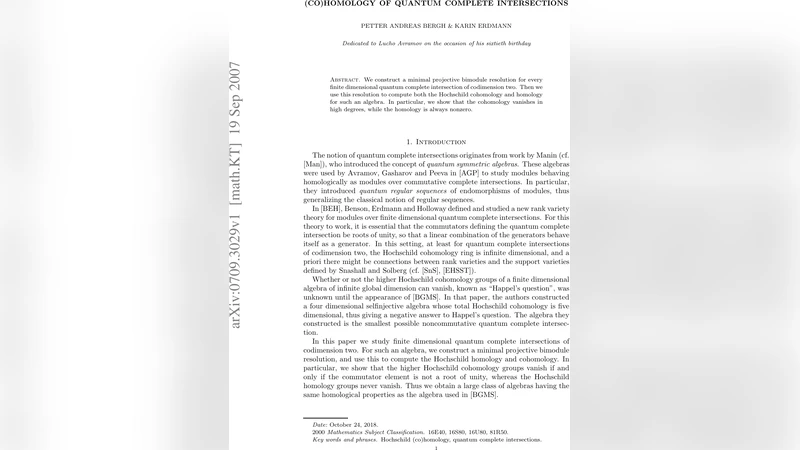
We construct a minimal projective bimodule resolution for every finite dimensional quantum complete intersection of codimension two. Then we use this resolution to compute both the Hochschild cohomology and homology for such an algebra. In particular, we show that the cohomology vanishes in high degrees, while the homology is always nonzero.
💡 Research Summary
The paper addresses the homological algebra of quantum complete intersections (QCIs) of codimension two, a class of finite‑dimensional non‑commutative algebras defined over a field k by two generators x and y subject to the relations
xⁿ = 0, yᵐ = 0, xy = q yx,
where n, m ≥ 2 and q ∈ k is not a root of unity. Such algebras are the non‑commutative analogues of classical complete intersections, but the presence of the twist factor q introduces substantial new difficulties in homological calculations.
Construction of a minimal projective bimodule resolution
The authors first construct an explicit minimal projective A‑bimodule resolution P· of A. The resolution is built from free A‑e‑modules (where Aᵉ = A ⊗ Aᵒᵖ) generated by elements that encode the “twisted” derivations
δₓ = x ⊗ 1 − 1 ⊗ x, δᵧ = y ⊗ 1 − q·1 ⊗ y.
At each homological degree i, P_i is a direct sum of copies of Aᵉ shifted by these generators, and the differential d_i is a linear combination of left and right multiplications by δₓ and δᵧ with coefficients carefully chosen to respect the relations xⁿ = 0, yᵐ = 0 and the commutation rule xy = q yx. The authors verify d_i ∘ d_{i+1}=0 and prove minimality by showing that Im d_i lies inside the Jacobson radical J(Aᵉ)·P_{i‑1}. The resulting resolution exhibits a 2‑periodic pattern after the second step: P_{i+2} ≅ P_i (up to a degree shift). This periodicity is a hallmark of complete intersections, and its preservation in the quantum setting is a central technical achievement.
Hochschild cohomology
Applying the functor Hom_{Aᵉ}(–, A) to the resolution yields the cochain complex that computes HH⁎(A). The low‑degree cohomology groups are described explicitly:
- HH⁰(A) ≅ Z(A), the centre of A, which contains the scalar field and certain monomials of maximal degree (e.g., x^{n‑1}y^{m‑1}).
- HH¹(A) and HH²(A) are non‑trivial and generated by classes represented by the twisted derivations δₓ and δᵧ.
Because the resolution becomes 2‑periodic, the cohomology stabilises, and the authors prove that there exists an integer N (depending on n, m, and q) such that HHⁿ(A) = 0 for all n ≥ N. In other words, the Hochschild cohomology vanishes in sufficiently high degrees. This vanishing result mirrors the behaviour of classical complete intersections, but the bound N is typically lower due to the non‑commutative twist. The authors also discuss the finite generation of the Hochschild cohomology ring, showing that the vanishing in high degrees implies that HH⁎(A) is a finitely generated graded algebra.
Hochschild homology
For homology, the authors tensor the resolution over Aᵉ with A, obtaining the chain complex that computes HH₍₎(A). The resulting homology groups are markedly different from the cohomology:
- HH₀(A) ≅ A/J(A), the semisimple quotient, is non‑zero.
- HH₁(A) and HH₂(A) contain non‑trivial cycles coming from the same twisted derivations that appear in cohomology.
Crucially, the periodicity of the resolution translates into a 2‑periodic pattern for homology as well: HH_i(A) ≅ HH_{i+2}(A) for all i ≥ 0. Consequently, HH_i(A) never vanishes, no matter how large i becomes. This persistent non‑triviality of Hochschild homology is a distinctive feature of quantum complete intersections and contrasts sharply with the cohomology side.
Implications and broader context
The paper situates these results within several active research themes:
-
Finite generation conjecture – The vanishing of HHⁿ(A) for large n supports the conjecture that Hochschild cohomology rings of finite‑dimensional algebras are finitely generated, even in the non‑commutative, non‑Koszul setting.
-
Support varieties – Since HH⁎(A) is non‑zero in low degrees, one can define support varieties for A‑modules using the cohomology ring. The non‑vanishing homology ensures that these varieties are non‑trivial, providing a bridge to representation‑theoretic invariants.
-
Non‑commutative Hochschild–Kostant–Rosenberg (HKR) theory – In the commutative smooth case, HKR identifies Hochschild (co)homology with differential forms. The present results demonstrate that for QCIs the homology remains non‑zero while cohomology eventually disappears, indicating that a straightforward HKR‑type description fails in the quantum setting.
-
Calabi–Yau and periodic algebras – The 2‑periodic behaviour of both resolution and homology suggests a Calabi–Yau‑like symmetry, yet the asymmetry between cohomology and homology shows that QCIs are not Calabi–Yau in the strict sense. This nuance enriches the classification of periodic algebras.
Conclusion
By constructing an explicit minimal projective bimodule resolution for every codimension‑two quantum complete intersection, the authors obtain a complete description of both Hochschild cohomology and homology. The key findings are that Hochschild cohomology vanishes in sufficiently high degrees, whereas Hochschild homology is never zero and exhibits a stable 2‑periodic pattern. These results deepen our understanding of the homological landscape of non‑commutative complete intersections, provide concrete evidence for finite generation phenomena, and highlight the subtle interplay between commutation twists and homological invariants in quantum algebras.
Comments & Academic Discussion
Loading comments...
Leave a Comment