Quasi-maximum likelihood estimation of periodic GARCH processes
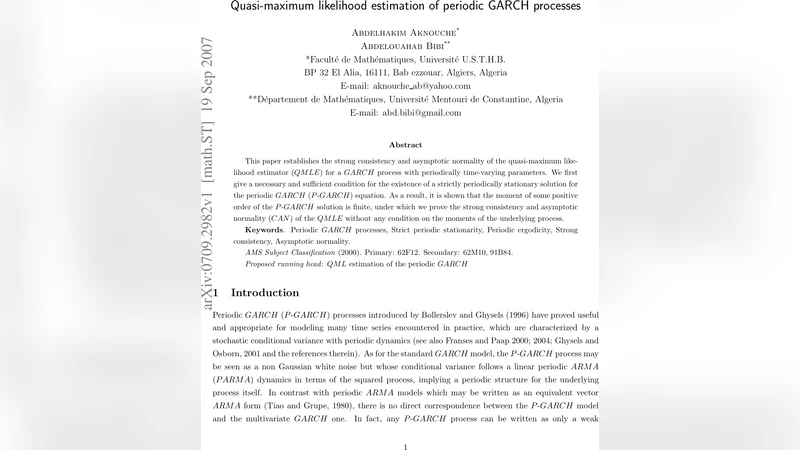
This paper establishes the strong consistency and asymptotic normality of the quasi-maximum likelihood estimator (QMLE) for a GARCH process with periodically time-varying parameters. We first give a necessary and sufficient condition for the existence of a strictly periodically stationary solution for the periodic GARCH (P-GARCH) equation. As a result, it is shown that the moment of some positive order of the P-GARCH solution is finite, under which we prove the strong consistency and asymptotic normality (CAN) of the QMLE without any condition on the moments of the underlying process.
💡 Research Summary
This paper develops a comprehensive asymptotic theory for quasi‑maximum likelihood estimation (QMLE) of GARCH models whose parameters vary periodically over time, a class referred to as periodic GARCH (P‑GARCH). The authors begin by formalising the P‑GARCH recursion
(X_t = \sigma_t \varepsilon_t,\qquad \sigma_t^{2}= \alpha_{0,t}+ \sum_{i=1}^{q}\alpha_{i,t}X_{t-i}^{2}+ \sum_{j=1}^{p}\beta_{j,t}\sigma_{t-j}^{2},)
where the coefficient sequences ({\alpha_{·,t}},{\beta_{·,t}}) satisfy (\alpha_{·,t+m}= \alpha_{·,t}) and (\beta_{·,t+m}= \beta_{·,t}) for a fixed period (m). The first major contribution is a necessary and sufficient condition for the existence of a strictly periodically stationary solution. By interpreting the recursion as a periodic Markov chain, the authors show that if the product of the one‑step coefficient matrices over one full period has spectral radius strictly less than one, i.e. (\rho\bigl(\prod_{k=1}^{m}A_{k}\bigr)<1), then a unique strictly periodically stationary process exists. This condition is weaker than the usual global contraction condition (\sum\alpha_i+\sum\beta_j<1) used for standard GARCH, because it allows the coefficients to differ across the cycle while still guaranteeing overall contraction.
Having established stationarity, the paper proves that the stationary solution possesses finite moments of some positive order (\delta>0). The proof relies on constructing a Lyapunov function (V(x)=|x|^{\delta}) and showing that the expected value of (V) contracts on average over one period. Consequently, (\mathbb{E}|X_t|^{\delta}<\infty) holds without imposing any high‑order moment assumptions on the innovations (\varepsilon_t). This moment result is crucial for the subsequent asymptotic analysis of the QMLE.
The QMLE is defined by maximizing the (misspecified) Gaussian log‑likelihood built from the conditional variance recursion, even though the true innovations may follow any distribution with zero mean and unit variance. The authors first establish a uniform law of large numbers for the period‑averaged log‑likelihood. By invoking a periodic ergodic theorem, they demonstrate that the sample log‑likelihood converges uniformly to its expectation, which has a unique maximiser at the true parameter vector (\theta_{0}). This yields strong consistency: (\hat\theta_{n}\xrightarrow{a.s.}\theta_{0}).
The second asymptotic result is the asymptotic normality of the QMLE. The score vector and the observed information matrix are shown to satisfy a central limit theorem for periodic Markov chains. Specifically, (\sqrt{n},S_{n}(\theta_{0})) converges in distribution to a normal vector with covariance equal to the periodic Fisher information matrix (I(\theta_{0})), while the normalized information matrix converges in probability to the same limit. Applying a Taylor expansion of the score around (\theta_{0}) leads to the classic result
\
Comments & Academic Discussion
Loading comments...
Leave a Comment